
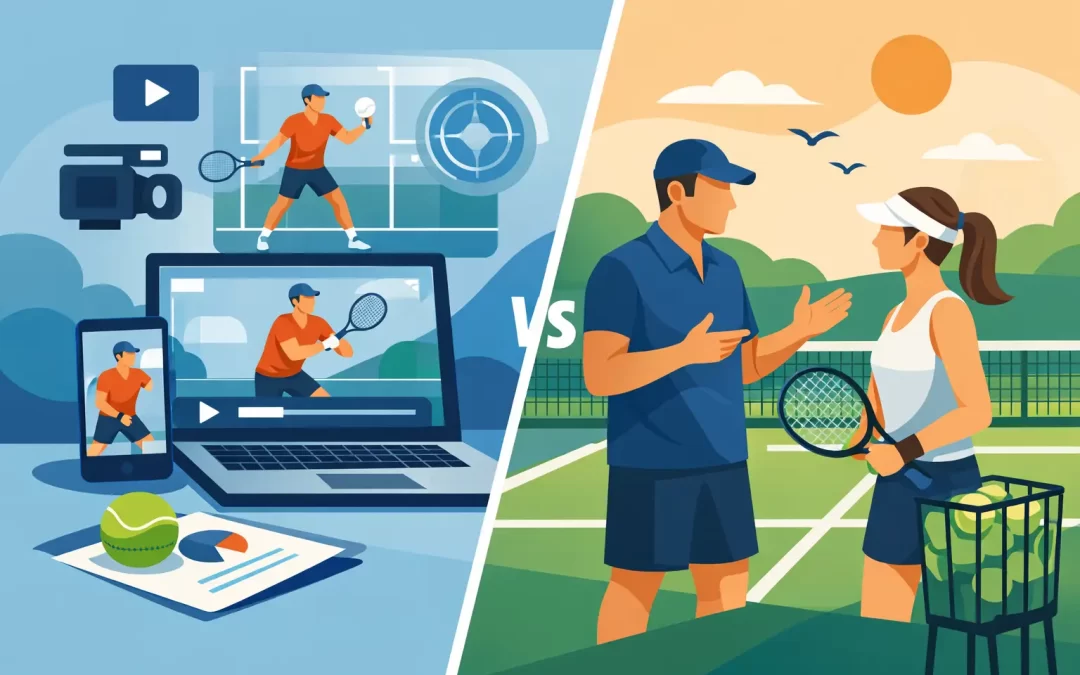
A forehand can look clean in a lesson and still break down at 4-4 in the third set. That gap is why the question of video feedback vs live tennis lessons matters for committed players. The real goal is not simply to receive more instruction. It is to build a training system that identifies errors, creates the right correction, and helps that correction hold up under pressure.
Live coaching and video review solve different problems. One gives you immediate direction in the moment. The other lets you slow the game down, study patterns, and connect what you feel with what is actually happening. Players who understand the role of each can train with more purpose, avoid random adjustments, and make progress that shows up in matches.
Video Feedback vs Live Tennis Lessons: The Real Difference
Live lessons are built around action and response. Your coach sees the ball flight, movement, timing, decision-making, and body language as they happen. They can stop a drill, adjust your grip or spacing, feed a different ball, and immediately test whether the change works. This is especially valuable when a player needs to learn a new movement pattern or develop confidence in an unfamiliar situation.
Video feedback creates a different type of awareness. It gives the player and coach the chance to review a stroke or point without the speed and emotion of the moment getting in the way. A player may feel that they are loading well on a backhand, for example, but video might show a late unit turn, poor spacing, or a contact point that is consistently too far behind the body.
Neither method is automatically better. The better choice depends on the player’s current challenge, practice environment, goals, and ability to apply coaching between sessions.
What Live Tennis Lessons Do Best
A live tennis lesson is the strongest setting for learning through repetition. A qualified coach can see the full chain of a shot: the split step, first movement, footwork to the ball, preparation, contact, recovery, and the result. That matters because a technical issue is often caused by something that happened before the racquet ever met the ball.
For beginners, live instruction creates a foundation. Players need to understand how to hold the racquet, organize their body, find the ball, and build a repeatable swing. Trying to make those changes from a video alone can be difficult because new players do not yet have reliable body awareness. They may focus on the finish of the swing while missing a poor setup or unstable base.
For intermediate and competitive players, live coaching becomes even more valuable when the work is tactical. A coach can create point situations that expose habits: attacking the wrong ball, recovering too slowly after a wide forehand, playing too safely under pressure, or failing to recognize an opponent’s weaker pattern. Those lessons teach competitive intelligence, not just stroke mechanics.
Live lessons also provide immediate accountability. If you are working on using a higher margin crosscourt ball before changing direction, your coach can reinforce that decision on the next point. There is no delay between the mistake, the correction, and the next opportunity to apply it.
The limitation is that one session ends. Without a clear practice plan and feedback between lessons, players can lose the feel of a correction by the time they return. This is one reason players often feel like they are working hard but not moving forward consistently.
When live lessons should lead your training
Live instruction should be the priority when you are new to the game, returning after a long break, changing a major technical pattern, managing an injury-related movement issue, or preparing for a match situation that requires on-court decision-making. It is also the best option when you need a coach to challenge your intensity, court positioning, and competitive habits in real time.
What Video Feedback Does Best
Video feedback is powerful because tennis happens too quickly for most players to accurately diagnose themselves. A serve may feel rushed, but the real issue could be an inconsistent toss. A player may blame their backhand for missing long, when the video shows they are opening the shoulders early and losing control of the racquet path.
The camera gives you evidence. Instead of relying on a vague thought such as “get lower” or “swing smoother,” the coach can identify a specific priority and show why it matters. This makes coaching more precise and makes practice more focused.
Video is particularly effective for technical review. It allows a coach to compare repetitions, study contact points, evaluate balance, and spot recurring patterns in the serve, return, forehand, backhand, volley, and movement. A player can also revisit the feedback before practice, which helps prevent the common mistake of trying to remember five different corrections at once.
For competitive players, match video can reveal the habits that do not appear in isolated drills. You may discover that your first serve percentage drops after missed break points, that you give up too much court when defending the backhand corner, or that you repeatedly attack down the line from a low, defensive ball. Those are not just technical errors. They are tactical and mental patterns that affect results.
Video review is also efficient between lessons. A player in New Rochelle, Westchester, or beyond can send practice or match footage and receive direction without waiting for the next time they step on court with their coach. That consistency helps turn coaching into an ongoing development process rather than a weekly reset.
The limits of video-only coaching
Video is not a substitute for every kind of instruction. Camera angle, lighting, frame rate, and poor ball tracking can hide important details. More importantly, video can tell you what happened without always giving you the right feel to change it. A player may understand that they are crowding the ball, then still repeat the same pattern because they need live feeding, movement drills, and guided repetition to build a new habit.
There is also a risk of overanalysis. Players who review every swing can become mechanical and hesitant. The purpose of video is to create one or two clear priorities, not to turn every practice into a search for flaws.
The Best Model Is Usually Hybrid Coaching
The strongest development plan combines live instruction with purposeful video feedback. Live sessions establish the change, test it under different ball speeds, and connect technique to movement and tactics. Video review tracks whether the change is holding up in independent practice and match play.
For example, an intermediate player may work live on creating more space on the forehand. The coach can feed balls that force better footwork, correct the setup immediately, and build the feeling of contact farther in front. During the week, the player records a short practice segment. Video feedback confirms whether that spacing remains consistent when the coach is not standing beside the court.
The same approach works for match performance. A live session may focus on serving to a target and playing the first ball with intent. Match video then shows whether the player follows that pattern at 30-30, after a double fault, or when facing a stronger opponent. That is where mindset, discipline, and strategy become inseparable.
At Point of Mind Coaching, this structured approach matters because improvement should not depend on what a player happens to remember from the last lesson. Players need a clear priority, a weekly plan, a way to measure progress, and direct coaching support when the game starts to drift.
How to Choose What You Need Right Now
Choose live lessons when you need hands-on correction, movement training, tactical drilling, or the pressure of competing against a real ball and opponent. Choose video feedback when you need to study a recurring technical pattern, review match habits, stay accountable between sessions, or receive coaching support around a busy schedule.
If your goal is long-term development, do not frame the decision as an either-or choice. Start with the problem you are trying to solve. A beginner may need more live instruction at first. A competitive junior playing frequent tournaments may benefit from regular match-video review. An adult player trying to win more league matches may need live tactical work plus short video check-ins to keep practice disciplined.
The most productive question is not, “Which type of coaching is better?” Ask, “What will help me apply the right change in my next practice and next match?” Train with that level of intention, and every lesson, video clip, and practice session can move your game forward.