
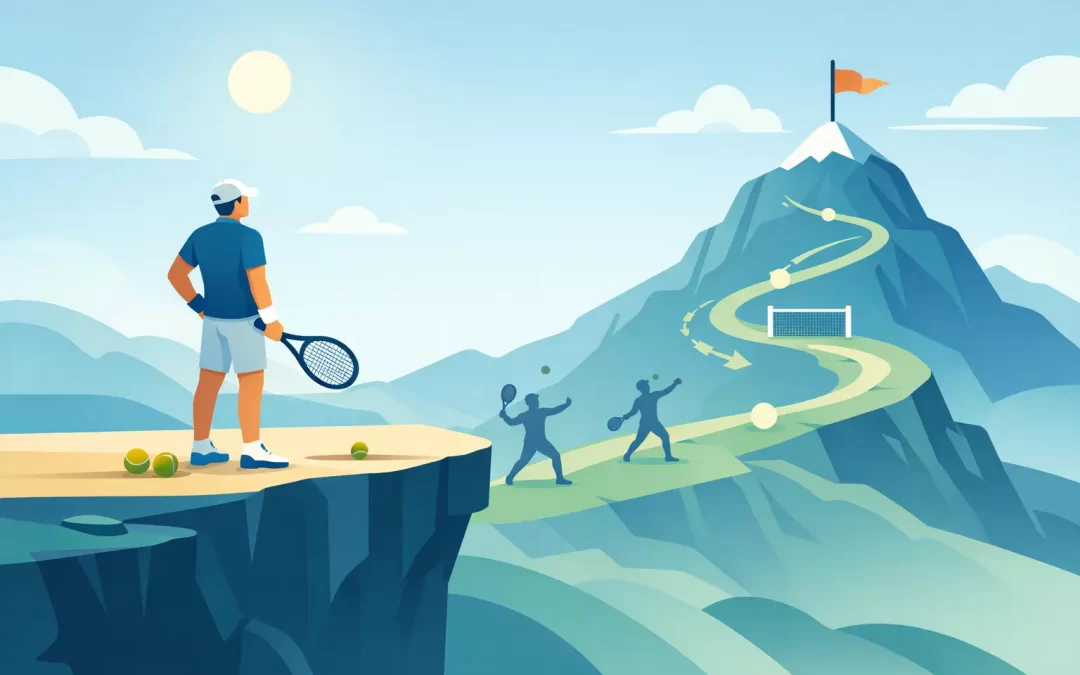
A player can spend months hitting cleaner forehands, serving more balls, and working hard – then lose to the same opponent in the same pattern. That frustration is real, but tennis plateau causes are rarely a mystery or a lack of effort. More often, the player is training without a clear connection between practice, feedback, and match performance.
A plateau does not mean you have reached your potential. It means your current training system is producing the same results. The answer is not to swing harder, buy another racket, or cram more drills into the week. It is to identify the limiting factor, train it with purpose, and measure whether it holds up under pressure.
The Most Common Tennis Plateau Causes
Practice that feels productive but lacks a target
Many players practice often but cannot explain what the session was designed to improve. They rally crosscourt, hit serves, play points, and leave tired. That is activity, not necessarily development.
A productive session has a specific performance goal. For example, an intermediate player may work on recovering behind every crosscourt ball, while a competitive junior may train a second serve that clears the net with more shape under scoreboard pressure. The goal should be visible, measurable, and connected to a match problem.
When every session looks similar, the body becomes efficient at repeating familiar patterns. That can create the feeling of consistency while hiding the fact that the player is not adapting. Improvement requires a training challenge that is slightly beyond the current comfort zone, not endless repetition inside it.
Technical changes without enough feedback
A player may know that the backhand breaks down or the serve lacks pace, but self-diagnosis has limits. In tennis, what a stroke feels like is often different from what it looks like. A player who believes they are turning early may actually be late with the shoulders. Someone trying to swing faster may be losing balance before contact.
Without timely feedback, players can spend weeks reinforcing the wrong adjustment. This is why video review and coach observation matter. They turn vague feelings into specific evidence: preparation is late, the contact point is too far behind, the split step is missing, or the player is recovering to the wrong position.
Technical work also needs a progression. First establish the movement in a controlled setting. Then add direction, movement, depth, live-ball pressure, and points. Trying to fix a stroke only during a match is usually too late. Trying to fix it only in a basket drill is not enough.
Movement is the real bottleneck
Players often label a problem as technical when it is really a footwork problem. If you arrive late, off-balance, or too close to the ball, even sound mechanics will look unreliable. The forehand is not suddenly weak. The setup before the forehand is weak.
Better movement is not just about being faster. It includes the split step, first step, adjustment steps, spacing, balance through contact, and recovery after the shot. A player who moves efficiently gives themselves more time, which improves shot selection and reduces unforced errors.
This is especially relevant for adults who play once or twice a week. If all training happens from comfortable feeds, movement skills never receive enough attention. For juniors, the trade-off is different: more physical work is not automatically better if fatigue destroys technical quality. Movement training should support the tennis objective, not compete with it.
Training does not resemble match demands
A player may look excellent in practice and still struggle on match day because the practice environment removes the decisions that make tennis difficult. There is no score, no consequence for a weak second serve, no opponent exposing the backhand, and no requirement to choose the right target under pressure.
Matches demand more than stroke production. They demand serving with intent, returning with a plan, recognizing patterns, recovering to the right court position, and managing momentum. If practice contains only cooperative rallying, the player is training execution without competition.
Add realistic constraints to practice. Start points with a serve and return. Play games where a point only counts after a deep crosscourt ball. Give one player a clear pattern to attack and require the other to neutralize it. These formats reveal whether a skill is usable, not merely present.
A missing tactical identity
Players plateau when they have shots but no reliable way to organize them. They know they should be aggressive, but attack low-percentage balls. They know they should be consistent, but push the ball short and surrender control. Their decisions change from point to point because there is no defined plan.
A tactical identity does not mean playing one style forever. It means knowing your highest-percentage patterns. Perhaps your best pattern is a heavy crosscourt forehand that opens space for the next ball. Perhaps it is a deep backhand return followed by a controlled recovery to center. Perhaps your serve gives you a predictable first ball on the deuce side.
The stronger your pattern recognition, the less you rely on emotion during a match. You do not need a highlight-reel winner on every point. You need repeatable decisions that put pressure on the opponent while protecting your own weaknesses.
Pressure exposes an untrained mindset
Confidence is not simply a personality trait. It is built through preparation, clear routines, and evidence that you can execute under difficult conditions. Players often plateau because they judge every miss as proof that something is wrong. Their attention shifts from the ball and the plan to fear of the outcome.
Pressure changes breathing, timing, muscle tension, and decision-making. The player who swings freely at 30-0 may guide the ball at 30-30. That is not a character flaw. It is a skill gap that must be trained.
Build between-point routines that are short and repeatable: reset physically, choose a simple intention, and commit to the next point. After an error, avoid technical lectures in your own head. Ask one useful question instead: Was the decision right? If the decision was right and execution missed, stay with the pattern. If the decision was poor, make a clearer choice on the next ball.
How to Identify Your Personal Plateau
The fastest way to break a plateau is to stop describing it in broad terms. “I am inconsistent” is not a diagnosis. Identify when, where, and how the breakdown happens.
Track several matches and practice sessions. Look for recurring evidence: Are you missing short balls because you rush forward? Are most double faults appearing late in sets? Do you lose points after a neutral backhand because the ball lands short? Are you winning rallies but losing service games?
Use these four questions after each match:
- Which two situations gave away the most points?
- What pattern did my opponent use successfully against me?
- What did I do well that I can repeat under pressure?
- What is one trainable priority for the next seven days?
One priority is enough. A player who tries to repair the serve, forehand, movement, return, and mindset all at once usually changes nothing. Focus creates quality repetitions, and quality repetitions create confidence.
Build a Plan That Produces Evidence
A strong weekly plan should include technical work, movement, point play, and recovery. The balance depends on the player. A beginner needs more foundation and simple ball-control goals. An aspiring tournament player needs more serve-return work, pattern training, and pressure situations. A committed recreational player may need a plan that fits limited court time without sacrificing direction.
Set a performance measure instead of only chasing wins. Track first-serve percentage in practice sets, successful deep returns, recovery position after wide balls, or the number of times you execute your preferred rally pattern. Wins matter, but they are delayed feedback. Process measures tell you whether your habits are improving now.
Then review the evidence with a coach who can separate the symptom from the cause. At Point of Mind Coaching, that process centers on structured development: fundamentals, movement, video feedback, tactical decision-making, and mental training working together rather than as separate fixes.
Your next breakthrough may not come from doing more. It may come from training one important problem with enough clarity that, when the score gets tight, you no longer have to hope your game appears. You know exactly what to do.