
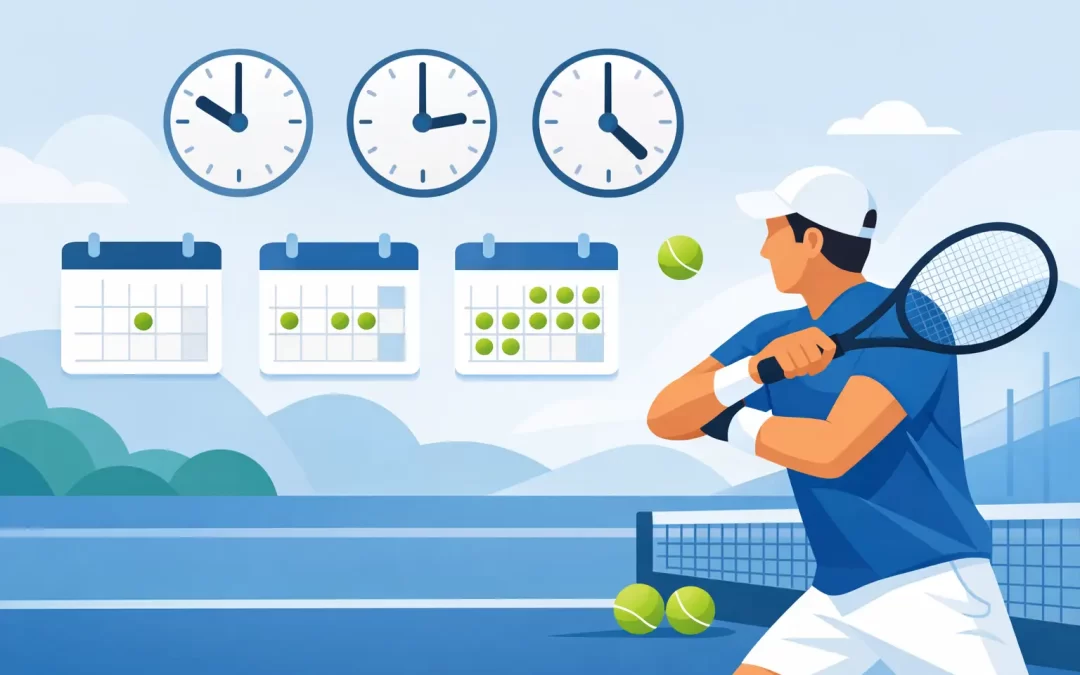
A player who takes one excellent lesson but does not touch a racket for two weeks will usually improve more slowly than a player with a clear plan between sessions. The right tennis lesson frequency is not about filling your calendar. It is about creating enough repetition, feedback, and competitive practice for new skills to hold up when the score matters.
For some players, one lesson a week is the ideal foundation. For others, especially juniors pursuing tournaments or adults trying to break through a plateau, two or more weekly coaching touchpoints can create faster, more reliable progress. The key is matching your schedule to your goals and making every lesson part of a larger training system.
Tennis Lesson Frequency Depends on Your Goal
The question is not simply, “How many lessons should I take?” Start with a more useful question: “What am I training to do?” A beginner learning to rally has different needs than a tournament player trying to improve their second-serve percentage under pressure.
If your goal is to enjoy tennis, build dependable fundamentals, and play socially with more confidence, one private or small-group lesson per week can work well. It gives you enough technical feedback to avoid building poor habits, while leaving time to practice what you learned. The lesson identifies the priority. Your practice turns that instruction into a skill.
If you are a committed recreational player who wants to win more league or club matches, one lesson per week may still be enough, but only if you add purposeful hitting, serving, and match play. Many adults take a lesson, receive a useful correction, then return to the same rushed habits in their next match. Progress stalls because the feedback never becomes a repeatable pattern.
Competitive juniors and serious tournament players often benefit from two coached sessions per week, supplemented by organized independent training. At this level, stroke production is only part of the picture. Movement, return patterns, shot selection, recovery, emotional control, and point construction all require regular review. More frequent coaching helps players make adjustments before weak habits become automatic.
A Practical Weekly Structure by Player Level
There is no single schedule that fits every athlete. School demands, physical conditioning, match volume, and access to practice partners all matter. Still, these structures provide a strong starting point.
Beginners: One Lesson, Two Short Practice Sessions
New players need clear technical guidance, but they also need time to absorb it. One coached lesson each week, combined with two 30- to 60-minute practice sessions, is often more effective than multiple lessons with no independent repetition.
The priority should be simple: athletic ready position, tracking the ball, spacing, basic grips, balance, and a consistent contact point. Beginners do not need a long list of corrections. They need one or two clear cues they can repeat successfully.
A second lesson can be helpful when a player is highly motivated, preparing for a school team, or struggling to establish basic coordination. But the added lesson only creates value if the player practices in between. Without repetition, every session becomes a restart.
Intermediate Players: One to Two Lessons With Match Play
Intermediate players can rally, serve, and play points, but their performance often changes from practice to matches. They may hit clean forehands during a lesson, then miss short balls, return serve passively, or lose control after a few errors.
One weekly lesson is a strong baseline for this stage. Add a second lesson when there is a specific objective, such as improving a backhand, building a more dependable serve, preparing for a league season, or developing a more aggressive game style. The player should also schedule one focused drill session and one set of match play each week.
This is where video review can make a major difference. A player may feel that they are loading correctly on the forehand or recovering quickly after a shot, yet video can show a different reality. Seeing patterns clearly makes practice more precise and helps the player take ownership of improvement.
Competitive Players: Two or More Coached Touchpoints
Competitive development requires more than more hours. It requires better organization. A junior who trains five days a week but spends every session hitting randomly may be busy without addressing the habits that decide matches.
Two coached sessions per week allow for technical work, tactical training, and accountability. One session might focus on serving and the first ball after the serve. Another may target return games, neutral-ball patterns, or defending under pressure. Between sessions, the player needs a plan for conditioning, point play, recovery, and mental preparation.
During tournament periods, the number of lessons may not increase. In fact, a heavy competition schedule may call for shorter coaching check-ins, video analysis, and strategic review rather than another physically demanding session. The goal is to arrive fresh, clear, and prepared – not overloaded.
Why More Lessons Are Not Always Better
Increasing lesson frequency can accelerate growth, but only when the player can recover, reflect, and practice with intention. Two lessons a week are not automatically better than one. If a player is exhausted, distracted, or unable to complete the assigned work, the second session may add pressure without producing results.
Players also need time to solve problems independently. Tennis is an individual sport. A coach can identify patterns, set standards, and provide solutions, but the player must learn to recognize situations on court. Independent practice builds that decision-making muscle.
Parents of junior players should pay attention to the quality of the full week, not just the number of hours with a coach. Is the player sleeping enough? Are they enjoying the work? Do they know the purpose of each session? Are they competing regularly? A sustainable program develops confidence and discipline, not burnout.
Make Every Lesson Carry Into the Next Match
The most effective lesson schedule connects instruction to action. After each session, a player should leave with a defined priority for the week. That priority might be keeping the non-dominant hand on the racket longer during the unit turn, landing more first serves in the correct target zone, or recovering through the middle after a wide ball.
Avoid trying to fix everything at once. One technical priority, one tactical priority, and one mental standard are usually enough. For example, an intermediate player might train a higher-margin crosscourt rally ball, use that pattern in practice sets, and commit to a composed response after errors. This gives the player a complete performance goal rather than a vague instruction to “play better.”
Tracking progress also changes the value of coaching. Record first-serve percentage during practice matches. Notice how often you miss returns. Keep a brief note after matches about what caused lost points: unforced errors, poor shot selection, weak movement, or rushed decisions. These details allow the next lesson to address what is truly limiting performance.
Signs You Need More Coaching Support
Consider increasing your lesson frequency or adding online feedback when you see the same problems repeating despite regular play. Common signs include technical changes that disappear after one session, a lack of confidence in matches, frequent tactical mistakes, or uncertainty about what to practice.
A player may also need more support when entering a new competitive phase. That could mean trying out for a school team, moving into higher-level junior events, returning after an injury, or preparing for an important league season. A structured short-term increase in coaching can provide direction during these transitions.
For players in New Rochelle, Westchester, and New York City, in-person training paired with between-session video review can be especially effective. The player receives live instruction, then continues to get feedback when practice and match situations reveal the real challenge.
Build a Schedule You Can Sustain
The best tennis lesson frequency is the one you can follow consistently for months, not the most ambitious plan you can manage for two weeks. Start with a schedule that includes coaching, purposeful practice, match play, fitness, and recovery. Then review it after four to six weeks based on results.
If your game is improving and you can clearly apply feedback, stay the course. If you are practicing consistently but repeating the same errors, add another coaching touchpoint or seek more specific feedback. Point of Mind Coaching approaches that process as a development plan, not a collection of isolated lessons.
Your next breakthrough may not come from training more randomly. It may come from one well-timed lesson, a focused practice objective, and the discipline to repeat the right work until it becomes your natural response under pressure.