
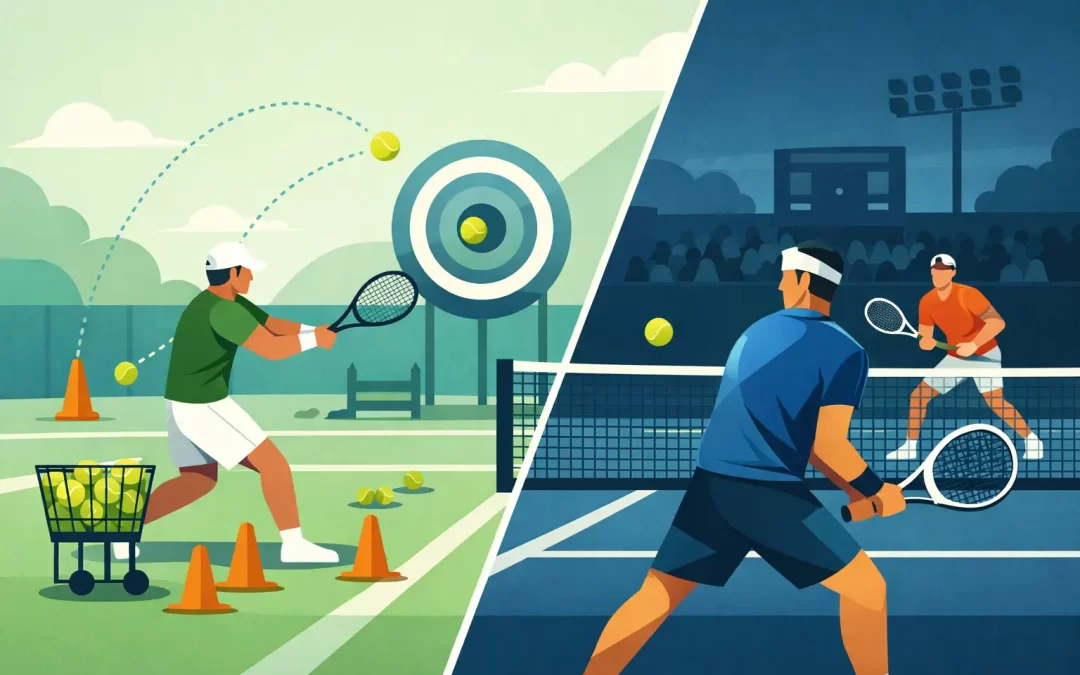
A player can strike 50 clean forehands in a drill and still miss the same ball at 4-4 in the second set. That gap is the central issue in tennis drills versus matchplay. Drills build reliable tools. Matches reveal whether you can select and use those tools when the score, opponent, fatigue, and pressure are working against you.
Serious improvement does not come from choosing one over the other. It comes from organizing both with a purpose. If your practice looks excellent but your results stay flat, the problem is often not effort. It is that your training has not prepared you to make competitive decisions.
Tennis Drills Versus Matchplay: Different Jobs, Same Goal
Drills are designed to isolate a skill. They give you repetitions that matchplay rarely provides. You can groove a higher net clearance on your forehand, improve your split step timing, repeat a serve target, or learn to recover after a wide ball. Because the variables are controlled, your attention can stay on one technical or movement priority.
That control matters. A beginner needs repetitions to establish sound contact and rally tolerance. An intermediate player may need a focused pattern to stop overhitting crosscourt backhands. A competitive junior may need to rehearse an aggressive first-ball sequence until it becomes dependable. In each case, drills create the volume needed for change.
Matchplay has a different assignment. It tests perception, problem-solving, emotional control, and shot selection. Your opponent may slice when you expect topspin, change direction earlier than usual, or expose the side of your movement that drills have not challenged. You must read the ball, recognize the score, select a target, and accept the result quickly enough to play the next point.
A drill can tell you whether you are capable of hitting a shot. A match tells you whether you trust that shot at the right time.
Why Great Practice Does Not Always Produce Great Matches
The most common mistake is confusing clean ball striking with competitive readiness. A cooperative drill often gives you predictable pace, height, direction, and rhythm. That is useful, but it removes many demands that decide points: an awkward incoming ball, a moving target, a short recovery time, or the temptation to force a winner too soon.
Players also behave differently when points count. They may tighten their grip, shorten their swing, avoid their backhand, rush between points, or abandon the pattern that worked all week. None of those issues are fixed by simply hitting more balls without intent.
This does not mean drills are unrealistic or that matchplay is the only honest form of practice. It means the progression must be deliberate. First, develop the skill in a controlled environment. Then add movement, direction, and a recovery requirement. Then add a decision. Finally, put that decision under a score.
For example, a player working on a more reliable second serve should not jump directly from basket serves to a tournament match and hope confidence appears. Start by repeating the motion and target. Progress to serving with a returner. Add a rule that the server must begin the point with a high-margin pattern. Then track second-serve percentage and point outcomes in practice sets. Each stage closes the gap between technique and trust.
What Drills Should Give You
A productive drill has a clear purpose and a measurable standard. “Hit forehands for 20 minutes” is activity. “Play 10 crosscourt forehand rallies with three feet of net clearance, then recover behind the baseline” is training.
The best drills usually improve one or more of these areas:
- Stroke quality, including contact point, shape, balance, and racket path
- Movement, including first step, spacing, recovery, and change of direction
- Repeatable patterns, such as serve plus first forehand or return plus crosscourt control
- Pressure tolerance through score-based consequences and specific targets
Drills should also fit the player’s current level. A newer player may benefit most from cooperative rally drills that develop control and confidence. A stronger competitor needs more variable feeds and live-ball situations that force quick decisions. Copying a professional-level drill before you can sustain the basic pattern usually creates frustration, not progress.
A coach should be able to answer three questions before starting a drill: What is the player improving? What behavior proves improvement? How will this skill appear in a match? Without those answers, repetition can become comfortable but disconnected from performance.
What Matchplay Should Teach You
Matchplay is not simply a reward after practice. It is a source of information. The score exposes habits that are easy to miss during controlled training.
Pay attention to the points you lose repeatedly. Are you missing returns because your split step is late? Are you getting pulled wide because your recovery position is poor? Do you attack low balls from behind the baseline when a neutral ball would keep you in the point? Are you serving well until you face break point, then protecting the serve instead of committing to a target?
Those patterns should shape the next practice plan. A player who loses to consistent opponents may not need a more powerful forehand. They may need higher-margin rally targets, better patience, and a clearer understanding of when to change direction. A player who wins practice sets but struggles in sanctioned competition may need routines that settle the mind between points and help them play the score without fear.
This is why post-match reflection matters. Within a few hours of competing, write down what held up, what broke down, and which situations appeared most often. Be specific. “I played badly” offers nothing to train. “I missed short backhands after being moved wide and forced too many down-the-line shots” gives you a practice priority.
Build a Week That Transfers to Competition
The right balance between drills and matchplay depends on the player, the season, and the performance goal. A beginner who is still learning to rally needs more technical and cooperative drilling than full sets. A tournament player preparing for competition needs regular live points and sets, but should not spend every session playing without addressing weaknesses.
For many committed players, a strong weekly structure includes two focused skill sessions, one live-ball or situational session, and one or two matchplay opportunities. The proportions can shift. During an off-season development block, drilling may take more time because you are making technical changes. Before a tournament, practice should become more open and score-driven so you can sharpen decision-making, routines, and competitive endurance.
The key is to connect sessions. If Monday’s practice develops a crosscourt backhand that stays deep and heavy, Wednesday’s live-ball session should require you to use that ball under movement. In Friday’s set, track whether you chose it when the rally became neutral. That is structured transfer.
Use constraints to make practice more competitive without losing the technical objective. Start points with a serve and return. Award bonus points for executing a planned pattern. Require every rally ball to clear a target height before either player can attack. Play a tiebreak in which a player must use a specific second-serve target. Constraints give matchplay direction and prevent players from reverting to familiar but unproductive habits.
Train Your Mind Along With Your Game
The difference between a drill and a match is often mental before it is physical. In a drill, the next ball is expected. In a match, the next ball may carry consequences. Players need a repeatable between-point routine that protects focus when momentum changes.
Keep it simple: respond to the previous point, reset your body language, choose a clear intention, and commit. Do not replay errors while the next point is beginning. Do not let a missed shot turn into three rushed decisions. Competitive confidence is built when you repeatedly return to a process, not when every shot feels perfect.
Video review can make this process more precise. A player may feel that they are attacking too much, but film may show that the real issue is poor court position before the attack. Another player may blame nerves, while the footage reveals that their return position changes under pressure. Honest feedback turns vague frustration into a training plan.
At Point of Mind Coaching, the goal is not to fill sessions with drills or matches for their own sake. It is to build players who understand what they are training, why it matters, and how to carry it into competition.
Your next practice does not need to be longer. It needs a stronger connection to the points you want to win. Choose one pattern that breaks down in matches, train it with intent, test it under a score, and learn from what happens. That is how practice starts showing up on the scoreboard.