
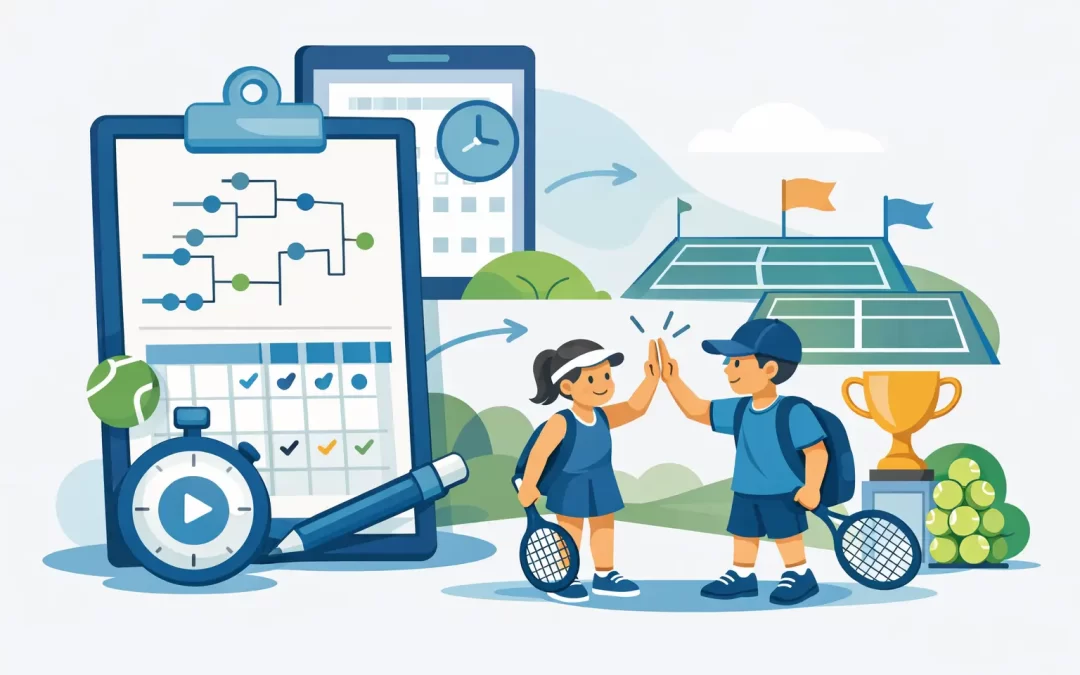
A junior tournament schedule can either accelerate development or quietly stall it. The difference is not whether a player competes every weekend. It is whether each event has a purpose, enough preparation behind it, and enough recovery afterward. This junior tournament scheduling guide helps families build a competitive calendar that develops the player instead of simply filling weekends.
For committed juniors, tournaments are not just opportunities to collect wins or ranking points. They are testing grounds for movement, patterns of play, emotional control, between-point routines, and decision-making under pressure. A strong schedule creates time to train those skills, measure them in matches, and return to practice with clear priorities.
Start With the Player’s Development Stage
The right number of tournaments depends on the player, not on what another family is doing. A beginner or early intermediate junior needs more practice repetitions than match volume. At that stage, too many tournaments can reinforce incomplete technique, rushed decision-making, and frustration. Competing occasionally is valuable, but the primary focus should remain fundamentals, movement, and learning how to construct points.
An intermediate player who can sustain rallies, serve reliably, and compete through normal momentum swings can begin playing a more consistent tournament schedule. Match play now reveals the gaps that practice may hide: a second serve that breaks down under pressure, poor return positioning, weak transition play, or a habit of playing too defensively when the score gets tight.
For an advanced junior with defined competitive goals, tournaments become a more regular part of the training plan. Even then, more is not automatically better. Players need protected blocks to improve physical capacity, sharpen technical details, build tactical options, and recover mentally. A packed schedule may create short-term match experience while limiting long-term improvement.
Build the Junior Tournament Schedule Around Goals
Before selecting events, identify the purpose of the competitive season. A player preparing for sectional or national-level events needs a different calendar from a junior learning to manage local tournament pressure. Put the main target events on the calendar first, then work backward.
A useful approach is to organize the year into three types of periods: development blocks, competition blocks, and recovery blocks. Development blocks emphasize practice, fitness, technical work, and video review. Competition blocks include selected tournaments that test the skills built in training. Recovery blocks allow the body and mind to reset after demanding stretches.
For example, a player targeting an important summer event may spend several weeks beforehand training with intention, playing only limited match opportunities, and focusing on specific patterns. The goal is not to arrive with the most matches played. The goal is to arrive prepared, fresh, and clear about how to compete.
Parents should also separate outcome goals from performance goals. Winning a tournament is an outcome goal and cannot be fully controlled. Serving with a high first-serve percentage, using a planned return position, or staying composed after errors are performance goals. Those are the standards that make tournament results more repeatable over time.
Choose Events That Provide the Right Test
Not every tournament belongs on the schedule. A junior should sometimes enter an event where they are expected to perform well and sometimes face a stronger field that exposes weaknesses. Both experiences matter.
Events that are consistently too easy may produce confidence without demanding growth. Events that are consistently too difficult can become discouraging, especially when the player has little time to practice between losses. The best calendar includes an appropriate mix of competitive levels, court surfaces when available, and formats that serve the player’s current needs.
Consider travel realistically. A distant tournament may offer strong competition, but the cost includes missed school, disrupted sleep, travel fatigue, and less productive training time. For families in Westchester and New York City, strong local and regional opportunities can often provide meaningful match experience without turning every event into a draining travel weekend.
Protect Training Time Between Tournaments
The most common scheduling mistake is entering tournaments back-to-back without leaving room to improve. Matches reveal problems. Training fixes them. When a junior competes every weekend, coaches may identify the same issues repeatedly without having enough practice time to change them.
After a tournament, review the performance while details are fresh. What happened on first serve? How did the player respond to deep returns? Were they able to defend, recover court position, and transition from neutral to offense? Did their body language change after missed opportunities? A short, honest review turns a weekend of matches into a focused practice plan.
The next training block should address one or two priorities, not ten. If the player struggled to control points from the baseline, work on rally tolerance, height and depth, recovery positioning, and the ability to recognize a short ball. If nerves affected the serve, practice a repeatable pre-serve routine and create pressure drills that require execution when the score matters.
This is where structured coaching makes a difference. Private instruction, practice plans, match analysis, and direct feedback should connect to the tournament calendar. Point of Mind Coaching approaches development as a continuous cycle: train with purpose, compete with a plan, review honestly, and improve the next block of work.
Account for Recovery, School, and the Whole Athlete
Tournament scheduling is not only a tennis decision. Junior players have school demands, family commitments, physical growth, and social lives. Ignoring those factors usually shows up later as burnout, injury, irritability, or declining motivation.
Plan lighter weeks after demanding events, particularly after multiple matches in heat, long travel, or emotionally intense losses. Recovery does not mean doing nothing. It may include mobility work, light hitting, sleep, hydration, and a low-pressure technical session. The key is to avoid stacking another demanding event on top of accumulated fatigue.
School calendars deserve the same respect as tournament calendars. A player who is anxious about missed assignments or staying up late to catch up is less likely to compete with clarity. Work ahead when travel is unavoidable, and avoid making every school break a nonstop series of tournaments. Time away from competition can be a valuable training window.
Pay attention to the player’s language. A junior who says they are tired, nervous before every event, or no longer wants to practice may need a schedule adjustment, not a lecture about toughness. Competitive resilience matters, but real resilience is built through smart stress and proper recovery, not relentless overload.
Use a Simple Decision Filter Before Registering
Before committing to an event, ask whether it supports the current plan. The following questions can prevent a reactive schedule:
- Is this tournament connected to a specific development or ranking goal?
- Will the player have enough quality training before the event?
- Is there time afterward to recover and address what the matches reveal?
- Does the level of competition offer an appropriate challenge?
- Will travel, school, and family logistics create unnecessary stress?
If the answer to several of these questions is no, skipping the event may be the stronger competitive decision. Discipline is not saying yes to every opportunity. It is protecting the opportunities that matter most.
Teach the Player to Own the Calendar
As juniors mature, they should understand why they are playing each event. Parents can manage logistics, but the player should gradually take responsibility for preparation, match notes, recovery habits, and communication with the coach.
Before a tournament, have the player name two performance priorities. They might commit to using a split step on every return, playing higher-margin targets when under pressure, or resetting immediately after errors. Afterward, ask what they learned before discussing the result. This reinforces that tennis development is more than a win-loss record.
A well-built calendar also builds confidence. Players become calmer when they know they have prepared, understand their game plan, and know one loss does not define their progress. They can compete hard because the schedule gives them another chance to train, learn, and respond.
The best junior tournament schedule leaves room for ambition without sacrificing development. Choose events with intention, train between them with discipline, and let every match provide useful information. Over time, that process produces a player who is not only busier, but better prepared to compete stronger when the important matches arrive.