
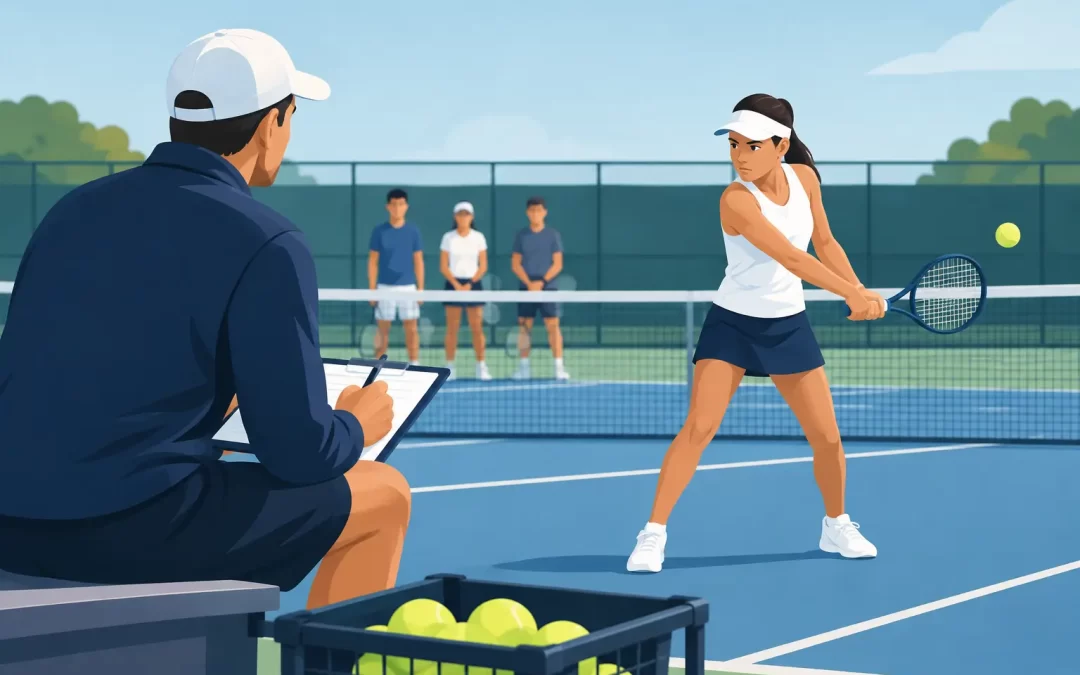
A tennis tryout can feel like a single day deciding an entire season. In reality, most tennis tryout requirements are designed to reveal something deeper: whether you can be coached, compete with discipline, and contribute to the team when points get tight. Clean strokes matter, but they are only part of the evaluation.
For juniors, parents, and committed adult players pursuing school, club, or competitive-team opportunities, preparation should begin well before the first ball is fed. The strongest candidates do not try to impress coaches with every swing. They demonstrate reliable habits, smart decisions, effort, and composure.
What Tennis Tryout Requirements Usually Include
Every program has its own standards. A high school team may need to assess a wide range of players quickly, while a college program, academy, or USTA team may place more weight on match results, rankings, fitness, and previous competitive experience. Still, coaches are generally evaluating the same core areas: technical fundamentals, movement, consistency, match awareness, mental toughness, and attitude.
Tryouts often begin with drills. Coaches may watch players rally from the baseline, hit crosscourt and down-the-line patterns, serve, return serve, volley, and complete movement or conditioning exercises. From there, players are typically placed into point-play situations or short matches.
Do not assume the player with the biggest forehand will earn the spot. A coach may value the athlete who makes eight solid balls, recovers to the correct position, and competes intelligently over the athlete who hits two spectacular winners followed by three unforced errors.
Technical skills coaches can trust
Coaches look for repeatable technique, not perfection. They want to see whether your forehand, backhand, serve, and volley can hold up under moderate pressure. A compact, balanced swing that produces depth is more valuable at tryouts than a high-risk stroke that only works when timing is perfect.
Your serve deserves special attention. It starts every service game, and it immediately shows a coach your rhythm, coordination, and ability to manage pressure. You do not need an elite serve to make a team, but you should be able to begin points consistently, use a reliable second serve, and avoid giving away games with repeated double faults.
Return skills matter just as much. Players who split step, move early, and put the return back in play are difficult to beat. If your return is inconsistent, prioritize depth and margin over trying to hit a winner.
Movement, balance, and recovery
Tennis is not played from a stationary stance. Coaches notice footwork from the first warm-up ball. Are you split stepping as your opponent hits? Do you adjust with small steps? Can you recover after a wide ball instead of watching your shot?
Strong movement does not mean sprinting frantically. It means arriving balanced, creating space from the ball, and recovering with purpose. Even players with developing strokes can distinguish themselves by competing with active feet and maintaining athletic posture through every drill.
Fitness may be tested directly through sprints, agility patterns, endurance runs, or court-based conditioning. More often, it is visible in your effort. A player who fades after ten minutes, walks between balls, or stops moving after an error sends a clear message. Build your conditioning before tryouts so you can maintain focus late in the session, when many roster decisions become clearer.
The Competitive Qualities Coaches Notice
Tryouts are evaluations, but they are also pressure tests. Coaches want to know what version of you appears when you miss an easy ball, lose a close tiebreak, or face a stronger opponent.
Point construction and tactical awareness
You do not need to play complicated tennis. You do need a plan. A player who can rally crosscourt, recognize a short ball, approach with control, and cover the next shot shows far more maturity than someone who swings harder without a pattern.
During practice games, use high-percentage decisions. Keep the ball deep through the middle or crosscourt when under pressure. Attack shorter balls with margin. Avoid changing direction from a defensive position unless the ball truly allows it. Coaches recognize players who understand the difference between a smart risk and a reckless shot.
Doubles awareness can also affect team selection. If doubles may be part of the season, demonstrate communication, court positioning, and willingness to work with a partner. Call the score clearly, move together, and encourage your teammate after mistakes. Doubles is not simply singles played with four people on the court.
Emotional control after mistakes
Mistakes are expected. Poor responses to mistakes are not.
Racket throwing, negative body language, arguing calls, or blaming a partner can eliminate a player from consideration quickly. Coaches are building a culture, not just filling a lineup. They need athletes who can reset and continue competing when a match becomes uncomfortable.
Use a simple between-point routine: turn away from the error, take a breath, identify the next intention, and return to the line with composed body language. Your next intention may be as basic as “deep crosscourt” or “make the return.” That small reset keeps frustration from controlling your match.
How to Prepare for Tennis Tryouts
The best preparation is structured. Random hitting sessions may help you feel active, but they do not always prepare you for the demands of an evaluation. Train the situations you are likely to face: extended rallies, serve-and-return patterns, pressure points, movement drills, and short-set competition.
In the two to four weeks before a tryout, organize your practice around consistency first. Track how many crosscourt balls you can make with control. Practice serves with targets, including second serves under fatigue. Play practice sets where you use a full between-point routine and keep score honestly.
Add conditioning that resembles tennis. Short intervals, lateral movement, repeated accelerations, and recovery work are more useful than endurance training alone. You need the ability to make a hard effort, recover quickly, and repeat it for the next point.
If possible, record portions of your practice. Video review can reveal rushed footwork, poor recovery position, a low contact point, or a predictable ball pattern that is difficult to notice while playing. Focus on one or two corrections at a time. Trying to rebuild every stroke during tryout week usually creates more tension than improvement.
The week before the tryout
Avoid the common mistake of overtraining. You want to arrive sharp, not exhausted. Continue hitting and competing, but reduce unnecessary volume in the final days. Sleep consistently, hydrate, and prepare your equipment in advance.
Bring a properly strung racket, a backup racket if available, water, appropriate shoes, and anything the program specifically requests. Arrive early enough to check in, warm up, and settle your nerves. Rushing onto the court creates avoidable stress before the evaluation has even started.
What to Do During the Tryout
Treat every drill as information for the coach. Hustle for balls, listen closely, and move into position promptly. If you do not understand an instruction, ask a concise question rather than guessing repeatedly.
Be respectful to coaches, opponents, teammates, and staff. That includes how you behave when you are not hitting. Coaches often learn as much from a player’s effort in line or reaction to another player’s success as they do from a forehand drill.
Play within your current level. This is not the time to force highlight-reel shots because you think a coach expects them. Compete with the game you can execute consistently. If an opportunity ball appears, take it with conviction. If you are stretched wide and late, use a defensive option that gives you another chance in the point.
For players training in New Rochelle, Westchester, or New York City, the same principle applies across school and club environments: measurable preparation creates confidence. At Point of Mind Coaching, the focus is not simply on hitting more balls. It is on building organized habits through fundamentals, movement, strategy, video feedback, and mental training that hold up when evaluation day arrives.
If You Do Not Make the Team
A tryout result is feedback, not a final verdict on your potential. Ask the coach what would most improve your chances next time. Be specific: Is it consistency, fitness, serve reliability, match experience, or attitude under pressure?
Then build a plan around the answer. Players improve fastest when they stop treating weaknesses as vague frustrations and start training them as measurable priorities. One stronger second serve, one better recovery step, and one more composed response to pressure can change how you perform at the next opportunity.
A roster spot is earned over a few hours, but the player capable of earning it is built over weeks of disciplined work. Prepare with structure, compete with purpose, and let your habits speak for you when the coach is watching.