
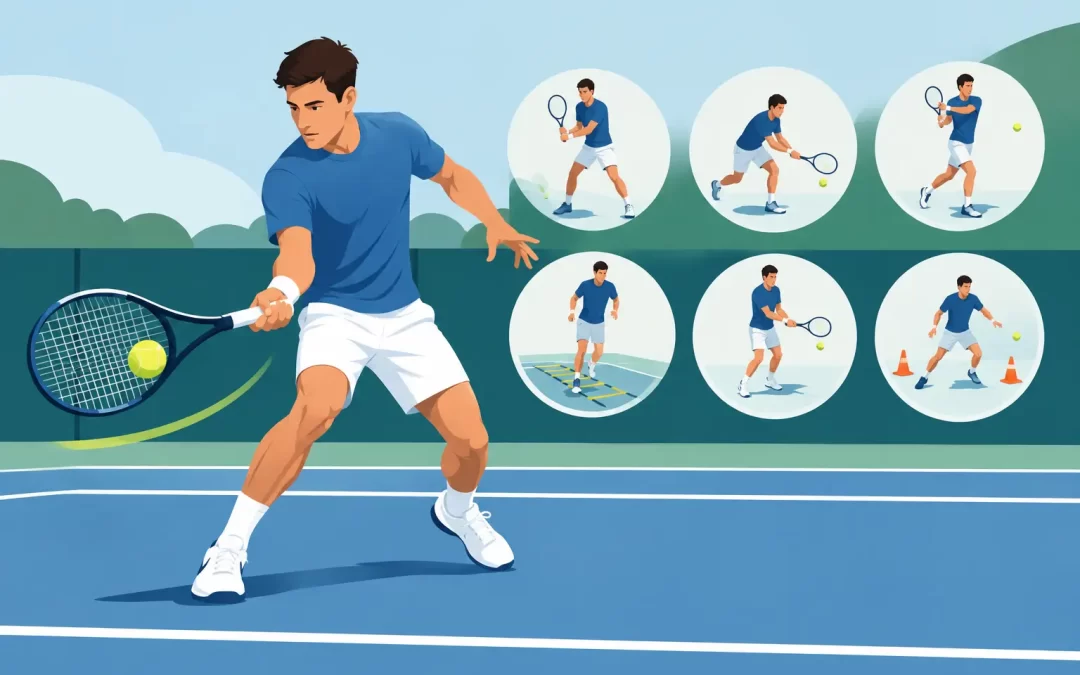
A ball that feels rushed, jams your body, and flies late off the strings is not usually a racquet problem. It is a timing and positioning problem that started before the swing. Learning how to fix late contact means training yourself to recognize the ball earlier, create space sooner, and meet it in a repeatable strike zone.
Late contact can show up as forehands that spray wide, backhands that float short, or defensive shots that feel weak even when you are standing near the ball. For competitive juniors and committed adult players, it also becomes a match problem. Under pressure, the feet slow down, the preparation gets late, and the opponent starts controlling the point.
How to Fix Late Contact Starts Before the Swing
Contact is late when the ball reaches your body before the racquet has reached its intended hitting zone. On most groundstrokes, that means you are striking beside your hip or behind it rather than out in front. The result is a cramped swing path, an open racquet face, and less ability to direct the ball with conviction.
Players often try to solve this by swinging faster. That usually makes the problem worse. A faster swing cannot rescue poor spacing. If your feet have not put you in position and your racquet has not prepared early, speed only creates more tension and less control.
The better question is not, “Why was my swing late?” Ask, “Why did I arrive late?” In most cases, the answer comes down to one of three areas: late recognition, delayed preparation, or inefficient footwork.
Recognize the Ball Earlier
Good contact begins when your opponent hits the ball. As soon as you read the direction, depth, height, and speed of the shot, your body should begin moving. Players who wait until the ball crosses the net often feel as if they are reacting to every shot. Players who read the opponent’s racquet and first ball trajectory gain valuable time.
Build the habit of watching the opponent through contact. Notice whether their racquet path is steep or flat, whether they are balanced or stretched, and whether the ball leaves with topspin, slice, or pace. You will not predict every shot perfectly, but earlier information gives your feet a head start.
Prepare the Racquet During Movement
Your unit turn should happen as you move, not after you stop. Turn your shoulders, set the racquet, and organize your hands while your feet are traveling to the ball. When players run with the racquet down or facing forward, they force themselves to complete too many actions at the last second.
On the forehand, feel your outside shoulder turn as soon as you identify the ball. On a two-handed backhand, take the racquet back with your torso rather than pulling it behind you with your arms. This keeps the swing compact and gives you time to accelerate through the intended contact point.
Create Space Instead of Chasing the Ball
Late contact is frequently caused by getting too close. You may reach the ball, but you cannot swing freely because it has entered your body line. Use adjustment steps near the ball to create a comfortable arm-to-ball distance. The final steps are not wasted movement. They are what allow a clean strike.
For a neutral-height forehand, most players need contact roughly an arm’s length in front of the body and slightly to the side. The exact distance depends on grip, height, and ball speed, but the principle does not change: make room for the racquet to travel.
The Technical Fix: A Clear Contact Window
Do not think of contact as one tiny point that you have to find by luck. Think of it as a window in front of your body. Your job is to arrive early enough that you can choose where within that window to strike the ball.
For crosscourt groundstrokes, contact is generally farther forward than players expect, especially when they are trying to play with pace and shape. On an inside-out forehand, the strike may be slightly more beside you because of the intended direction. On a defensive ball, the contact point can move back somewhat because survival is the priority. This is why a fixed rule such as “always hit far in front” is incomplete. The ideal contact point depends on the ball, your position, and your target.
What should remain consistent is posture. Keep your head still through the strike, maintain athletic balance, and avoid falling backward as you swing. If your upper body is leaning away from the ball, late contact becomes much more likely.
Six Drills to Fix Late Contact
1. The Catch-and-Point Drill
Have a partner feed easy balls from the service line. Before hitting each ball, move into position, catch it with your non-racquet hand at your preferred contact point, and point the ball toward your target. Then drop-feed the next ball and hit it using that same contact location.
This drill removes the temptation to rush. It teaches your eyes, feet, and body where contact should happen before you add a full rally.
2. The Freeze-at-Contact Drill
Rally at moderate speed from the baseline. After every third shot, freeze your finish for two seconds. Check whether your weight is balanced, whether your racquet traveled freely, and whether contact occurred in front of your lead hip.
If you cannot hold the finish, you were probably reaching, falling backward, or swinging while off balance. Do not judge the shot only by whether it landed in. Evaluate the quality of the position that produced it.
3. The Short-Ball Adjustment Drill
Ask a partner to alternate deep feeds with shorter balls. Your goal is to use small adjustment steps after you reach the short ball, rather than planting too early and letting the ball crowd you.
Many players are quick enough to get to a short ball but do not organize their last three steps. That is where late contact appears. Arrive under control, create space, then strike through the ball with balance.
4. The Early-Turn Shadow Swing
Without a ball, begin in your ready position and have a coach or partner call “forehand” or “backhand.” Split-step, turn immediately, take two movement steps, and shadow swing to a defined contact point. Repeat in sets of eight to ten repetitions.
This is simple, but it builds a vital competitive habit: the unit turn happens with the first movement. Once that habit is automatic, live-ball timing becomes less rushed.
5. The Rise-and-Fall Timing Drill
Feed one series of balls that bounce high and another that stay low. On the high ball, choose to take it on the rise or allow it to drop into your strike zone. Say your choice out loud before the bounce.
Late contact is sometimes a decision failure. When you have not decided whether to take the ball early or let it fall, your feet hesitate. This drill develops clearer timing choices and helps you stop getting trapped by changing ball height.
6. The Pressure Pattern Drill
Play a crosscourt pattern with a scoring consequence. For example, play forehand crosscourts until one player earns a shorter ball, then attack to the open court. If you make late contact, stop the point and give the opponent the score.
This creates accountability. You are no longer practicing clean contact only when the feed is comfortable. You are training it when the ball is deep, fast, and connected to a competitive decision.
Fix the Habits That Return Under Pressure
A player may hit cleanly in a technical session and still make late contact in matches. That does not mean the correction failed. It means the skill has not yet been trained under enough speed, movement, and consequence.
Start by reducing your backswing when the ball is faster. A compact preparation gives you more time and often produces a heavier ball than a large swing you cannot time. Next, make your split-step intentional. If your split-step is late or absent, your first move will be slow, and the entire stroke sequence will be rushed.
Finally, use a simple cue between points: “See early. Turn early. Space.” Three words are easier to carry into competition than a long technical checklist. The goal is not to think more during a match. The goal is to trust a disciplined routine that puts your body in the right position.
At Point of Mind Coaching, this is the difference between simply receiving a correction and building a repeatable performance skill. Video review can reveal whether the issue is recognition, movement, spacing, or racquet preparation, while structured practice gives the correction a chance to hold up in real points.
Clean contact is earned before the ball reaches you. Train your eyes to read sooner, your feet to adjust longer, and your racquet to prepare earlier. When those pieces work together, the ball stops jamming you and starts feeling like an opportunity to take control.