
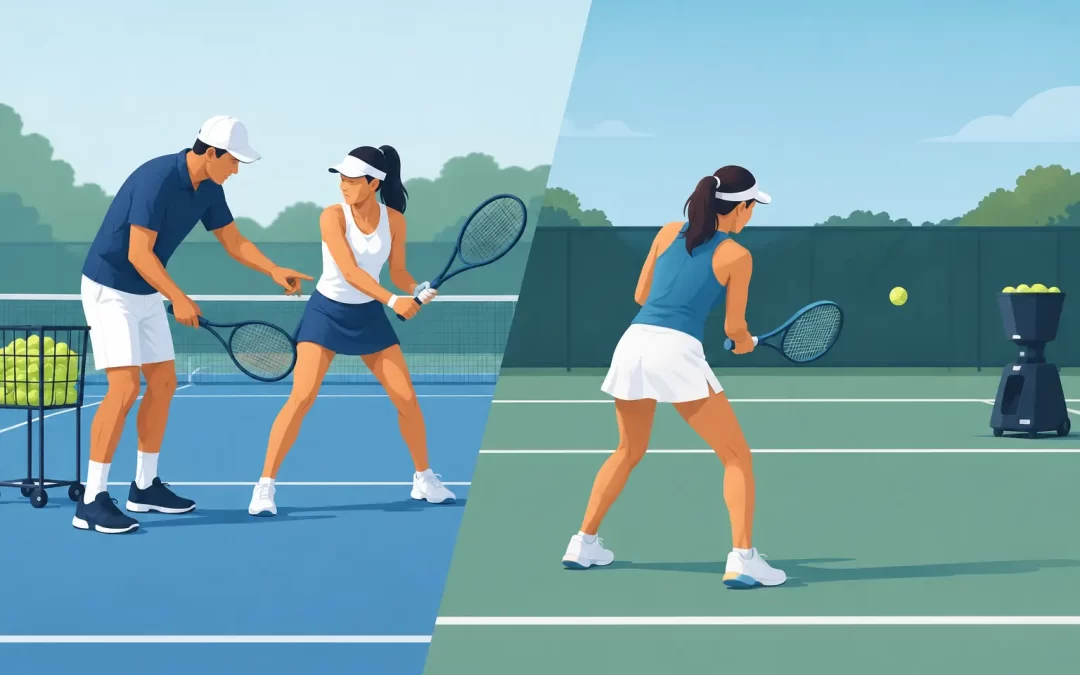
A player can hit against a wall for an hour, watch five instructional videos, and leave the court feeling productive. But if the same late contact point shows up in the next match, that effort has not yet become improvement. The real question in tennis coaching versus self training is not which option feels harder. It is which one gives you the feedback, structure, and competitive habits needed to perform when the score matters.
For committed juniors, serious adult players, and parents building a development plan, the strongest answer is rarely all coaching or all independent work. Progress comes from knowing what each approach can do well, where it breaks down, and how to use both with purpose.
Tennis Coaching Versus Self Training: The Core Difference
Self training puts the player in charge of the session. You select the drills, decide what needs work, manage the intensity, and evaluate the result. That independence can be valuable. It teaches ownership, encourages repetition, and makes it possible to train more often without paying for every hour on court.
Coaching provides something self training cannot reliably provide: an experienced outside eye. A qualified coach sees whether a missed forehand came from footwork, spacing, racket path, balance, decision-making, or a rushed response to pressure. Those causes can look similar to a player. They are not the same problem, and they should not be trained the same way.
A coach also places technical work in a larger performance system. A stronger serve is useful, but only if the player can use it to start points with intention. Better movement matters, but only if it helps the player recover, defend, and create offensive court position. Training without that connection often produces players who look polished in drills but struggle to build points in matches.
Where Self Training Builds Better Players
Independent practice is not a lesser form of training. When it is organized, it is one of the most important tools a player has. A one-hour lesson each week cannot create lasting change unless the player applies the work between sessions.
Self training is especially effective for repetition and physical habits. Players can practice serves, shadow swings, split-step timing, recovery footwork, wall rallies, conditioning, and simple ball-control patterns without needing constant supervision. It is also a strong place to build the discipline that competitive tennis demands. Showing up, following a plan, and completing quality repetitions are skills.
The challenge is that most self-directed sessions become too comfortable. Players tend to practice shots they already like, hit at the same pace, and stop when the drill becomes frustrating. They may mistake volume for quality. Hitting 100 forehands with poor spacing does not reinforce a better forehand. It reinforces the pattern already holding the player back.
Self training works best when the goal is specific and measurable. Instead of deciding to “work on my backhand,” a player might set a session target: maintain a neutral crosscourt backhand rally for 20 balls, recover behind the baseline after every shot, and record whether the contact point stayed in front. That gives practice a standard beyond simply getting a good sweat.
Why Coaching Accelerates Progress
A strong coach shortens the trial-and-error cycle. Rather than spending months trying random drills from online videos, the player receives a clear priority: what to change first, why it matters, and how to practice it correctly.
That matters most when a player has plateaued. Many players believe they need more power or more advanced technique when the real limitation is timing, movement, shot selection, or emotional control. A coach can identify the pattern and keep the player from chasing the wrong solution.
Feedback prevents bad habits from becoming permanent
Tennis movements happen quickly. Players often cannot feel the exact difference between being balanced and slightly late, or between preparing early and reacting at the last moment. Video can help, but video without informed review can also create confusion. Players may focus on how a stroke looks instead of whether it works under match conditions.
Coaching turns observation into correction. The player gets immediate feedback, a clear cue, and a drill that connects the adjustment to a live ball. Over time, that process helps technique hold up under pressure rather than disappear when the match gets tight.
Coaching develops tactical intelligence
Tennis is not a collection of isolated strokes. It is a decision-making sport. Players need to recognize when to rally crosscourt, when to change direction, when to attack a short ball, and when to reset the point rather than forcing a low-percentage winner.
Self-trained players often improve their shot-making before they improve their choices. This is why they can look strong in practice yet lose to opponents who are steadier, more patient, and more aware of court position. Coaching creates the match situations where tactical habits are tested, corrected, and repeated.
Accountability changes the standard
A player who knows a coach will review progress is more likely to complete the assigned work with intention. That accountability is not about pressure for its own sake. It creates consistency. The player arrives at the next session prepared to build on the previous one instead of starting over.
For juniors, this structure is particularly valuable. Parents often see effort but cannot always tell whether their child is practicing the right things. A coach-led plan provides direction and makes progress easier to evaluate over time.
The Trade-Offs: Cost, Access, and Ownership
Coaching is an investment. Private lessons, video review, and structured programs cost more than an open court and a basket of balls. For some players, frequent in-person coaching may not be practical because of budget, schedule, or court availability.
Self training is more flexible and can deliver tremendous value when the player has a plan. It allows athletes to accumulate repetitions, develop fitness, and reinforce coach-assigned priorities between lessons. It also builds ownership. No player reaches a high level by relying on a coach to provide every ounce of motivation.
But low cost does not automatically mean efficient training. If a player spends several months repeating ineffective mechanics or practicing without match purpose, the hidden cost is lost development time. The right question is not only, “What does coaching cost?” Ask, “What does unstructured training cost my progress?”
The answer depends on the player. A beginner may need more direct instruction early to establish sound fundamentals. An intermediate player may benefit most from a blend of lessons and organized independent practice. A competitive athlete may need ongoing technical feedback, match analysis, tactical planning, and mental training to keep improvement moving at the level competition requires.
A Smarter Hybrid Training Model
The most productive development path combines expert guidance with independent execution. Coaching establishes the priorities. Self training supplies the repetition. Match play reveals whether the skill holds up. Then the coach and player review the result and adjust the plan.
A practical weekly structure might include one focused coaching session, two independent sessions built around the coach’s assignments, one fitness or movement session, and match play with a short post-match review. The exact schedule changes with age, goals, tournament volume, and physical readiness. What should not change is the connection between each session.
Every training block should answer three questions: What is the priority skill? How will it be practiced this week? How will we know it improved? That could mean a higher first-serve percentage, fewer backhand errors under pressure, better recovery after wide balls, or more disciplined shot selection in key moments.
Online support and video review can make this model even stronger. A player does not have to wait until the next court session to receive direction. At Point of Mind Coaching, the goal is to give players a structured progression system that carries beyond the lesson, connecting technical work with movement, strategy, confidence, and competitive preparation.
How to Know What You Need Right Now
Choose more coaching support if you are unsure why you miss, repeat the same errors despite practicing often, struggle to transfer practice skills into matches, or feel unclear about your next priority. These are usually signs that effort is not the issue. Direction is.
Lean more heavily on self training when you have clear assignments, can execute the drills with sound form, and need repetitions to make a new pattern automatic. Independent work is where you prove that you can take ownership of your development.
Players who improve consistently do not wait for motivation or rely on random practice. They build a system: expert feedback to set the standard, disciplined training to reinforce it, and honest match review to keep moving forward. Start with one clear priority, train it with purpose, and let every session earn its place in your progress.