
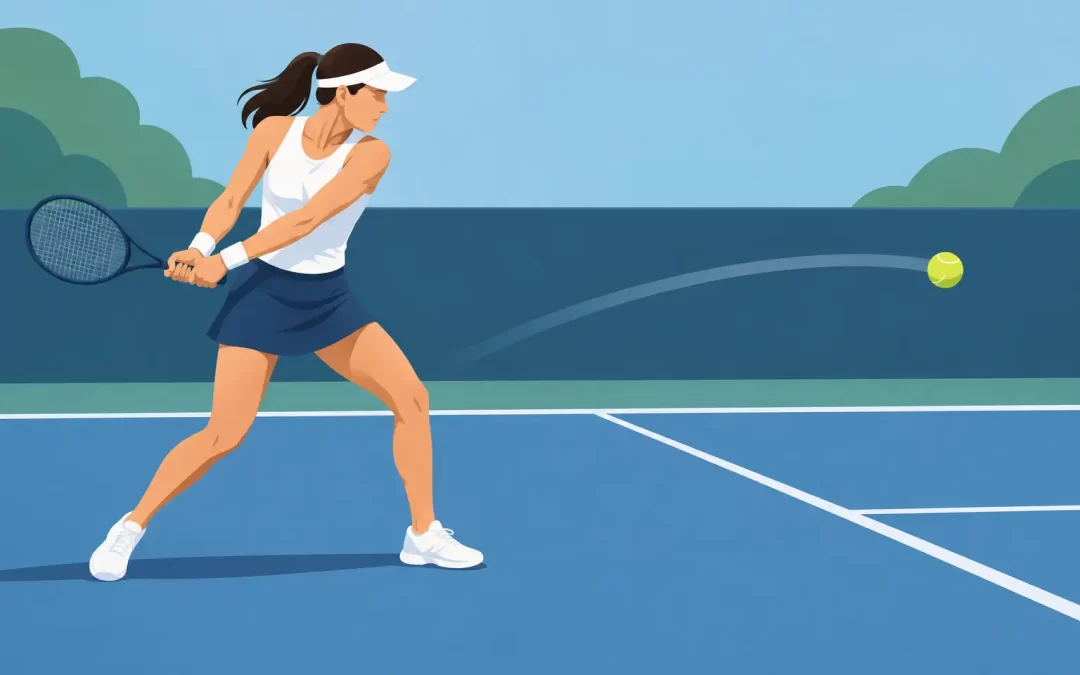
A short backhand gives opponents a simple decision: step inside the baseline and take time away from you. That is why learning how to improve backhand depth is not just a stroke-production goal. It is a competitive priority. A deeper backhand pushes an opponent back, protects your court position, and gives you more time to recover for the next ball.
Players often try to solve this problem by swinging harder. That usually creates a different problem: late contact, poor balance, and errors that miss long or wide. Depth comes from organized movement, clean contact, the right swing path, and a clear target. Build those elements with purpose, and your backhand becomes a shot you can trust when the score gets tight.
Why Backhand Depth Changes the Match
A backhand that lands near the service line may feel safe, but it often puts you under pressure. Your opponent can move forward, attack angles, or direct the next ball to your weaker side. Even a solidly struck ball loses its value if it lands too short.
A deep backhand does three things. First, it reduces the opponent’s ability to attack. Second, it creates a more neutral rally when you are defending. Third, it lets you establish a repeatable crosscourt pattern, one of the most valuable patterns in singles tennis.
Depth does not mean every ball must land on the baseline. The smarter target is usually a high-percentage window: roughly three to six feet inside the baseline, with enough net clearance to keep the ball out of trouble. On a fast court or against an aggressive opponent, you may need more height and margin. On a slower court, a heavier, deeper ball can push the opponent well behind the baseline.
Start With Spacing and Early Preparation
Many short backhands begin before the swing. The player recognizes the ball late, turns late, then reaches for contact. A rushed arm swing may get the ball over the net, but it rarely produces dependable depth.
As soon as you read the ball coming to your backhand, make your unit turn. Rotate your shoulders, bring the racquet into position, and begin moving your feet. For a two-handed backhand, both hands should help set the racquet early. For a one-handed backhand, the non-dominant hand should support the racquet through the preparation phase before releasing into the forward swing.
Your goal is to arrive with enough space between your body and the ball. If the ball crowds you, your swing gets jammed and the shot floats short. If it is too far away, you lose balance and control. Work toward contact slightly in front of your body, with your weight organized over a stable base.
A useful checkpoint is this: can you hold your finish without falling sideways or backward? If not, the issue may be movement and spacing rather than your backhand mechanics.
Use Your Feet to Create the Contact Point
Do not wait for the perfect ball. Adjust to create it. Use small adjustment steps as the ball approaches, especially on neutral rally balls. The final two or three steps often determine whether you strike through the ball or merely guide it back.
When you have time, step into the ball and transfer your weight forward. When the ball is deep or fast, load outside the hitting zone, create space, and use a controlled open or neutral stance. The stance can change. The requirement does not: maintain balance through contact and recover immediately after the shot.
Create Depth With Shape, Not Excess Effort
The ball needs enough speed to travel deep, but raw speed is not the answer. The best backhands combine forward extension with topspin. Think of driving through the ball toward your target while brushing up enough to create a safe arc over the net.
Players who miss short often stop the racquet at contact. They are trying so hard to control the ball that they decelerate. Instead, allow the racquet to continue through the hitting zone. A complete finish helps you maintain acceleration, direction, and spin.
For a two-handed backhand, the non-dominant hand typically drives much of the forward and upward action. Keep the dominant hand relaxed enough to support the racquet rather than strangle the swing. For a one-handed backhand, use the shoulder turn, legs, and extension through the ball to avoid flicking with the wrist.
Net clearance matters. A ball that clears the net by two to four feet can still land deep when it has the right shape. Trying to skim the net may work on an easy ball, but it is a low-margin choice under pressure. Give yourself room to swing with confidence.
How to Improve Backhand Depth With Better Targets
A player without a target usually hits toward the middle of the court and hopes the ball travels far enough. A player with a target trains depth deliberately.
During crosscourt backhand rallies, aim through the deeper third of the court rather than toward the sideline. Picture a large target area between the service line and baseline, several feet inside both the baseline and sideline. This target gives you depth without demanding a risky winner.
Crosscourt is the best place to build your backhand depth because the court is longer and the net is lower. Establish that ball first. Once you can consistently send the crosscourt backhand deep, add a down-the-line change of direction on the right ball. Do not force the down-the-line shot from a stretched or defensive position. That is a tactical error, not a technical one.
When defending, your target should change. Use more height and aim deeper through the middle or crosscourt. The goal is not to hit a perfect ball. The goal is to reset the point and deny your opponent an easy attack.
Train Depth With Purposeful Drills
Random hitting does not reliably improve a specific weakness. Your practice needs a measurable standard. Place a visual reference about three feet inside the baseline, such as court markers or cones outside the active playing area. Your objective is to land a defined percentage of backhands beyond that line while keeping them inside a safe lateral target.
Start with cooperative crosscourt rallies. Hit sets of 10 backhands and record how many land in the deep target zone. If you are below six out of 10, slow the pace and improve your spacing and shape before adding more speed.
Then progress to movement. Have a partner alternate one ball to your backhand corner and one closer to the center. This forces you to recover, adjust, and find the contact point repeatedly. Depth that only appears on stationary feeds will disappear in matches.
Finally, add pressure. Play points where a backhand that lands short of the target line gives the opponent an attacking advantage, or begins the next ball inside the baseline. This creates a consequence for short ball placement and teaches you to choose a higher-margin shape when nerves rise.
Video review is especially valuable here. A ball may land short because of late preparation, poor spacing, a dropped racquet head, early deceleration, or weak recovery. These causes look similar from the other side of the court, but they require different corrections. Structured feedback prevents you from practicing the wrong solution.
Bring It Into Match Play
Do not enter a match telling yourself to hit every backhand harder. Use one clear performance cue: prepare early, create space, or drive through your deep crosscourt target. One cue keeps your attention on an action you can control.
Against a player who attacks your backhand, your first objective is not to produce a highlight shot. Make them hit from behind the baseline. Use height when needed, keep your margin, and wait for a shorter ball before changing direction or stepping forward.
Confidence grows when your training matches your match demands. At Point of Mind Coaching, that means connecting technique to movement, decision-making, and pressure situations instead of treating the backhand as an isolated stroke.
Your backhand does not need to be flashy to change your results. Train it to travel deep with shape and purpose, and it becomes a disciplined response you can rely on when the rally starts asking difficult questions.