
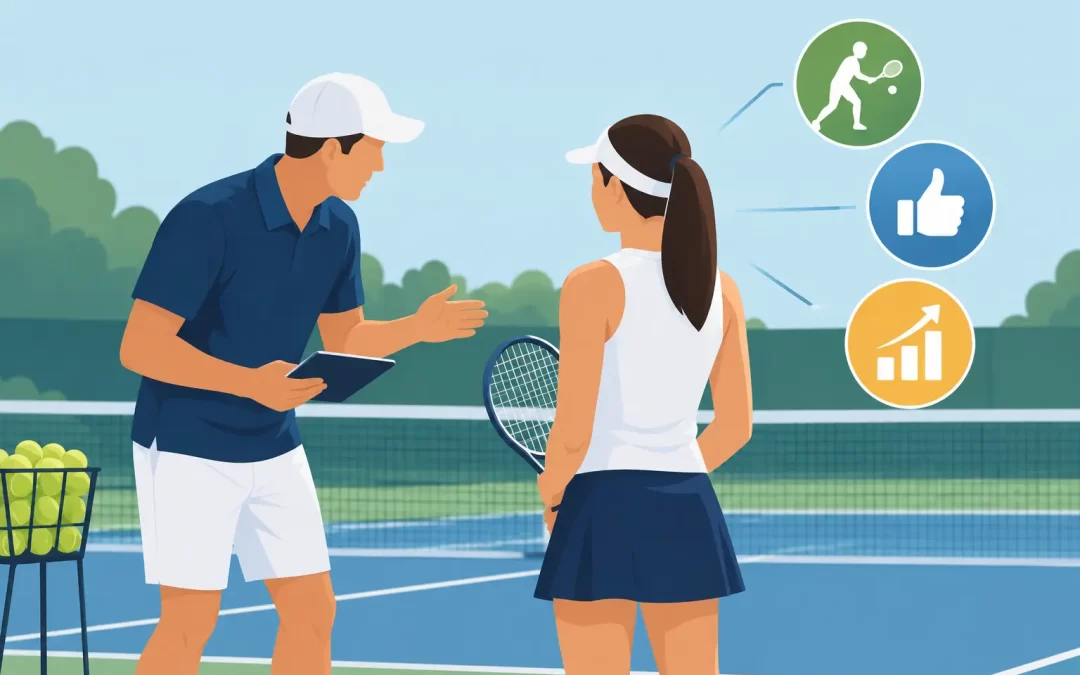
A forehand can look clean in a private lesson and still break down at 4-4 in the third set. The difference is rarely effort alone. It is often the quality of the feedback a player receives, how clearly they understand it, and what they do with it before the next ball is struck. This guide to tennis coaching feedback explains how players and parents can turn coaching input into measurable progress instead of collecting tips that disappear by the next practice.
For committed juniors, competitive players, and adults who want to win more consistently, feedback is not a compliment or a correction. It is a performance tool. Used well, it connects technical work, movement, decision-making, and mindset into a training process that holds up under pressure.
What Effective Tennis Coaching Feedback Does
Good feedback gives a player a clear answer to three questions: What happened? Why did it happen? What is the next action?
A coach who says, “You need to move your feet,” may be correct, but the instruction is too broad to create an immediate change. Stronger feedback identifies the moment and the consequence: “You stopped your adjustment steps before contact, so the ball got too close to your body. Create two small adjustment steps after the bounce.” The player now has a specific behavior to train.
The best coaching feedback also protects the player from trying to fix everything at once. Tennis is too fast and too complex for a player to process five technical thoughts during a point. A disciplined coach prioritizes the issue that will produce the biggest improvement right now, whether that is contact point, recovery position, shot selection, or emotional control after an error.
That priority changes depending on the player. A beginner may need simple feedback on grip, balance, and rally control. An intermediate player may need help recognizing when to recover crosscourt versus when to move forward. A competitive athlete may need feedback on patterns, return position, and choices made under scoreboard pressure.
A Guide to Tennis Coaching Feedback During Practice
Practice feedback should make the next repetition better. It should not interrupt every ball or turn training into a lecture.
The most productive rhythm is observe, identify, communicate, repeat, and review. The coach watches enough repetitions to see a pattern, gives one concise correction, then allows the player to apply it through multiple balls. This creates the connection between information and feel.
Keep the Cue Short and Actionable
A useful cue is easy to recall while moving. “Load outside leg, then drive” is easier to use than a long explanation of the kinetic chain. “Clear the net by three feet” gives a player an immediate target when they are missing low. “Recover through the middle” can reset court positioning after a wide ball.
Short cues are not oversimplified coaching. They are competition-ready coaching. The deeper explanation still matters, especially in video review or between drills, but a player needs language that survives the pace of a live ball.
Connect Technique to the Ball and the Point
Technical feedback matters most when it is tied to an outcome. Rather than telling a player to “rotate more,” explain that earlier shoulder rotation can help them create a more stable contact point and drive the ball deep through the court.
This is especially important for players who look sharp in controlled drills but lose consistency in matches. Their stroke may not be the central problem. They may be attacking from poor court position, rushing between shots, or selecting a low-percentage target. Feedback should address the full point, not isolate the swing from the situation.
Do Not Correct Every Miss
Not every error requires a new instruction. A missed forehand may be the result of a late split step, poor spacing, fatigue, an ambitious target, or simple normal variation. Overcorrecting can make a player tight and overly mechanical.
A coach should look for repeated errors and identify their source. If a player misses three forehands long after being pushed deep, the issue may be balance and recovery rather than the forehand itself. If they miss short balls into the net, the issue may be indecision about moving forward and creating lift. Pattern recognition is where experienced coaching creates value.
Video Feedback Turns Memory Into Evidence
Players often remember a point differently from what actually happened. They may say, “I was late on every ball,” when video shows they were in position but chose the wrong target. Or they may blame nerves when their return position was too far behind the baseline and gave the opponent control from the start.
Video feedback is effective because it replaces guesswork with evidence. It lets a coach slow down the sequence, compare intention with execution, and highlight the moments that decide the point.
For technical analysis, one or two clips can reveal whether the player is losing balance, contacting too close, opening the racquet face, or recovering in the wrong direction. For match analysis, video can show return patterns, rally tolerance, transition decisions, and emotional responses after mistakes.
The goal is not to create a highlight reel of flaws. A productive review should end with a focused training priority for the week. For example, a player may leave with the assignment to recover one step more toward the likely crosscourt reply after every wide forehand. That can be measured in the next practice and tested in match play.
Feedback Must Include Tactical and Mental Training
A player who receives only stroke feedback is not receiving complete coaching. Tennis rewards the player who can recognize situations, manage momentum, and make disciplined choices when the score becomes tight.
Tactical feedback should help players understand why a point was won or lost. Did they build the rally with margin before changing direction? Did they attack the opponent’s weakness from a balanced position? Did they choose the right serve location for the score? These questions develop competitive intelligence.
Mental feedback should be equally concrete. “Stay confident” is encouraging but vague. “After an error, turn away from the baseline, take one reset breath, identify the next target, and commit to your feet” gives the player a repeatable response. Confidence is built through reliable routines, preparation, and evidence of improvement, not empty reassurance.
Parents can support this process by avoiding a second coaching session in the car after practice or a match. Ask the player what they learned, what they will train next, and what they did well under pressure. Let the coach’s priorities remain clear. When parents, players, and coaches communicate around the same plan, development becomes much more stable.
How Players Can Get More From Coach Feedback
The player has responsibilities, too. Feedback only works when it is applied with attention and consistency.
First, listen for the priority, not every word. If the coach gives a technical explanation, identify the one cue you will use in the next drill. If you are unsure, ask: “What should I focus on for the next ten balls?” That question turns information into action.
Second, track patterns between sessions. A simple training journal can include the week’s technical cue, tactical focus, match goal, and one observation about mindset. This creates accountability and helps prevent the common cycle of repeating the same correction every lesson.
Third, report honestly. Tell your coach what happened when you tried the adjustment in a match. Did it work in practice but disappear under pressure? Did a new movement pattern feel awkward? Did a tactical plan fail because the opponent had a stronger weapon than expected? Honest feedback from the player allows the coach to adjust the plan.
When Feedback Needs to Change
There is no single feedback style that works for every player or every day. A young beginner may need immediate encouragement and one visible task. A high-level junior preparing for tournament play may need direct, detailed analysis and demanding accountability. An adult player returning after time away may need technical rebuilding before advanced strategy becomes useful.
Timing also matters. During a high-intensity drill, brief cues work best. During a water break, the coach can explain the reason behind the adjustment. After a match, emotions may be high, so the first conversation should often be short and constructive. Detailed analysis can come later, when the player is ready to learn rather than defend.
The right feedback is not always comfortable. A serious player needs to hear when their preparation is inconsistent, their shot selection is reckless, or their body language gives away frustration. But direct coaching should always point toward a solution. The purpose is to raise standards, not diminish belief.
At Point of Mind Coaching, the goal is to make feedback part of a structured development system, not a one-time correction. When technical instruction, video review, tactical planning, and mental training reinforce one another, players stop guessing about how to improve.
The next time you leave the court, do not ask only whether you hit the ball well. Ask what pattern you recognized, what adjustment you can repeat, and what you will test under pressure. That is how feedback becomes a habit – and habits become stronger performances when the match is on the line.