
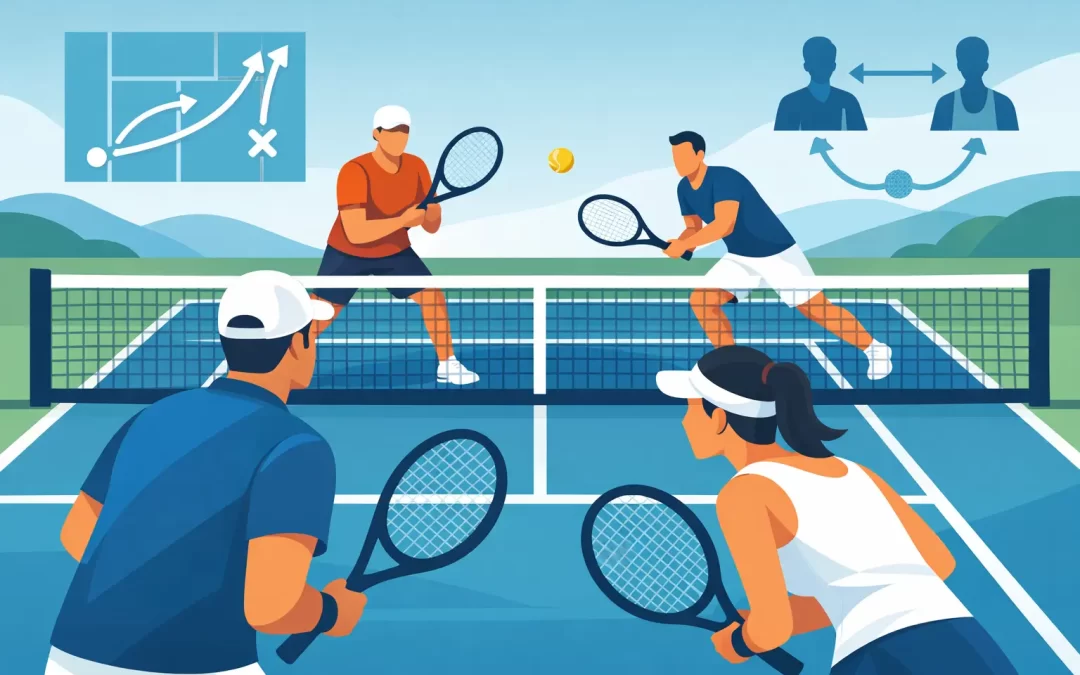
Most doubles matches are not lost because one team has weaker strokes. They are lost through poor positioning, low-percentage decisions, and partners playing two separate matches on the same court. This tennis strategy guide doubles as a practical framework for players who want to compete with more clarity, communicate better, and make opponents feel pressure from the first ball.
Doubles rewards the team that controls space, protects the middle, and recognizes the right moment to attack. You do not need to hit every ball harder. You need a shared plan that gives each player a defined job.
Tennis Strategy Guide: Doubles Starts With Position
Court position determines what shots are available and how much pressure your team can create. Too many teams stand in familiar positions without asking whether those positions fit the score, the opponent, or the ball.
On serve, the server should use the first ball to set up the net player. A wide serve can pull a returner off the court and expose the middle. A body serve can jam an aggressive returner and create a floating ball. A serve up the T can limit angles and make a poach more realistic. The point is not to serve a predetermined pattern every time. The point is to serve with the next ball in mind.
The net player must be active without becoming reckless. Start close enough to threaten the middle, but not so close that a firm return at the body becomes unmanageable. Watch the returner’s shoulders and contact point, not just the ball. A late, stretched, or defensive return is a signal to move forward or cross. A balanced return with early contact is usually a signal to hold position and protect your alley.
When returning, the default target should often be low through the middle. The middle is the largest target, creates confusion between opponents, and reduces the angle available for the opposing net player to intercept. A returner who tries to paint the alley under pressure gives away too many free points. Use the alley when the opposing net player has committed too far toward the center or when you have time and balance.
Establish Clear Roles Before the Match
Strong doubles teams do not need constant discussion between points because they have already agreed on basic responsibilities. Decide who takes the middle ball when both players can reach it. In most situations, the forehand should take priority, particularly on higher balls. But that rule is not absolute. If one player is moving forward with momentum and the other is retreating, the forward player may have the better play regardless of side.
Also decide how you will handle lobs. If the ball goes over the net player, the baseline player should call it early. If it goes over the baseline player, the net player may need to switch and cover the open court. Silence turns a manageable lob into a point-ending scramble.
Communication should be brief and useful. Call “mine,” “yours,” “switch,” and “bounce it” early and clearly. Between points, use simple language: serve body, stay back, watch the lob, or look middle. Long tactical speeches create hesitation. A disciplined team identifies one adjustment, commits to it, and plays the next point.
Use Hand Signals With a Purpose
Hand signals are valuable only when both players understand the intention. Before serving, the net player can signal a planned poach, a fake poach, or a stay. The server should confirm the plan verbally or with a quick response.
A poach works best when the serve supports it. If the server delivers a wide serve and the returner is pulled outside the court, the net player has a better chance to close through the middle. If the serve sits up in the middle, crossing early can leave a large opening. Aggressive movement without a tactical reason is gambling, not strategy.
Win the Middle Without Living There
The middle is doubles territory, but that does not mean every ball should be hit directly down the center. It means your team should understand why the middle matters. It is safer than the sidelines, forces opponents to communicate, and often draws weaker volleys because neither player is fully certain who owns the ball.
Use the middle especially when returning serve, defending from the baseline, or trying to neutralize a team that is crowding the net. Hit with margin over the lowest part of the net and keep the ball below volley height when possible. A low ball through the middle is difficult to attack.
Once opponents begin protecting the center, the outside lanes become more available. This is where smart doubles players change direction. Show middle repeatedly, then pass behind the poaching net player. Hit two or three crosscourt balls to move the baseline opponent, then use the open alley. The best teams create predictable reactions before they exploit them.
Build High-Percentage Point Patterns
A doubles team should enter each game with two or three patterns it trusts. These patterns reduce indecision under pressure and give both players a clear expectation.
On the deuce side, a server might use a body serve followed by a first volley to the opposing net player’s feet. On the ad side, a left-handed or strong wide-serving player may pull the returner off the court, allowing the partner to cover the middle. A return team may choose to return crosscourt low, then look for the next ball through the center.
At lower levels, simply serving, returning, and moving forward with control will win many points. At stronger levels, you must also account for opponents who can drive returns, use sharp angles, and punish weak second serves. That is when formations such as I-formation or Australian positioning can help. They can disrupt a returner’s rhythm and protect a vulnerable side, but they require practice. Do not use advanced formations in a close match if your team has not rehearsed the movement and coverage.
Know When to Attack and When to Reset
The urge to finish points quickly causes many doubles errors. A shoulder-high ball at the net is an attacking opportunity. A low, dipping ball near your feet is not. Learn to distinguish between a ball you can put away and a ball you need to neutralize.
When you are under pressure, reset with a deep crosscourt ball or a controlled lob. A lob is not a desperate shot when used intentionally. It can push an aggressive net player backward, buy time for your team to recover, and change the height of the rally. The key is placement. A short lob gives opponents an overhead. A deep lob over the weaker overhead player can change the point.
If both players are at the baseline, move forward together when your shot creates an opportunity. If one player charges the net while the partner stays well behind without a reason, the team creates a gap that skilled opponents will exploit. Doubles movement should be connected. Advance together, retreat together when necessary, and avoid leaving your partner alone against the next ball.
Make Pressure a Training Skill
Competitive doubles is often decided at 30-all, deuce, and break point. Those moments expose whether a team has a process. Instead of trying to produce a perfect shot, return to your highest-percentage pattern. Serve to the planned target. Return low through the middle. Make the first volley simple. Force opponents to hit one more ball.
Between points, use a consistent reset: turn away from the net, take a breath, state the next intention, and reconnect with your partner. This protects your focus after a missed volley or a frustrating return error. Emotional reactions are contagious in doubles. So is composure.
Practice should reflect this reality. Play short games beginning at 30-all. Track first-serve percentage, return depth, successful poaches, and points lost from communication errors. Video review can reveal whether a net player is moving too early, whether a team is leaving too much space down the middle, or whether the returner is choosing targets without a plan. Structured feedback turns match frustration into a specific training priority.
The Best Doubles Teams Make Each Other Better
Great doubles is not two players displaying individual talent side by side. It is coordinated movement, disciplined targets, and trust under pressure. One partner’s serve should support the other’s movement. One player’s defensive lob should give the other time to recover. One missed shot should be followed by a clear plan for the next point, not blame.
Build your doubles strategy around repeatable patterns, then test those patterns against better competition. When both players understand the purpose behind every position and target, the court becomes smaller for your opponents and clearer for your team.