
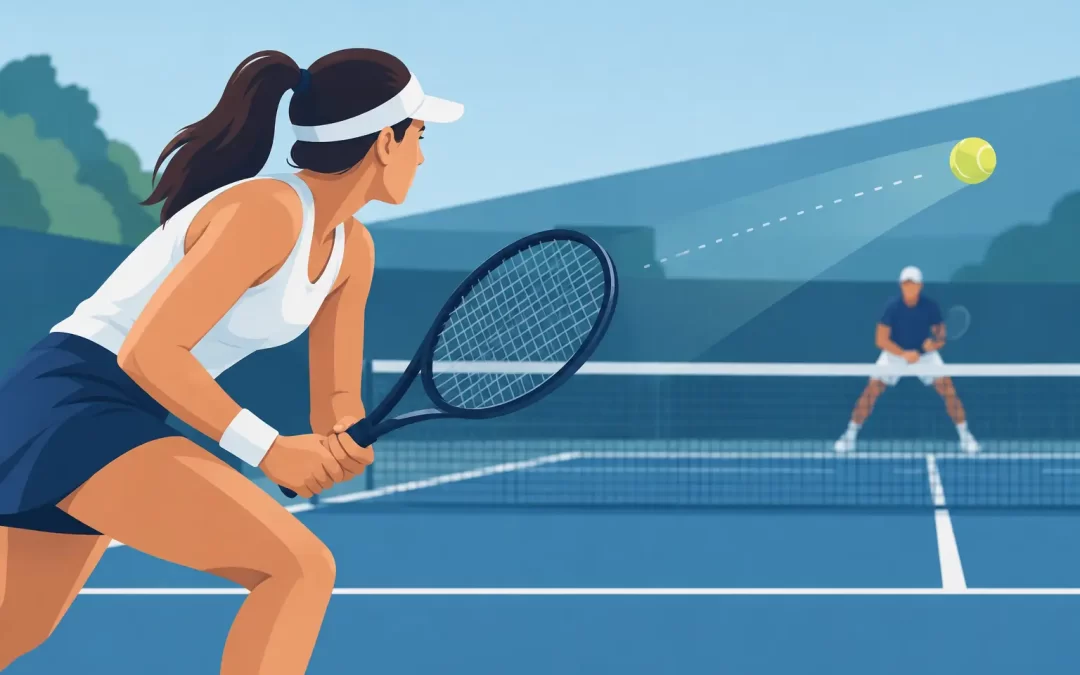
A fast opponent can make tennis feel rushed. But many players are not actually losing time because they are slow. They lose time because they recognize the next ball too late. To develop tennis anticipation, you must learn to read the information available before the opponent strikes the ball, then organize your feet and decision before the shot is already on its way.
Anticipation is not guessing. Guessing commits you to a direction without evidence. Strong anticipation uses patterns, positioning, body language, and ball quality to create an earlier, more intelligent first move. That difference matters in every level of the game, from a junior learning to recover after a rally ball to a competitive player trying to take time away from an opponent.
Why Anticipation Changes Match Results
Tennis is a reaction sport, but pure reaction is rarely enough. By the time a powerful ball leaves the opponent’s strings, the available response window may be less than a second. Players who wait to see the entire shot often arrive late, contact the ball off balance, and feel forced to play defensively.
Players with better anticipation do not magically move faster. They begin moving sooner and more efficiently. Their split step is timed better. Their first step is purposeful. They recover to positions that make sense for the next likely ball rather than returning automatically to the center mark.
This improves more than court coverage. Early recognition gives you better contact, more shot options, and greater confidence under pressure. When you arrive balanced, you can choose whether to defend, redirect, attack, or use height. When you arrive late, the opponent has already made that decision for you.
How to Develop Tennis Anticipation Through Better Cues
The ball is only one source of information. The strongest players read the court before the ball is struck. Train yourself to observe three areas at once: the opponent, the incoming ball, and the open spaces on the court.
Read the opponent’s position
An opponent’s court position often tells you what is realistic. A player stretched wide beyond the doubles alley is less likely to hit an aggressive crosscourt winner than a player balanced inside the baseline. If they are pulled far off court, expect a shorter recovery ball or a defensive shot through the middle more often than a perfect angle.
Watch whether the opponent is moving forward, falling backward, or setting their feet. A player stepping into the court has more ability to drive the ball. A player hitting while retreating may use more height, spin, or a safer target. These are probabilities, not guarantees, but tennis is won by making better decisions more often.
Read the quality of the incoming ball
The ball tells you what your opponent can do next. A deep, heavy crosscourt ball can push you behind the baseline and limit your angles. A shorter ball that sits up creates an attacking opportunity. A ball that pulls you wide changes your recovery position because your opponent now has access to the open court.
Pay attention to depth first. Depth controls time. Then assess height, speed, and spin. A high, slow ball may look easy, but it can force you to contact above your comfort zone. A low skidding ball may demand a more conservative response even if it lands short. Good anticipation begins with an honest read of the ball, not a hopeful one.
Read the racquet and body shape
Do not stare only at the strings. Notice shoulder turn, racquet path, contact point, and balance. On a forehand, a player who is late and jammed is unlikely to create the same angle as a player who has loaded early and reached a comfortable contact point. On a backhand, an open racquet face can suggest a slice, while a strong coil and low-to-high path may signal topspin.
These cues become clearer through repetition. At first, slow down video of your matches or watch stronger players from behind the baseline. Pause just before contact and make a prediction. Then watch the outcome. This is deliberate pattern training, not passive match watching.
Recover to the Right Place, Not Just the Middle
“Recover to the middle” is useful advice for beginners, but competitive tennis requires a more precise rule: recover based on the ball you just hit and the opponent’s available options.
If you hit a deep crosscourt forehand, your opponent has the easiest access back crosscourt. Your recovery should shade toward that likely reply while still respecting the down-the-line option. If you hit down the line, you have opened the crosscourt lane and must recover accordingly. If your shot is short, you need to expect the opponent to move forward and take time away.
The goal is not to cover every inch of the court equally. It is to protect the highest-percentage reply first. This is where tactical awareness turns anticipation into a repeatable skill.
Practice Drills That Build Anticipation
Anticipation improves when drills demand a decision, not when players simply feed balls to the same location. Add uncertainty to practice while keeping the objective clear.
- Call the direction: During a cooperative rally, have a partner call “crosscourt” or “line” just before contact. Begin with slower balls, then increase pace. The purpose is to sharpen your split step and first reaction without turning the drill into random chaos.
- Two-ball pattern recognition: Start with a predictable first ball, then allow the second ball to vary. For example, rally crosscourt once, then the feeder can send the next ball crosscourt or down the line. Focus on reading the feeder’s position and racquet preparation before moving.
- Live point constraints: Play points where one player must hit the first two balls crosscourt before the point opens. This creates recognizable patterns and teaches the defender where to recover. As players improve, remove the restriction and see whether the same reads still appear.
- Video prediction review: Record match play and stop the video just before each opponent contact. State where you expect the ball to go and why. Review whether the read was correct. If it was wrong, identify whether you missed a cue or made an unreasonable assumption.
A drill should challenge your perception without removing technical quality. If the pace is so high that every ball becomes a scramble, reduce speed or simplify the pattern. Train the correct read first, then add pressure.
Build Anticipation Into Your Split Step
Even the right read is useless if your body is flat-footed. The split step is the physical bridge between recognition and movement. Time it as the opponent makes contact, not after you see the ball traveling toward you.
Land light and balanced, with your hips ready to move in either direction. Avoid a large jump that delays your first step. The split step should prepare you to react, not become a separate athletic performance.
Many players split step consistently during drills but forget it in matches because they are focused on their previous shot. Use a simple reset cue after every ball: hit, recover, split. Repeat it until the sequence becomes automatic. Under pressure, simple routines protect your decision-making.
Anticipation Under Pressure Requires Discipline
Pressure makes players chase the spectacular read. They overcommit to a down-the-line shot, lean too early, and give away the open court. Against better opponents, this is costly. A disciplined player anticipates likely options while maintaining enough balance to respond to the unexpected.
It also depends on the opponent. Against a player with limited directional control, you can shade toward their preferred pattern. Against a skilled competitor who disguises shots well, recover more neutrally and prioritize balance. The better the opponent’s ability to change direction, use drop shots, or disguise pace, the less aggressively you should lean before contact.
Between points, review patterns instead of replaying mistakes emotionally. Ask practical questions: Where does this opponent go when stretched? What do they do on a short ball? Which side breaks down under pressure? Those answers give your next return game, rally, or defensive situation a clearer purpose.
At Point of Mind Coaching, anticipation is trained as part of a complete performance system: movement, tactical decision-making, video feedback, and confidence under pressure. The goal is not merely to get to more balls. It is to arrive early enough to play the point on your terms.
Start with one match habit this week: after every shot, identify the opponent’s most likely reply and recover for it. You will not predict every ball correctly, but you will begin seeing the game earlier. That is where faster movement, smarter choices, and stronger competition begin.