
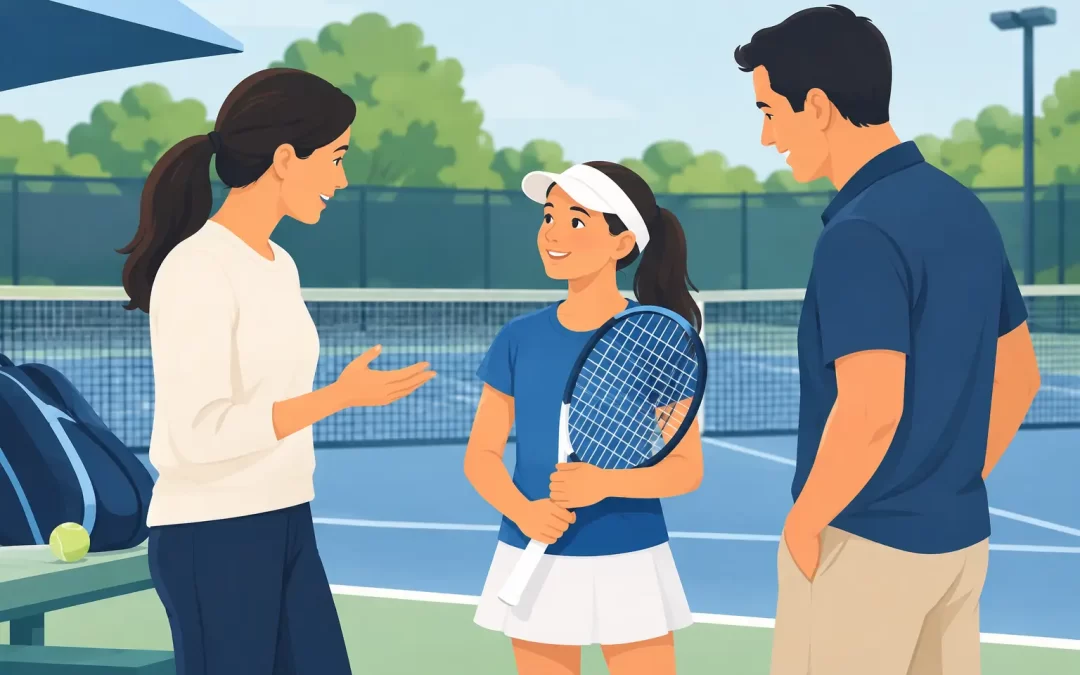
A junior can leave the court after a hard three-set match needing very different things from a parent: a ride home, a meal, a quiet moment, or a focused conversation. What they do not need is an instant technical review in the parking lot. This tennis parent communication guide is built around a simple performance principle: the way parents communicate can strengthen a player’s confidence, accountability, and long-term development – or quietly weaken all three.
Parents are essential to junior tennis. You provide the investment, transportation, schedule, encouragement, and stability that make consistent training possible. But competitive improvement requires each person to stay in the right role. The coach develops the player. The player learns to own the work. The parent creates the environment where that work can happen.
Define Roles Before Results Create Pressure
Confusion usually begins when a loss, a plateau, or a tournament problem creates urgency. A parent sees effort, expense, and potential, then naturally wants answers. The risk is stepping into technical or tactical coaching without a complete view of the player’s training plan, physical readiness, and developmental stage.
A productive parent does not need to be passive. They need to be purposeful. Your role is to reinforce habits, observe patterns, ask strong questions, and communicate relevant information to the coach. The coach’s role is to diagnose performance, set priorities, and build progression. The player’s role is to prepare, compete, reflect, and follow through.
This division matters because junior players receive enough input already. If the coach says one thing, a parent adds a different correction, and the player tries advice from teammates or social media, the result is often hesitation. Tennis rewards committed decisions. A player who is thinking about five technical cues rarely competes freely.
Let the Coach Set the Technical Priority
One week, a player may be working on recovery steps after the serve. Another week, the focus may be height and margin over the net from the backhand corner. Those priorities can look small to someone watching matches, but they may be part of a larger progression.
When you notice an issue, describe what you saw rather than prescribing the fix. “She looked rushed on short balls in the second set” gives the coach useful information. “Tell her to change her grip” may conflict with the work already underway. Observation opens a coaching conversation. Instruction from the sideline can close it.
Build a Better Coach-Parent Communication System
Good communication is not constant communication. It is clear, scheduled, and connected to the player’s goals. Parents should know what the player is developing, what practice habits support that goal, and how progress will be measured. They do not need a play-by-play explanation after every lesson.
Set a regular check-in rhythm with the coach, especially during competitive periods. A brief conversation every few weeks can cover development priorities, training attendance, match patterns, tournament planning, and the player’s mindset. This is far more effective than reaching out only after a disappointing result.
Before contacting a coach, organize your message around facts. Four categories are especially helpful:
- Changes in energy, motivation, health, sleep, or school demands
- Match patterns you observed repeatedly, not one isolated mistake
- Questions about the player’s current goals or training expectations
- Practical scheduling concerns that affect consistency
Keep the message direct. For example: “Over the last two tournaments, he has become frustrated after double faults and rushes the next point. Is this something you are seeing in training, and what language should we reinforce at home?” This gives the coach a real performance pattern to address.
Avoid using the coach as a referee in every emotional moment. A player who is upset about playing time, a lineup decision, or a tough practice may need time to process before adults intervene. If the concern involves safety, respect, unclear expectations, or a recurring issue, raise it promptly and professionally. If it is one difficult day, allow the player to build resilience first.
Include the Player When Appropriate
As juniors mature, they should not be discussed as if they are absent from their own development. For younger players, parent-coach communication will be more direct. For competitive teenagers, the player should increasingly lead conversations about goals, feedback, and tournament lessons.
This shift builds a skill that matters beyond tennis: self-advocacy. Encourage your child to ask the coach, “What should I focus on this week?” or “What did you see in my match that I can train?” A player who can seek feedback calmly is more likely to use it under pressure.
Match-Day Communication: Fewer Words, Better Support
Tournament days can make well-intentioned parents overly active. There are schedules to manage, opponents to watch, weather changes, and emotional swings. The best support is often calm, predictable, and brief.
Before a match, avoid adding last-minute technical reminders. The player should enter the court with one or two simple intentions already established through training, such as competing with high margin or using a clear serve-plus-one pattern. Your job is to help them arrive prepared: water, food, equipment, time, and emotional steadiness.
A useful pre-match question is, “What is your plan for the first few games?” It invites the player to think tactically without placing more pressure on them. If they do not want to talk, respect that. Some players perform better with conversation; others need quiet. Support should fit the player, not the parent’s anxiety.
During the match, follow event rules and keep your body language under control. Players notice every sigh, head shake, whispered critique, and frustrated walk away from the court. Even when no words are spoken, the message can be, “You are disappointing me.” That is a heavy burden for a young competitor.
After the match, start with connection, not analysis. “I love watching you compete” is more valuable than “Why did you keep missing that backhand?” If the player wants to talk, listen first. If they are emotional, give them space to recover before reviewing the match.
Later, one or two reflection questions are enough: “What worked today?” and “What is one thing you want to train next?” This keeps the focus on learning rather than blame. Detailed analysis belongs in the player’s post-match routine and in conversation with the coach, where it can become a specific training plan.
Reinforce Accountability Without Controlling Every Detail
The strongest junior tennis environments balance support with responsibility. Parents should expect commitment, but commitment is more than attending lessons. It includes arriving ready, completing assigned work, recovering well, and maintaining a respectful response to feedback.
Create simple standards at home. Equipment should be packed the night before. The player should know the weekly training schedule. Schoolwork, sleep, nutrition, and recovery should be treated as part of performance, especially for athletes pursuing competitive goals. These habits are not punishment. They teach the player that preparation creates confidence.
At the same time, avoid making every family conversation about tennis. A young athlete needs room to be more than a ranking, a UTR number, or a tournament result. When tennis becomes the only measure of approval, fear of failure grows. A player may protect their ego by avoiding difficult events, blaming conditions, or resisting honest feedback.
Praise controllable behaviors. Recognize the player who stayed composed after a bad call, followed a tactical plan, competed hard when tired, or returned to practice ready to learn after losing. Results matter in competitive tennis, but results are delayed evidence of daily habits.
Handle Disagreement With Discipline
Parents and coaches will not always see every decision the same way. Tournament schedules, training volume, doubles versus singles priorities, and readiness for a higher level can involve real judgment calls. Productive disagreement is possible when both sides stay focused on the player’s long-term development.
Ask for the reasoning behind a recommendation before rejecting it. A coach may advise fewer tournaments because technical changes need practice time. Or the coach may recommend more competition because the player needs to learn how their game holds up under pressure. Neither approach is automatically right. It depends on the athlete’s age, goals, confidence, physical condition, and current development needs.
Address concerns privately, never in front of the player or other families. Do not ask your child to carry messages between adults. That places them in an uncomfortable position and can damage trust in the coaching relationship.
A serious player needs a serious support system. Clear communication gives the coach better information, gives the parent a defined role, and gives the junior the freedom to take ownership. When the adults around a player are calm, aligned, and focused on growth, the athlete can do what matters most: train with purpose, compete with courage, and keep moving forward after every match.