
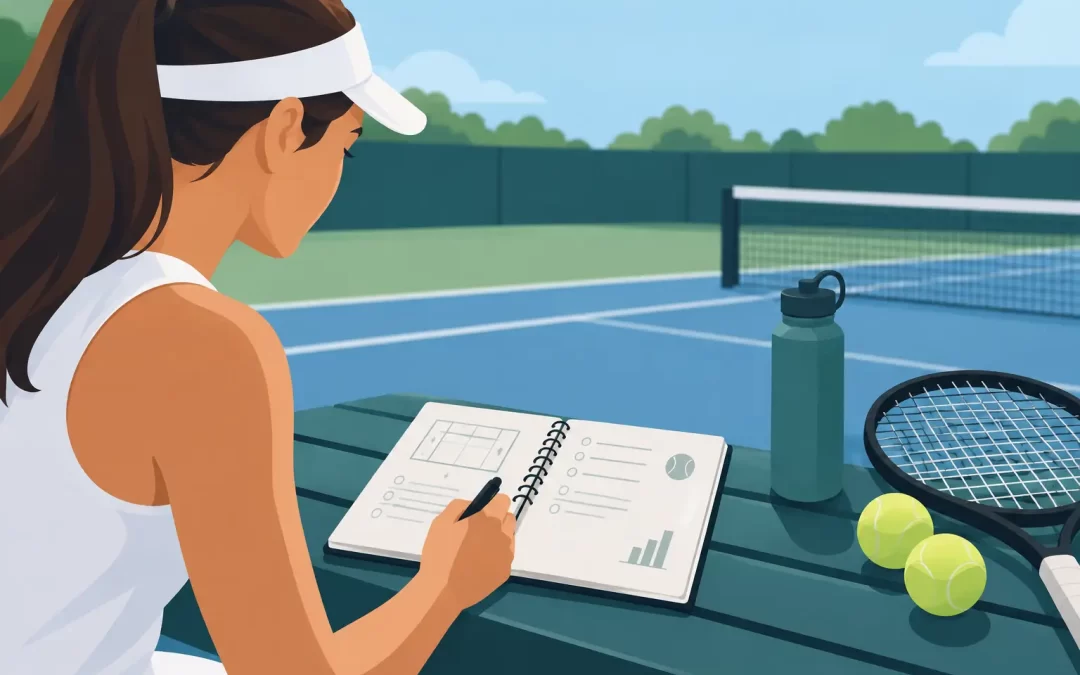
A player can spend two hours on court, hit thousands of balls, and still repeat the same mistakes next week. The difference is often not effort. It is awareness. When you use a tennis practice journal, every lesson, drill, and match becomes information you can apply instead of a memory that fades on the drive home.
For serious juniors, competitive adults, and parents supporting a player’s development, a journal creates the bridge between coaching sessions. It gives practice a purpose, helps players recognize patterns under pressure, and makes progress visible. That matters because tennis improvement is rarely linear. Some weeks the forehand feels reliable. The next week, return errors or poor shot selection can take over. A journal helps identify what changed and what needs attention.
Why a Tennis Practice Journal Produces Better Training
Unstructured practice usually feels productive in the moment. You hit balls, get a workout, and may leave with a few good shots in mind. But without a record, it is difficult to know whether the session improved your game or simply reinforced comfortable habits.
A tennis practice journal creates accountability. Instead of saying, “My backhand was off,” you can identify that backhand errors appeared most often when you were late to high balls, or that you missed crosscourt targets after moving wide. Those are coachable problems. They can become specific priorities for the next session.
It also protects players from judging their development based on one result. A tough loss does not automatically mean your game is getting worse. If the journal shows you served with better placement, competed through long points, and followed your tactical plan for two sets, there is real progress to build on. The score matters, but it is not the only measure of performance.
For players working with a coach, the journal improves communication. A short, accurate record gives your coach a clearer picture of what happened between lessons. That means less time guessing and more time correcting the right technical, tactical, or mental issue.
How to Use a Tennis Practice Journal After Every Session
The most effective journal is simple enough to use consistently. You do not need pages of detailed notes after every practice. You need a repeatable system that takes five to ten minutes while the session is fresh.
Start by recording the date, session type, and your main objective. Session type might be a private lesson, live-ball drill, serve practice, fitness work, match play, or tournament match. Your objective should be narrow. “Improve my game” is too broad. “Keep my return crosscourt against second serves” gives you something you can evaluate.
Then document what you actually did. Record drills, score-based games, serve targets, movement patterns, and any coaching cues that stood out. This is not busywork. Details allow you to revisit a productive drill or recognize that a certain situation keeps exposing a weakness.
Finish with an honest performance review. Use the following categories as your core entry:
- Technical execution: What stroke, movement pattern, or serve skill improved or broke down?
- Tactical decision-making: Did you choose the right targets, patterns, and margins for the situation?
- Mental performance: How did you respond after errors, close games, bad calls, or momentum shifts?
- Physical readiness: Did fatigue, footwork, recovery, or preparation affect your level?
- Next priority: What is the one focus you will carry into the next practice?
Keep your language specific and neutral. Replace “I played terribly” with “I rushed my second-serve return on important points and missed long.” The second statement is useful because it identifies a situation, a decision, and an outcome. It also prevents emotional reactions from becoming your version of the truth.
A Strong Practice Entry
A strong entry might read like this: “Objective: use height and depth to recover when pulled wide. In baseline drills, I succeeded when I loaded my outside leg and aimed three feet inside the crosscourt sideline. In points, I tried to hit too close to the line after wide balls. Mental note: after an error, I moved on faster when I turned away from the court, took one breath, and named the next target. Next practice: defend crosscourt first, then look for the short ball.”
That entry gives the player a clear tactical rule and a mental routine. It also gives a coach something concrete to reinforce.
What to Track in Match Play
Practice reveals habits. Matches reveal whether those habits hold under pressure. Your match journal should therefore focus less on every point and more on the patterns that influenced the result.
Record the score, opponent style, court surface if relevant, and conditions such as wind, heat, or indoor speed. Then review your serve, return, rally tolerance, and decision-making in key moments. Did you protect your second serve? Were you passive on return games? Did you lose points because of execution, poor choices, or emotional impatience?
Pay special attention to the first four shots. Many matches are decided before the rally becomes long. If you serve well but repeatedly miss the next ball, the issue may not be the serve. If your return lands in play but sits short and allows the opponent to attack, you have found a priority for training.
Do not turn your journal into an excuse file. Avoid writing that you lost because the opponent pushed, cheated, got lucky, or had an unusual style. Those factors may be frustrating, but they do not tell you what to train. A competitive review asks a stronger question: What did this match require that I was not prepared to do consistently?
Turn Journal Notes Into a Weekly Plan
The journal becomes valuable when it changes what you do next. At the end of each week, review your entries and look for repeated themes. One poor volley session may be temporary. Three notes about late preparation on high backhands point to a real training need.
Choose one primary technical focus, one tactical focus, and one mental focus for the following week. For example, a player may work on earlier preparation for the backhand, use more crosscourt margin when defending, and reset with a breath after each point. Limiting the number of priorities is critical. Trying to fix six things at once creates confusion and weakens execution.
Match goals should be process-based. A result goal is “win the match.” A process goal is “make 70 percent of first returns,” “use a higher crosscourt ball when under pressure,” or “commit to my between-point routine before every serve.” You cannot control an opponent’s level, but you can control your preparation and competitive behavior.
For families, the journal can be especially helpful when used as a development tool rather than a report card. Parents should encourage honest reflection, not demand perfect entries or critique every loss. The goal is to help the player build ownership. A player who can explain what they are working on becomes more coachable, more resilient, and more independent.
Common Mistakes That Make Journaling Useless
The first mistake is writing too much. A journal is not a diary. If entries take 30 minutes, consistency will disappear. Use short notes with enough detail to guide the next session.
The second mistake is recording feelings without context. Frustration is real, but “I was nervous” is incomplete. Identify when the nerves appeared, what thoughts came up, how your body reacted, and whether you followed your routine. That turns an emotional response into a mental skill you can train.
The third mistake is failing to review the journal. Notes that are never revisited do not create a plan. Schedule a weekly review, even if it takes only ten minutes. Before a lesson, tournament, or serious practice block, read your last few entries and choose the one priority that matters most.
Finally, do not use the journal to chase perfection. Tennis requires adjustment. Some days call for technical work. Other days call for competing, problem-solving, or recovering physically. The journal helps you recognize those needs instead of forcing the same approach every time.
Build the Habit That Supports Better Competition
The best time to write is immediately after practice, while the details are clear. Keep the journal in your tennis bag, use a notes app, or follow a consistent page format in a notebook. The tool does not matter as much as the habit.
At Point of Mind Coaching, structured development is built around more than hitting better strokes. Players need feedback, strategic clarity, and the ability to evaluate their own performance between sessions. A journal supports all three. It turns coaching cues into daily actions and makes your training more intentional.
Start with your next practice. Write down one objective before you step on court, then record one lesson after you finish. That small discipline can change the quality of every session that follows.