
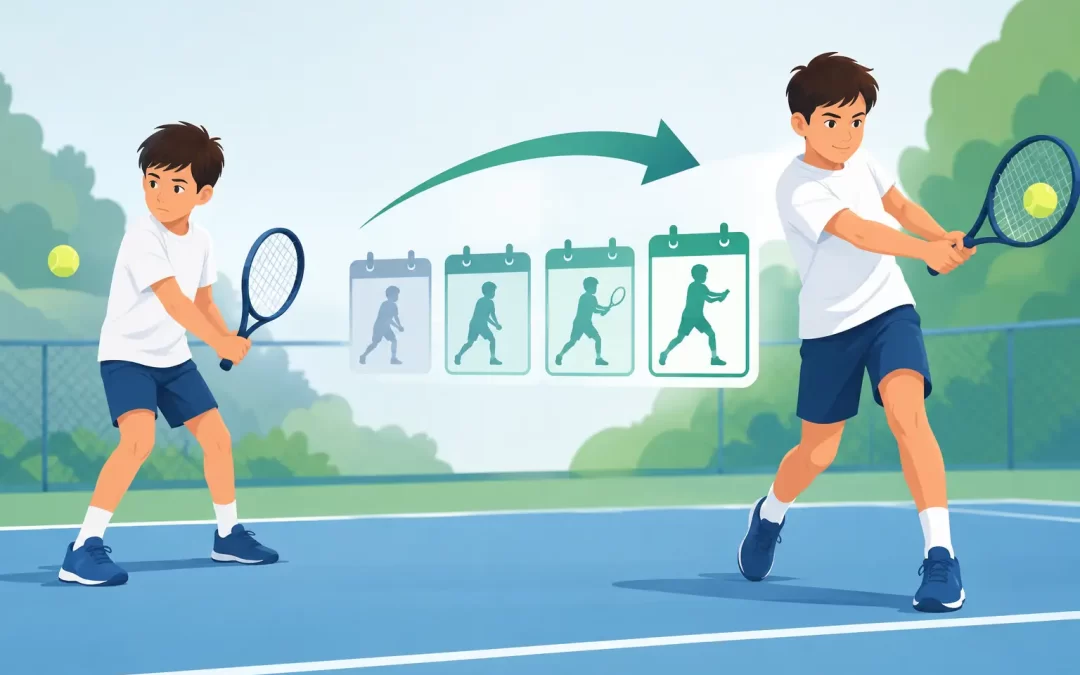
A junior tennis improvement case study should show more than a cleaner forehand. The real question is whether a player can recognize the right ball, move into position, choose a pattern with purpose, and stay composed when the score gets tight. That is where structured coaching separates temporary progress from competitive development.
The following is a representative 12-week case study based on common challenges seen in committed junior players. Details have been adjusted for privacy, but the training framework and performance lessons are practical for parents and players who want a smarter way to train.
The Starting Point: Good Strokes, Unreliable Matches
The player was a 13-year-old competing in local junior events. From the baseline, the player looked capable during lessons: a sound forehand, developing two-handed backhand, and enough athleticism to extend points. Yet match results did not reflect those tools.
The pattern was familiar. Against steady opponents, the player tried to end points too early. When pushed wide, recovery footwork was late. A missed first serve led to a cautious second serve, and one bad game often carried into the next. After matches, the player could usually say, “I made too many mistakes,” but could not explain which mistakes mattered most or what to do differently.
That gap matters. A junior does not improve simply by hitting more balls. Improvement requires feedback that turns observations into priorities, then priorities into repeatable actions.
The initial assessment identified four performance needs: more efficient movement into the ball, a higher-margin rally pattern, a dependable second-serve routine, and a reset process after errors. None of these required rebuilding every stroke. They required structure.
The 12-Week Junior Tennis Improvement Case Study Plan
The training plan combined one focused in-person session each week with guided practice, video review, match reflection, and direct coaching support between sessions. The goal was not to overload the player with technical thoughts. It was to make a few high-value behaviors automatic under pressure.
Weeks 1-3: Create a Baseline and Build Better Habits
The first phase began with measurement. The player tracked first-serve percentage, double faults, unforced errors by wing, and the number of points lost within the first four shots. Match video added context that statistics alone could not provide.
The video showed that many “forehand errors” were actually movement errors. The player was arriving late, contacting the ball too close to the body, and trying to generate pace from an unstable position. The correction was not simply “swing slower.” It was earlier preparation, a more purposeful split step, and a recovery route after each shot.
Practice also changed. Instead of open-ended rallying, sessions included target-based crosscourt drills, controlled direction changes, and recovery-footwork repetitions. The player used a simple cue: move, set, shape. Move early, set the feet, then shape the ball with appropriate margin.
On serve, the priority was a second serve that could be trusted. The player practiced height, spin, and a clear target rather than chasing speed. At this stage, a safer serve was the correct trade-off. A junior who fears the second serve cannot compete freely from the baseline.
Weeks 4-6: Turn Technique Into Patterns
As movement improved, training shifted toward decision-making. The player had been treating every short ball as a winner opportunity. Video review made the cost clear: rushed approach shots, low-percentage line attempts, and poor court positioning at net.
The new rule was simple: earn the attack. A short ball could be used to move the opponent, open the court, or create a comfortable first volley. It did not need to end the point immediately.
This is where juniors often need coaching discipline. Aggression is valuable, but reckless aggression is not competitive confidence. The player began using two primary baseline patterns: crosscourt pressure to the backhand, followed by a forehand into the open court; and a deep ball through the middle when pulled wide, followed by recovery rather than a desperate attempt at a highlight shot.
Weekly match assignments supported the work. The player was asked to identify one pattern used well, one point where shot selection broke down, and one pressure moment handled better than before. That reflection built competitive intelligence. It also moved post-match conversations away from emotion and toward evidence.
Weeks 7-9: Train the Response to Pressure
By the middle of the program, practice consistency was noticeably better. The next test was whether the player could maintain it at 30-all, on a second serve, or after a disputed call.
Pressure training was built into drills rather than saved for tournament day. Games started at 30-all. Serving drills included a consequence for missed second serves. Rally exercises required a set number of deep balls before the player could change direction. These constraints exposed habits that casual hitting can hide.
The mental routine was equally direct. After an error, the player turned away from the court, took one controlled breath, named the next intention, and returned to the line. The routine lasted only a few seconds, but it stopped frustration from deciding the next point.
There was no promise that nerves would disappear. Competitive players feel pressure because the point matters. The goal was to give the player a response that worked while nervous.
Weeks 10-12: Compete With a Clear Identity
The final phase focused on carrying the work into match play. The player entered matches with a short plan: serve with shape to a defined target, build points through the crosscourt pattern, and use recovery footwork after every wide ball. Between points, the reset routine remained non-negotiable.
The player also learned when the plan needed adjustment. Against an opponent with a stronger backhand, the automatic backhand pattern was not the answer. Against a player who stood far behind the baseline, the player needed to use shorter angles and controlled depth changes. Strategy is not memorizing one pattern. It is recognizing what the opponent gives you without abandoning your own strengths.
What Changed After 12 Weeks
The clearest change was not a dramatic increase in winners. It was a reduction in self-inflicted losses. The player made fewer rushed errors, put more second serves in play, and recovered more effectively after being pulled off the court.
Match reflections also improved. Early in the program, the player described losses in broad terms: bad day, poor strokes, nerves. By week 12, the player could identify specific causes: “I stopped using height to the backhand,” or “I rushed my second serve after getting broken.” That awareness is a major step in junior development because it creates ownership.
Confidence changed as well, but not because the player was told to be confident. Confidence came from evidence. The player had practiced difficult situations, reviewed performance honestly, and seen the same patterns work in competition.
What Parents and Players Can Take From This Case Study
The lesson is not that every junior needs the same 12-week plan. A beginner may need more time on basic coordination and contact. An advanced tournament player may need deeper work on return strategy, physical conditioning, and opponent scouting. The right plan depends on age, goals, schedule, and competitive level.
But the principle holds: random practice produces random feedback. A player improves faster when technical work, movement, tactics, mindset, and match review support one another.
At Point of Mind Coaching, that is the purpose of a hybrid development model. In-person instruction establishes the standard, while video analysis, weekly plans, and coach communication help the player apply it between lessons. The work does not stop when the session ends.
Parents should also look beyond the scoreline. A loss can still show progress if a junior uses the right pattern, competes with better body language, and responds productively after errors. A win can hide problems if it comes from an opponent’s mistakes rather than sound decision-making. Results matter, but they should be read alongside behavior and execution.
The next meaningful improvement may not come from adding another hour of random hitting. It may come from choosing one measurable weakness, training it with purpose, and reviewing whether it held up when the score mattered.