
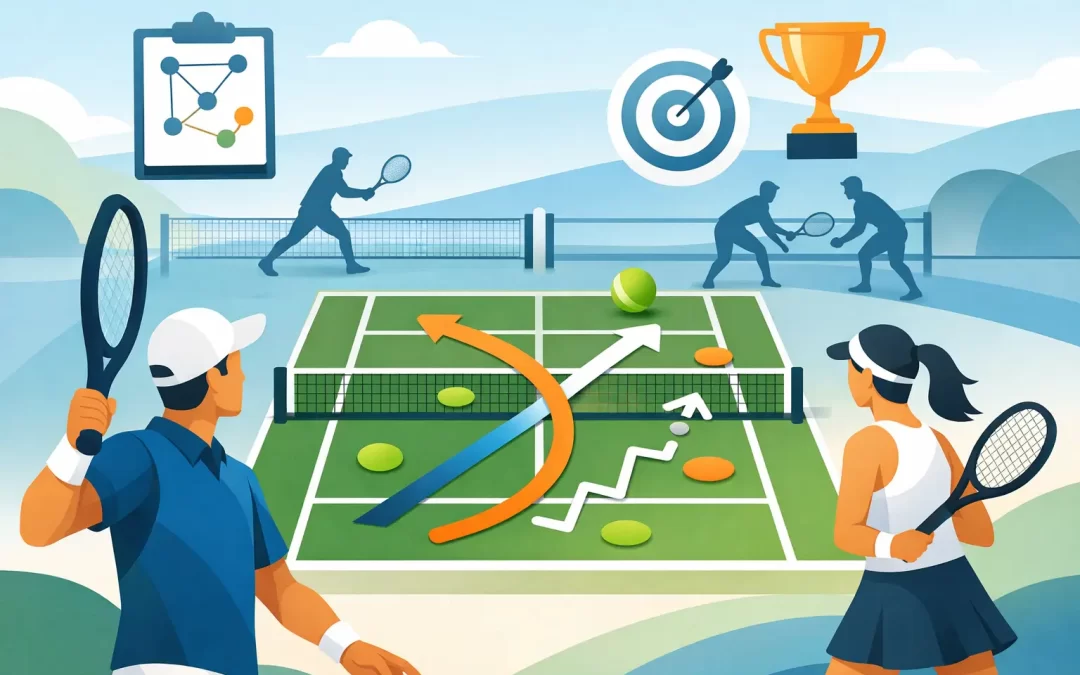
Most players do not lose points because they cannot hit the ball. They lose because they choose the wrong shot at the wrong time, recover to the wrong spot, or try to finish too early. That is exactly why tennis point construction drills matter. They train you to build points with purpose instead of reacting one ball at a time.
If you want to compete stronger, your practice has to teach decision-making, not just repetition. A clean forehand in warm-up means very little if you cannot use it to create space, expose a weakness, or manage a score situation. Point construction is where technical skill becomes match performance.
Why tennis point construction drills change matches
A lot of practice sessions are built around isolated feeds. Crosscourt forehands. Backhand down the line. Volley repetitions. Those drills have value, especially for building fundamentals, but they often stop short of the real problem. Matches are not won by single shots. They are won by patterns, recognition, and discipline.
Tennis point construction drills force you to connect each shot to the next one. You start seeing the court in sequences. Heavy crosscourt to move your opponent. Another ball to the same side to stretch them further. A shorter reply. Then attack the open space. That is a very different mindset from trying to hit a winner as soon as you see daylight.
This matters even more for junior players and competitive adults who feel stuck. If your level has plateaued, it may not be a stroke issue. It may be a structure issue. You need practice that teaches what to do, when to do it, and why.
What good point construction practice should train
Before getting into specific drills, it helps to understand what you are actually trying to improve. Strong point construction usually comes down to five things: direction control, depth, recovery position, shot tolerance, and pattern recognition.
The trade-off is straightforward. If you train only aggressive patterns, you may become dangerous but inconsistent. If you train only neutral rally tolerance, you may become steady but predictable. The best sessions build both. You need to know how to stay in a point, how to create pressure, and how to finish when the right ball appears.
1. The three-ball pattern drill
This is one of the most practical tennis point construction drills because it teaches sequence rather than improvisation. Start a live rally or coach feed with a specific three-ball pattern. For example, ball one crosscourt to establish control, ball two heavier and deeper to the same side, ball three into the open court if the reply is short.
The goal is not just execution. The goal is discipline. Too many players skip the first two balls and rush the third. This drill teaches patience before attack.
You can build several versions based on player level. Beginners may use simple crosscourt-crosscourt-middle patterns. Intermediate and competitive players can work inside-out forehand patterns, backhand line change patterns, or serve plus first-ball combinations. The key is repeating the same pattern enough times that it becomes reliable under pressure.
2. Crosscourt control to line change
A lot of poor decision-making starts with changing direction too early. This drill fixes that. Two players rally crosscourt only until one player receives a short, balanced ball. Only then can that player change down the line and play out the point.
This drill teaches an essential competitive lesson: direction changes should be earned. If you try to redirect a deep, heavy crosscourt ball while stretched or late, the error rate rises fast. But when you get the right ball, the line change becomes high percentage and effective.
For players who struggle with shot selection, this drill builds trust in the idea that point construction is not passive. It is selective. You are not waiting and hoping. You are building toward a moment you can actually use.
Tennis point construction drills for offense and defense
Not every point starts with offense. Sometimes smart construction means surviving a difficult position and resetting the rally. Players who only practice attack patterns often panic when they are pulled wide or forced back.
That is why your drills should include transition moments, not just ideal setups.
3. Defense to neutral drill
Start with one player on defense. Feed or rally the first ball wide, deep, or high to put that player in trouble. Their objective is not to counterattack immediately. Their first job is to recover the point to neutral with height, depth, and margin.
Once the rally becomes neutral, both players can build and play out the point live. This teaches emotional control as much as tactical control. Under pressure, many players go for too much because they hate feeling defensive. Strong competitors know how to absorb pressure first and rebuild the point.
If you coach juniors, this drill is especially valuable. Young players often equate confidence with aggression. Real confidence is making the right decision, even when the right decision is a heavy, deep reset ball.
4. Wide ball plus recovery drill
This drill focuses on one of the most overlooked parts of point construction: what happens after the shot. Feed a player a ball that pulls them off the court. They hit crosscourt or down the line based on the pattern, then must recover to the correct position before the next ball.
The purpose is to connect movement and tactics. A good shot with bad recovery still loses points. If you hit a strong crosscourt ball from the alley and recover straight to center without accounting for angles, you leave the court exposed. If you hit down the line and fail to close the space behind the shot, you create the next problem yourself.
This drill helps players stop treating recovery as conditioning. Recovery is strategy.
5. Serve plus two drill
The serve starts the point, so it should start your construction training too. In this drill, the server must play a specific pattern off the serve and first rally ball. For example, deuce side serve wide, first ball to the opposite open court. Or body serve, then first ball heavy to the backhand corner.
This is one of the best ways to turn practice into match improvement quickly. It gives players a repeatable plan for pressure moments. Instead of stepping to the line hoping the serve does damage on its own, they begin to understand the serve as the first move in a larger sequence.
For recreational players, even one reliable serve pattern can change results. For tournament players, you need patterns for different opponents and score situations. A safe pattern at 30-all may be different from an aggressive one at 15-40.
6. Score-based pattern play
Some drills fall apart because they ignore the scoreboard. But point construction changes with context. A pattern that works well at 40-15 may be reckless at 30-30.
Set up live points with score constraints. On big points, the player must use a designated high-percentage pattern before opening the point up. On advantage points, they may be allowed one aggressive direction change if they have earned it. This teaches players to connect tactics to risk management.
It also reveals a lot about mental habits. Some players become too passive under pressure. Others speed up and force offense. Score-based point construction drills expose those tendencies and give coaches something specific to correct.
7. Pattern recognition games
This is where training becomes more advanced. Instead of telling the player exactly what to do, you give them a scenario and ask them to identify the right pattern. Maybe the opponent has a weak backhand on the run. Maybe they defend well crosscourt but leave space when pulled short angle. The player has to recognize the opening and build the point accordingly.
This type of work matters because matches are not scripted. You need structure, but you also need adaptable intelligence. Great competitors are not just technically sound. They read what is happening and make disciplined adjustments.
At Point of Mind Coaching, this is the difference between training strokes and training performance. One builds tools. The other teaches when to use them.
How to use tennis point construction drills in a weekly plan
If you do all of these drills in one session, quality usually drops. A better approach is to assign a clear focus to each practice. One day might center on crosscourt tolerance and line changes. Another on serve plus first-ball patterns. Another on defense to neutral and recovery decisions.
Video review can help here. A player may think they are losing because of unforced errors, but film often shows that the real issue started earlier with poor court position or a bad target choice. That kind of feedback turns generic practice into targeted development.
You should also match the drill to the player. Beginners need simpler patterns and larger targets. Intermediate players benefit from live constraints and decision rules. Competitive players need score pressure, opponent-specific adjustments, and more accountability around execution.
The standard is not perfection. The standard is clarity. Can you explain the pattern? Can you recognize when to use it? Can you execute it often enough to trust it in a match?
That is what smart training looks like. When your practice teaches you how to organize a point, not just strike a ball, your game becomes more stable, more confident, and much harder to break down. The player who wins more is usually not the one hitting harder. It is the one making better decisions one shot earlier.