
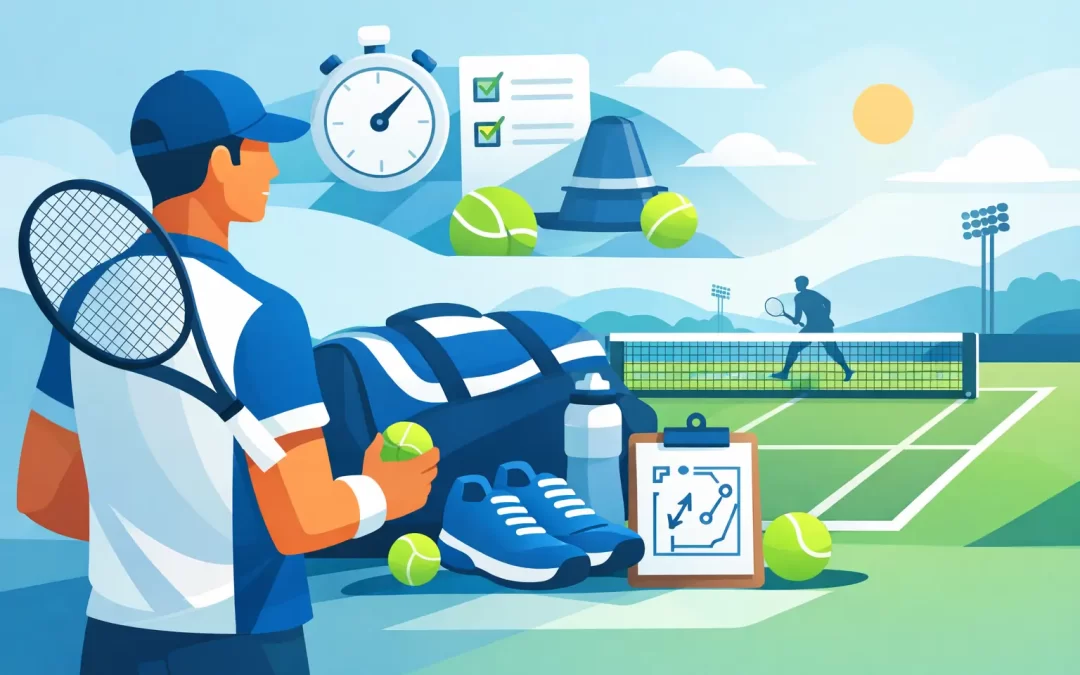
A match is often decided before the warm-up begins. Players who arrive rushed, uncertain of their plan, or physically flat spend the first few games trying to find themselves. This tennis match preparation guide gives you a repeatable system to arrive clear, ready, and prepared to compete from the first point.
Preparation is not about creating a perfect feeling. You will not always feel loose, confident, or fully energized. The objective is to control the factors you can control: your physical readiness, tactical clarity, equipment, routines, and response to pressure.
Build Your Tennis Match Preparation Plan Early
Your preparation should begin several days before the match, not in the parking lot. The closer you get to competition, the less you should chase major technical changes. A last-minute attempt to rebuild your serve, overhaul your backhand, or add a new return position usually creates doubt rather than improvement.
Instead, use the days before a match to reinforce your highest-percentage patterns. If your forehand crosscourt is your most reliable rally ball, build confidence in it. If your first serve is inconsistent, focus on rhythm, targets, and a loose throwing motion rather than power. Competitive tennis rewards the player who can execute familiar patterns under stress.
The training load matters. A demanding player may benefit from a sharper practice two or three days before the match, followed by a lighter session that includes movement, serves, returns, and point play. A recreational player with limited court time may simply need one purposeful hit that restores timing. It depends on your fitness level, recent workload, and how your body responds to competition.
Do not confuse exhaustion with preparation. You want to enter a match feeling trained, not drained.
Practice the Patterns You Expect to Use
A productive pre-match practice includes more than clean groundstrokes from the baseline. Rehearse situations that will show up under pressure: serving at 30-30, returning a second serve, defending a deep ball, approaching behind a strong forehand, and recovering after a short ball.
Give each practice a tactical purpose. For example, you may decide that your first four balls after the serve need to be played through the opponent’s backhand, or that you will use more height and margin when defending. These decisions make your match plan practical. “Play aggressive” is too vague. “Use my crosscourt forehand to create a shorter ball, then attack to the open court” is a usable pattern.
If you know your opponent, review what has happened in previous matches without becoming obsessed with it. Identify one or two tendencies: perhaps they struggle with high balls, protect their backhand corner, or rush when forced to hit extra shots. Then decide how your own strengths can test those areas. Your plan should be simple enough to remember when the score gets tight.
The Night Before: Remove Friction
The night before is not the time for a long, emotional strategy session. It is a time to organize the details that can distract you the next day. Pack your bag, confirm the match location and start time, check the weather, and know how long travel and parking may take.
Bring more than you think you will need. An avoidable equipment problem can pull attention away from the match. Your bag should include spare strings or a backup racquet if available, grips, water, electrolytes, a towel, sun protection, and simple foods you know your stomach handles well. If you play outdoors, prepare for changing conditions instead of hoping the forecast stays perfect.
Sleep helps, but one restless night does not ruin a match. Many players create unnecessary anxiety by staring at the clock and calculating every lost minute. Your job is to give yourself the best opportunity to rest: reduce screens, eat a familiar dinner, hydrate steadily, and use a short wind-down routine. If sleep is imperfect, accept it and compete anyway. Discipline is often the ability to perform without ideal conditions.
Match-Day Fuel, Timing, and Arrival
Arrive early enough to settle in, but not so early that you sit around for an hour and lose your energy. For most players, getting to the site 30 to 45 minutes before a scheduled match provides enough room to check in, use the restroom, assess the court, and begin a deliberate warm-up. Tournament procedures and travel distance may require more time, so plan accordingly.
Eat familiar food. Match day is not the time to test a new energy drink, a heavy restaurant meal, or a supplement a teammate recommends. Choose a meal that gives you energy without leaving you sluggish, then keep easy snacks available if the match is later in the day. Sip fluids consistently rather than waiting until you are thirsty.
When you arrive, notice the conditions. Is the court fast or slow? Is the wind pushing toward one baseline? Is the sun affecting the toss on one side? These details are not excuses. They are information that should shape your targets, margins, and shot selection.
Use a Warm-Up That Prepares You to Compete
A proper warm-up progresses from general movement to tennis-specific actions. Begin by raising your body temperature with light jogging, skips, lateral movement, and controlled dynamic mobility. Your goal is not to stretch aggressively. Your goal is to prepare your hips, ankles, shoulders, and trunk to move explosively and safely.
Then activate the movement patterns you need on court. Include split steps, short acceleration, deceleration, crossover recovery, and a few shadow swings. Players often warm up their strokes but ignore the footwork that allows those strokes to work under pressure.
During the on-court warm-up, start with control. Find the center of the strings, use shape over the net, and establish your feet before trying to hit big. Gradually add depth, direction, serves, returns, and a few transition balls. The warm-up is not a contest to impress the opponent. It is an assessment period.
Pay attention to what your body and the ball are telling you. If your forehand feels late, give yourself more space and use extra net clearance early in the match. If your serve is not firing, choose safer first-serve targets and commit to competing behind your second serve. Adjusting intelligently is a strength, not a sign that you are unprepared.
Prepare Your Mind for the First Pressure Point
The first few games carry emotional weight because players want immediate proof that they will play well. Let that go. Your only goal is to establish a strong process: active feet, clear targets, margin over the net, and committed decision-making.
Before the match begins, choose a few performance cues. Keep them short and physical, such as “split early,” “use height,” or “breathe and commit.” Avoid cues that create a negative picture, like “don’t miss” or “don’t double fault.” Under pressure, the mind responds better to a clear action than a warning.
You also need a reset routine for mistakes. After an error, turn away from the court, take one controlled breath, relax your hand on the racquet, and decide what the next point requires. The routine should be brief. A missed backhand is feedback, not a verdict on your level.
For juniors, parents can support this process by keeping pre-match communication simple. Avoid a long list of technical reminders on the ride to the court. Ask the player what they want to focus on, reinforce effort and composure, and let the match belong to them. Players develop confidence when they learn to solve problems independently.
Make Tactical Adjustments Without Panicking
Your initial strategy is a starting point, not a contract. If the opponent is handling your preferred pattern comfortably, adjust one variable at a time. Change the height, depth, pace, direction, or court position. Do not abandon your identity after two missed shots.
If you are being rushed, create more time with height and depth. If your opponent is camped far behind the baseline, consider a shorter ball or a well-timed net approach. If they are serving bigger than expected, prioritize a deep return through the middle before attempting a low-percentage winner. Competitive intelligence is the ability to see what the match is asking for and respond with discipline.
Between points, stay with the same sequence: recover physically, reset emotionally, then plan tactically. This prevents the score from controlling your behavior. Whether you are up 5-2 or down 2-5, the next point still requires the same attention.
A strong match does not begin when you feel fearless. It begins when you arrive organized, trust your preparation, and commit to the next ball with purpose. Build that routine often enough, and confidence stops being something you wait for. It becomes something you earn.