
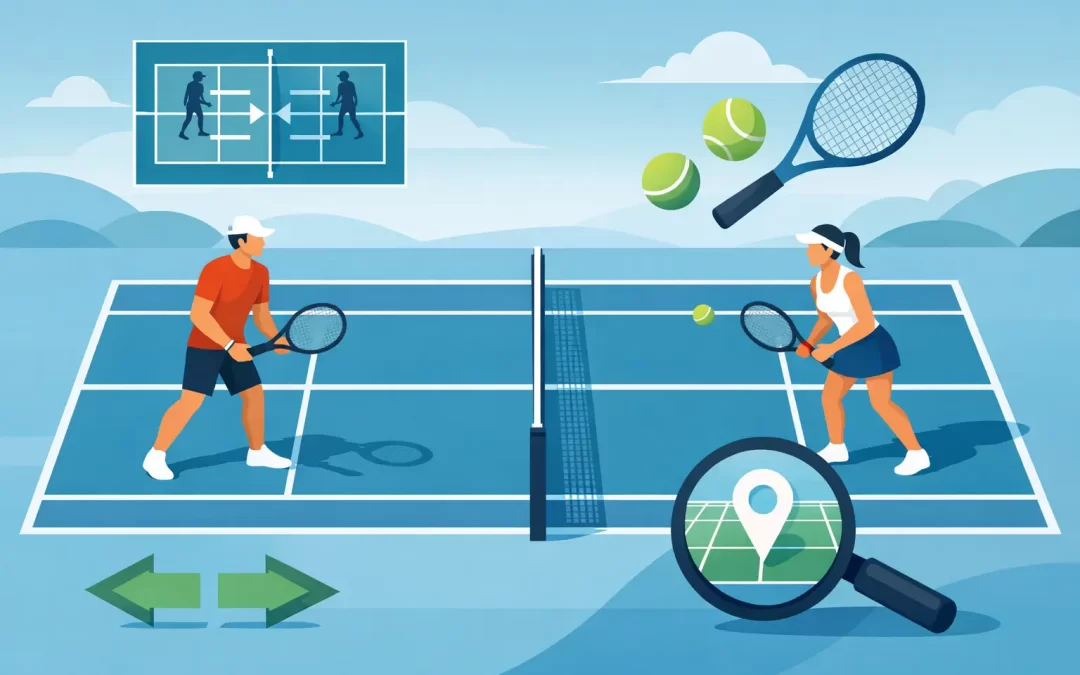
A player can strike a clean forehand and still lose control of the point before the next ball arrives. The difference is often what happens after contact. This tennis court positioning guide gives you the framework to recover with purpose, take away your opponent’s highest-percentage options, and arrive balanced for the ball that matters next.
Positioning is not standing in one perfect spot. It is a sequence of decisions based on your shot, your opponent’s location, the ball’s speed, and the pattern you are trying to create. Players who understand this stop chasing the court. They begin controlling it.
Start With the Recovery Position
Your recovery position is where you move after hitting the ball, not where you wait randomly between shots. The right position is rarely the exact center of the court. It shifts according to the direction and quality of your previous shot.
If you hit crosscourt from the baseline, recover slightly toward the side where you sent the ball. A crosscourt ball gives your opponent more available court on the crosscourt return, so your position should protect that larger, more likely target. If you hit down the line, recover more toward the middle because you have opened the crosscourt angle for your opponent.
This is a simple rule with major match consequences: recover toward the opponent’s most dangerous reply, not toward the spot that feels comfortable.
A strong recovery position also requires a split step. As your opponent makes contact, land on the balls of your feet with your base stable and your body ready to move in either direction. Without that timing, even correct court positioning becomes too slow to use.
Tennis Court Positioning Guide: The Three Court Zones
Every player needs to recognize three basic areas: behind the baseline, the baseline zone, and the transition zone near the service line. Each area has a different purpose.
Behind the baseline: Defend and rebuild
When you are pushed deep or receiving a heavy ball, give yourself room. Standing two to five feet behind the baseline can provide the time needed to create height, depth, and control. This is not passive tennis when used correctly. It is intelligent defense.
From this position, your first goal is not to hit a winner. Your goal is to send a ball that prevents your opponent from attacking again. Aim deep through the middle or play a high, heavy crosscourt ball that buys recovery time. Trying to redirect a difficult ball down the line from a defensive position is often a low-percentage decision.
At the baseline: Control the rally
The baseline is where most competitive points are built. Here, your job is to maintain a balanced position that lets you handle balls on both sides without overcommitting.
Against a neutral ball, stay close enough to take the ball at a comfortable contact point, but far enough back to handle depth. Many players stand on the baseline regardless of the incoming ball. That creates rushed contact against pace and leaves short balls untouched. Read the depth early. Move back for deep balls, then move forward decisively when the ball lands short.
Inside the baseline: Take time away
A shorter ball is an invitation, not an automatic green light for a winner. When you move inside the baseline, your advantage is time. You can take the ball earlier, direct it to a target, and force your opponent to defend.
The best option depends on your balance. If you arrive early and stable, attack with a firm, controlled ball to an open area or into your opponent’s weaker side. If you are stretched or late, play a strong approach shot with margin rather than forcing a low-percentage finish. Good positioning creates options. Good decision-making selects the right one.
Position Yourself Based on Ball Direction
The direction of your shot changes the geometry of the court. This is where many recreational players lose points they should control.
When you hit crosscourt, recover toward the same half of the court because the crosscourt reply is both easier and safer for your opponent. If you send a forehand crosscourt from the deuce side, do not sprint all the way back to center. Shade toward your forehand side while staying prepared for the down-the-line change.
When you hit down the line, recover closer to center. Your opponent now has a wide crosscourt angle available, and the middle position helps you cover both the open angle and the possible down-the-line reply.
This does not mean moving in exaggerated patterns after every ball. Small, efficient adjustment steps are usually enough. The goal is to close the highest-percentage space without leaving yourself vulnerable to the next obvious option.
Know When to Move Forward
Players often hear that they should attack the net more. That advice is incomplete. You should move forward when your shot puts your opponent under pressure and limits their passing options.
A deep approach shot, a ball driven to the opponent’s weaker side, or a short ball that pulls them wide can justify a move to the net. But your first volley position matters. Do not charge directly into the service line and stand there. Move forward, split as your opponent hits, and adjust based on their contact point.
If your approach lands short or sits up in the middle, expect a difficult passing shot. In that situation, avoid crowding the net too quickly. A slightly deeper volley position may give you more reaction time and a better chance to make the first volley solid.
At net, your position should reflect the opponent’s location. If they are wide, close the angle by moving toward the side where they can create the most dangerous pass. If they are stretched behind the baseline, take an assertive position and be ready to finish the next ball. If they have time and balance, respect their ability to pass or lob.
Doubles Positioning Requires Clear Priorities
In doubles, court positioning is shared responsibility. The biggest mistake is treating two players as separate singles players standing side by side.
When your partner serves, the net player should be active, alert, and ready to intercept balls that travel through the middle. The server must recover quickly enough to protect the open court after the serve. When returning, the returner should prioritize a deep, controlled return, while the partner at the net starts near the service line and reacts to the return’s quality.
The middle is especially important in doubles. A ball through the center often causes confusion, reduces sharp angles, and can expose weak communication. Call short balls, lobs, and switches early. Positioning improves when both players understand not only their own job, but also what their partner is trying to cover.
Use Positioning to Manage Pressure
Under pressure, players tend to retreat too far, recover too slowly, or stand frozen in the middle after hitting a big shot. Competitive positioning requires emotional discipline. A missed shot does not mean the next ball needs to be forced. A winning shot does not mean you can admire it.
Build a simple between-shot routine: hit, recover, split step, read. Repeat it until it becomes automatic. This keeps your attention on the next decision rather than the last result.
Video review can be particularly valuable here. Many players believe they are recovering to center, moving forward aggressively, or covering the correct angle. On video, they often see late recovery steps, unnecessary distance, and poor spacing between shots. Identifying one repeated positioning error can change the quality of an entire match.
Train Court Positioning With Purpose
Positioning will not improve through random hitting alone. In practice, use constraints that force better recovery habits. Play crosscourt-only rallies and require each player to recover toward the likely reply. Practice approach-and-volley patterns where the first volley must be made from a balanced split step. In baseline drills, alternate deep defensive balls with short attacking balls so players learn to recognize when to retreat and when to move forward.
For match play, choose one positioning objective at a time. You might focus on recovering after every down-the-line shot, taking short balls inside the baseline, or using a split step before every opponent contact. Measurable focus creates accountability, and accountability creates change.
Point of Mind Coaching builds this kind of tactical awareness into structured player development because smarter movement is not separate from better tennis. It is what allows your technique, strategy, and confidence to hold up when the score gets tight.
The court will always feel smaller when you are late and larger when you are prepared. Learn to recover with intention, and every ball becomes less of a scramble and more of an opportunity to compete stronger.