
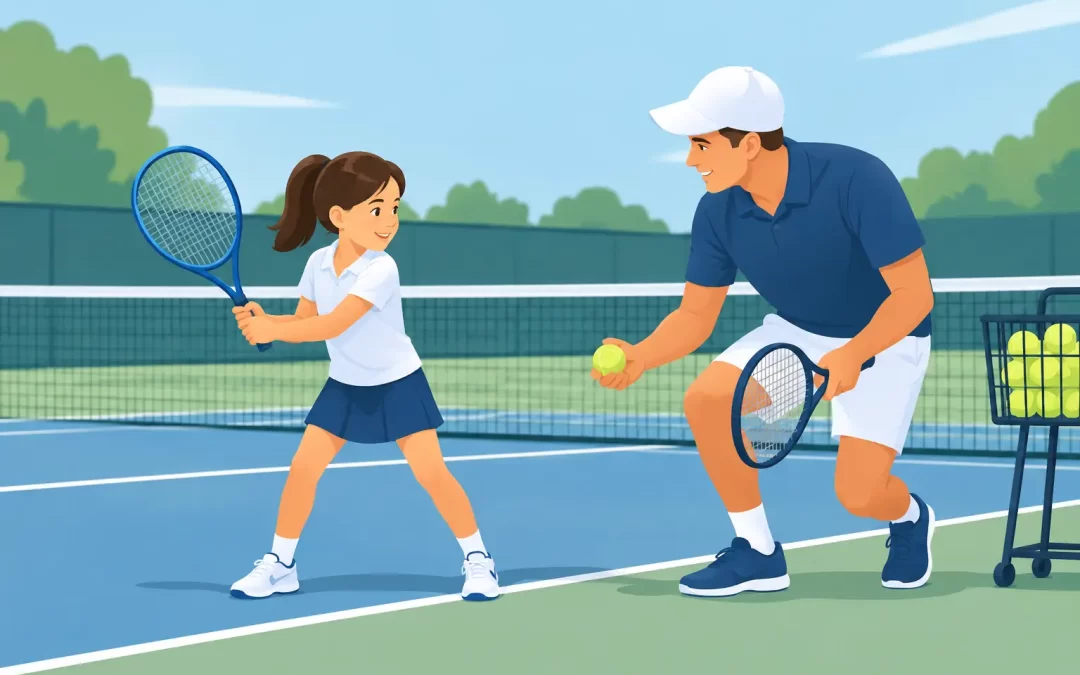
A child does not need a perfect forehand to begin learning tennis. They need curiosity, enough attention to follow simple direction, and an environment that makes them want to come back. For parents asking when should kids start tennis coaching, the better question is not simply, “What age?” It is, “What kind of coaching will help my child build confidence and real foundations?”
Starting too late is rarely the problem. Starting with the wrong expectations can be. Young players who are pushed into adult-style drills, long technical lectures, or constant scorekeeping may lose interest before they discover the fun of striking the ball, moving well, and solving problems on the court.
When Should Kids Start Tennis Coaching?
Most children can begin age-appropriate tennis instruction between ages 4 and 6. At this stage, coaching should feel active and engaging. The goal is not to create a finished player. It is to develop coordination, balance, tracking skills, basic racket control, and a positive relationship with practice.
A child who begins at 4 will not necessarily become a stronger player than one who begins at 8. Early exposure helps, but quality matters more than the calendar. A focused 8-year-old in a structured program can progress quickly, while a 5-year-old who is not ready for instruction may benefit more from movement games and occasional play.
For many families, ages 6 to 9 are an excellent window to begin consistent coaching. Children at this age can usually follow routines, listen to short corrections, understand simple goals, and start building the habits that support long-term development. They can learn to rally, serve with an appropriate ball and court size, recover to position, and begin recognizing where to hit the ball.
By ages 9 to 12, players who enjoy tennis and want to improve can move into a more deliberate training process. This is where technical development, athletic movement, tactical awareness, and mental habits should begin working together. A player does not need to be nationally ranked to train with purpose. They simply need a plan that matches their commitment and current level.
Readiness Matters More Than a Specific Birthday
Age gives parents a starting point, but readiness determines whether coaching will be productive. A young child does not need to stand still for an hour or execute perfect technique. They should, however, be able to engage with a coach, participate safely, and recover emotionally when a ball does not go where they wanted.
Look for a few practical signs. Your child may be ready for tennis coaching if they can focus on a game or activity for short periods, enjoy throwing or catching, respond to basic instruction, and show interest in hitting a ball. They should also be comfortable participating without needing to win every activity.
The strongest signal is often simple: they ask to play again.
That enthusiasm gives a coach something valuable to build on. Tennis requires repetition, and repetition only works over time when a young player feels ownership of the process. A child who is excited to return to the court is more likely to develop the resilience needed for later technical and competitive challenges.
What Good Coaching Looks Like for Young Beginners
The first stage of tennis coaching should not be a line of children waiting to hit one ball at a time. Young players need movement, frequent contact, encouragement, and clear goals. They should be using equipment that fits their size and skill level, including shorter rackets, low-compression balls, and appropriately sized courts.
These adaptations are not shortcuts. They allow children to learn the actual game earlier. When a ball bounces at a manageable height and moves at a manageable speed, a child can swing with better timing, learn to judge distance, and experience the satisfaction of a rally.
A quality beginner program teaches more than strokes. It introduces athletic posture, balance, hand-eye coordination, court awareness, and simple decision-making. Instead of telling a child to “hit harder,” a coach may teach them to send the ball over the net with shape, move back to a ready position, or aim into open space.
The language matters. Clear, simple cues help young athletes learn without overthinking. Positive feedback should be specific as well. “Great effort” is encouraging, but “You moved your feet before the ball bounced” teaches a player what to repeat.
When to Move From Fun Exposure to Structured Training
Tennis should remain enjoyable at every level, but enjoyment and structure are not opposites. Once a child is attending consistently, rallying with control, and asking to improve, it is time to add more direction to the training process.
This often happens between ages 7 and 10, though every player develops differently. A child may be ready for more structured coaching when they can practice a skill with intention, accept correction without shutting down, and understand that improvement comes from repeated effort. They may also begin showing interest in match play, local events, or keeping score.
At this point, random lessons are usually not enough. Players benefit from a clear progression: what they are working on now, why it matters, and what comes next. Technical work should connect to movement. Movement should connect to tactics. Tactics should connect to how the player manages pressure and makes decisions in a match.
For example, a player learning a forehand should not only learn the shape of the swing. They should learn when to use that forehand crosscourt, when to recover, and how to avoid rushing after an error. That is how fundamentals become usable tennis.
Avoid the Two Common Mistakes
The first mistake is waiting for a child to become “naturally good” before investing in coaching. Tennis is a learned skill. Coordination and athletic instincts can help, but players improve through instruction, repetition, feedback, and purposeful practice. A child does not need obvious talent to deserve good teaching.
The second mistake is treating early coaching as a race. Some parents see another child competing often and assume their child needs the same schedule. But more matches, more lessons, and more pressure do not automatically produce better development. Too much competition before a player has confidence in their movement, technique, and emotional control can create frustration.
The right pace depends on the player. A highly motivated 9-year-old may be ready for more frequent practice and guided match play. Another 9-year-old may thrive with one or two sessions per week and plenty of time to build skills without pressure. Progress should be measured by consistency, effort, learning, and growing independence, not only by wins.
How Often Should Young Players Train?
For a beginner under age 8, one or two coached sessions per week is usually enough. The priority is consistent exposure and positive momentum. Short practice at home, such as bounce drills, coordination games, or simple racket-and-ball control, can reinforce what they learn on court without making tennis feel like a chore.
As a player becomes more serious, two to three training sessions per week can create stronger results. This is especially helpful when those sessions have distinct purposes: technical development, movement and rally skills, and supervised point play. Players who want to compete may eventually need additional practice, fitness work, and match experience, but volume should increase gradually.
Parents should pay attention to energy, attitude, and recovery. A tired player who dreads practice is not building a sustainable competitive foundation. A challenged player who still wants to improve is usually in the right environment.
The Parent’s Role in Long-Term Development
Parents do not need to become second coaches. In fact, young players often develop better when parents provide support without turning every ride home into a post-match analysis.
Ask questions that keep the focus on learning: “What did you work on today?” “What felt easier?” “What do you want to practice next time?” These questions help children reflect without making every session a test.
Consistency also matters. Arriving on time, bringing the right equipment, encouraging good sleep, and respecting the training plan all reinforce discipline. Over time, a player learns that progress is not based on one great lesson or one bad match. It is built through steady work and honest feedback.
At Point of Mind Coaching, that long-term view is central to player development. Young athletes need more than occasional technical corrections. They need a structured path that develops fundamentals, movement, strategy, confidence, and the ability to compete with composure.
Give Your Child Room to Grow
The best time to begin is when your child is ready to engage, not when outside pressure says they should. Start with coaching that makes tennis accessible, active, and rewarding. Then, as interest and commitment grow, give them a training structure that turns effort into measurable progress.
A young player does not need to have their future mapped out. They only need the right first experience: a coach who sees where they are now, a process that challenges them appropriately, and enough encouragement to step onto the court ready to try again.