
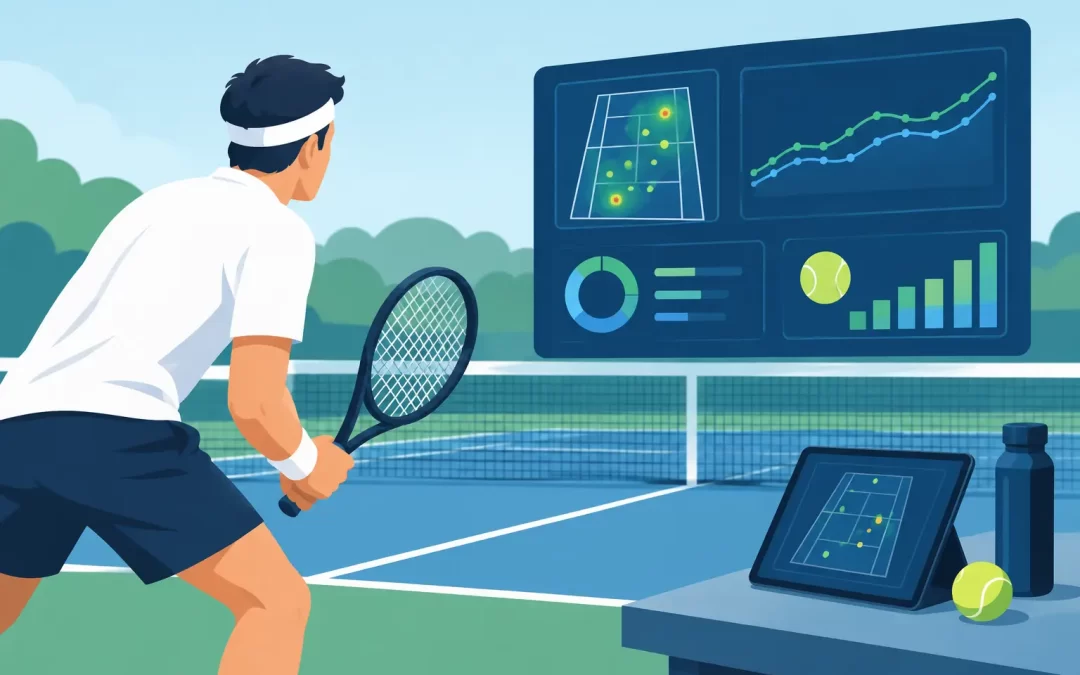
Most players can tell you whether they won or lost. Fewer can explain why the match turned. Tennis analytics closes that gap. It turns a vague reaction – “I missed too much” or “my serve was off” – into evidence a player and coach can use to train with purpose.
For committed juniors, competitive adults, and parents investing in development, this matters because improvement is rarely limited by effort alone. Players often practice hard while repeating the wrong priorities. They hit hundreds of forehands when the real issue is a weak second serve, poor return positioning, rushed shot selection, or a pattern that breaks down at 30-all.
What Tennis Analytics Should Actually Measure
Analytics is not about collecting every number available. A stat that does not influence a training decision is just decoration. The most valuable data reveals what happens in the moments and patterns that shape a match.
Start with a few performance areas: serve effectiveness, return effectiveness, rally tolerance, errors by situation, and point outcomes under pressure. These categories show where a player earns control, where control disappears, and whether the player is choosing high-percentage options.
A player may finish with more winners than their opponent and still lose comfortably. Why? Perhaps they gave away too many second-serve points, missed returns in the ad court, or forced low-margin shots after gaining a neutral ball. The scoreboard tells the result. Good analysis explains the chain of decisions behind it.
Serve and Return Numbers Carry Extra Weight
The serve begins roughly half the points in a match, and the return begins the other half. That makes these phases a practical starting point for almost every player.
Track first-serve percentage, first-serve points won, second-serve points won, double faults, and the direction of both serves. On return, record returns in play, return depth, points won against first and second serves, and whether the return gave the opponent an immediate advantage.
The key is to read these numbers together. A high first-serve percentage is not automatically a strength if those serves sit in the middle of the box and opponents attack them. A lower percentage may be acceptable if the player earns more free points and protects the second serve well. Context matters more than one impressive stat.
Rally Data Reveals the Player’s Real Identity
Rally length is useful because it exposes a player’s tolerance and tactics. Does the player win short points but lose neutral rallies? Do they become impatient after four balls? Are they allowing opponents to dictate with the same crosscourt pattern repeatedly?
Break points into simple rally bands: 0-4 shots, 5-8 shots, and 9 or more shots. Then examine what happens in each band. A player who loses most points after five shots may not need a new stroke. They may need better recovery position, more height over the net, improved movement under fatigue, or permission to stay patient until the right ball appears.
How to Use Tennis Analytics Without Losing the Feel for the Game
Tennis is not played from a spreadsheet. Players still need instincts, courage, athleticism, and the ability to respond when a match becomes unpredictable. Data should sharpen those qualities, not make a player robotic.
The right approach is to connect one or two numbers to a clear tactical objective. If a player wins only 35 percent of second-serve points, the next training block might focus on three priorities: a more reliable second-serve shape, a first-ball pattern after the serve, and calmer decisions when the return comes back deep. The goal is not merely to raise a percentage. The goal is to build a point structure the player trusts under pressure.
Video makes this process even more valuable. A match chart may show that backhand errors rise late in sets. Video can reveal whether the player is arriving late, hitting from a poor contact zone, over-swinging, or attempting the wrong target. Numbers identify the problem area. Video and coaching help diagnose the cause.
A Simple Match-Analysis Process for Serious Players
A disciplined process does not need to be complicated. After each meaningful match, record the score, opponent style, surface, conditions, and a focused set of statistics. Add brief notes on momentum shifts: What happened when the match changed? Which patterns felt stable? Which situations created hesitation?
Then review the match within 24 hours, while the details are still clear. Do not begin by judging your effort or replaying every missed shot. First identify the two biggest reasons you won or lost. They should be specific enough to train.
For example, “I need to be more consistent” is too broad. “I missed seven second-serve returns long because I stood too close and rushed the swing” is actionable. So is, “I won most extended crosscourt rallies but gave up short balls by recovering too far behind the baseline.”
From there, build the next week around one primary performance goal and one supporting goal. A player who needs stronger return games might spend one session on return footwork and compact contact, then use practice sets to apply a return target on every second serve. Progress comes from repeated execution in conditions that resemble competition.
The Metrics That Matter Most Under Pressure
Pressure points deserve their own review because players often perform differently when the score tightens. Track break points, game points, tiebreak points, and points played at 30-all or deuce. You do not need a large sample from one match. Over several matches, trends become visible.
Look for decision patterns. Does the player become passive and leave short balls in the middle? Do they suddenly try for lines? Do they rely on a serve they have not trained enough to trust? Pressure does not create a completely new player. It exposes habits that have not been tested or corrected.
Mental training belongs in the analytics conversation for this reason. If the data shows a drop in first-serve percentage on break points, the answer is not automatically technical. The player may need a repeatable between-point routine, a clearer serve target, and more practice serving with consequences. Confidence grows when preparation gives the player something dependable to do.
Common Mistakes Players Make With Match Data
The first mistake is overreacting to one match. A single poor serving day may reflect wind, a tough returner, fatigue, or a small sample of points. Look for patterns across multiple matches before making major technical changes.
The second is tracking outcomes without tracking decisions. An unforced error count is useful, but it becomes far more useful when you know the target, court position, rally ball, and score situation. A missed forehand after a strong approach is different from a missed forehand attempted from three feet behind the baseline with no opening.
The third is using analytics only after losses. Wins can hide weaknesses because confidence and favorable matchups cover them. Review successful matches too. Find the patterns worth protecting and the areas that could fail against a stronger opponent.
Finally, avoid comparing your numbers blindly to professional tennis. Professional benchmarks can provide perspective, but age, level, surface, style, and opponent quality all change what a productive number looks like. Your best benchmark is your own developing standard: Are you winning a higher share of second-serve points? Are your return errors dropping? Are you executing your primary pattern more often in close sets?
Turn Evidence Into a Training Plan
The value of tennis analytics appears when it changes the work between matches. A coach can use the information to organize technical drills, movement work, point-play constraints, video review, and mental routines around the player’s highest-impact needs.
At Point of Mind Coaching, structured feedback is designed to prevent the gap between a lesson and a match from becoming wasted time. The player needs to know what to practice, how to measure it, and how that work supports better decisions when the score is tight.
The strongest players do not chase perfect statistics. They build awareness, choose smarter patterns, and train their weaknesses until those weaknesses stop deciding matches. Start with the numbers that explain your last match, then let your next practice prove what you are ready to change.