
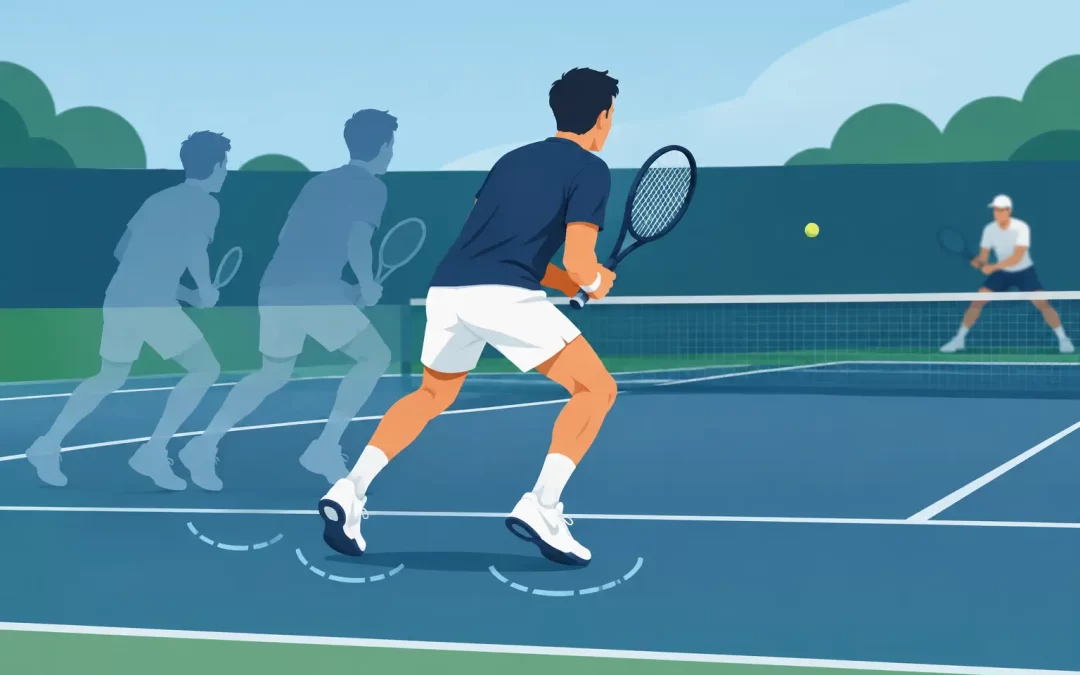
The split step is not a jump you perform because a coach told you to. It is the moment that prepares your body to react. When it is late, even quick players feel slow. When it is early, they get stuck flat-footed. To improve tennis split step timing, you must learn to coordinate your landing with your opponent’s contact, then build that habit under the speed and pressure of real points.
For juniors, competitive players, and committed adults, this is one of the highest-value movement skills to train. Better split step timing improves first-step speed, balance on wide balls, recovery after your own shot, and confidence when a point becomes fast. It also gives your strokes a more stable foundation because you arrive to the ball under control instead of reaching from a poor position.
Why Split Step Timing Changes Everything
A split step is a small, controlled hop or unweighting action. You land with your feet about shoulder-width apart, knees flexed, and body centered enough to push in either direction. The purpose is simple: your feet briefly leave the ground so they can load and drive toward the next ball.
The mistake is treating it as a fixed rhythm. Tennis is not a metronome. A heavy crosscourt forehand, a short slice, a serve, and a quick volley all demand slightly different movement patterns. The consistent principle is not the height of the hop. It is the relationship between your landing and the opponent’s strike.
In most baseline exchanges, aim to land just as the opponent contacts the ball. That gives you visual information about direction, height, and pace while your legs are prepared to move. At net, the timing is often more compact because reaction windows are shorter. On return of serve, you may use a subtle split as the server makes contact, but your ready position and first movement must remain efficient rather than overly bouncy.
A late split step produces a familiar problem: you recognize the ball correctly but cannot move cleanly because your feet are still in the air. An early split step creates a different problem: you land, wait, and lose the elastic energy needed for the first push. Both errors cost time. At a competitive level, time is the point.
The First Cue: Land on Contact, Not on the Bounce
Many players unconsciously time their split step to the ball bouncing on their side. By then, the decision is already too late. Your opponent has shown you the shot at contact, and the ball is already traveling toward you.
Make the opponent’s contact your trigger. As you recover after your shot, track the opponent’s preparation. When their racket begins the forward swing, begin to unweight. As the strings meet the ball, land and move.
This cue can feel difficult at first, especially when you are focused on recovering to the center or watching the ball after your own shot. That is why movement training must include attention training. You are not only teaching your legs a pattern. You are teaching your eyes and brain to recognize a meaningful event sooner.
For players who tend to watch their own shot too long, use a simple internal command: “Hit, recover, split.” Your shot is finished. Your next responsibility is positioning for the opponent’s reply. That shift in focus alone can make your court coverage look more disciplined.
Use the Right Split Step for the Situation
There is no benefit in making every split step large. Excess movement wastes energy and can delay your first step. Strong movers use the smallest action that prepares them for the ball they expect.
From the baseline, use a compact hop with quiet feet. Your heels may lift slightly, but the goal is not height. Keep your chest balanced over your hips and avoid leaning forward so far that you cannot push backward for a deep ball.
When you are inside the court or approaching the net, the split step may be more of a quick bounce or a staggered landing. You need to stop your forward momentum enough to react, but not so much that you lose the ability to continue through the next volley. On a wide defensive recovery, you may not have time for a textbook hop. A quick re-centering step and a loaded outside leg can serve the same purpose.
This is an important distinction for match play: good timing is not robotic. It is adaptable. The standard is whether your feet are organized when the opponent strikes, not whether every split step looks identical on video.
Drills That Build Better Split Step Timing
Start with a simple shadow sequence before adding a ball. Stand near the baseline and imagine hitting a forehand. Recover with two or three controlled steps, call out “contact” as an imaginary opponent strikes, make a small split step, and take your first move to either side. Repeat on both wings. This develops the rhythm without the distraction of stroke mechanics.
Next, use a cooperative rally. One player feeds or rallies from the baseline while the other says “split” quietly at the moment the hitter makes contact. The moving player must land on that cue and then respond to the ball. Switch roles after several minutes. The verbal cue makes the timing visible and creates immediate feedback.
A coach or training partner can then add direction uncertainty. Rally from the middle of the court, with the feeder alternating balls to forehand and backhand without a predictable pattern. The player should focus on three actions: recover, watch the opponent’s forward swing, and land at contact. Do not chase perfect shots during this drill. The movement quality is the priority.
For more advanced players, train the skill with an attack-and-recover pattern. Hit an approach shot, move forward, split as the opponent contacts the passing shot, and react to the volley or first defensive ball. This exposes a common weakness: players often rush toward the net but fail to organize their feet before the opponent’s response.
Video review is especially useful here. Record from behind the player or from the side. Pause at the opponent’s contact. Are both feet still moving through the air? Did the player land much earlier and become static? Is the first step efficient, or is there an extra adjustment before movement begins? Small timing errors are difficult to feel but easy to identify on film.
Common Problems That Keep Players Late
The first problem is admiring your shot. A player hits a strong forehand, stays tall, and watches to see if it lands near the line. That moment of hesitation makes recovery late. Commit to moving immediately after contact, even when you believe you have hit a winner.
The second is recovering to a fixed spot instead of reading the rally. The center mark is a reference, not a place to stand regardless of the ball. If you send your opponent wide, recover in a position that protects the most likely reply. If you are pulled off the court, your first goal may be to regain balance before a full recovery. Smarter court positioning makes the split step more effective because you are starting from a better location.
The third is excessive tension. Players who tighten their shoulders, jaw, and hands often make stiff, loud split steps. Their legs cannot react freely because the entire body is braced. Stay athletic. Your landing should be light enough that you can immediately push, not heavy enough that it announces itself across the court.
Finally, do not confuse fast feet with rushed feet. Some players bounce constantly between shots, believing activity equals readiness. Constant hopping can blur the moment that matters. A purposeful split step has a clear trigger and a clear first move.
Take Split Step Timing Into Match Play
Do not try to fix this skill by thinking about it before every ball in a match. Choose one performance cue for a set or practice tiebreak: “Land on contact.” Keep it short. Between points, assess whether you were organized before the opponent hit, not whether you won the point.
If you are often late, begin your recovery sooner after your own shot. If you are early, make the hop smaller and delay it slightly. If you struggle only against pace, train with faster feeds and live points rather than repeating slow, predictable patterns. The correction depends on the source of the breakdown.
At Point of Mind Coaching, movement work is treated as part of a complete development system. Technical training, video feedback, tactical awareness, and competitive mindset all affect whether a player arrives prepared for the next ball.
Build the split step into every rally, return drill, and net session until it becomes automatic. The goal is not to think about your feet forever. The goal is to make your feet respond on time, so your attention is free to construct the point, trust your movement, and compete stronger.