
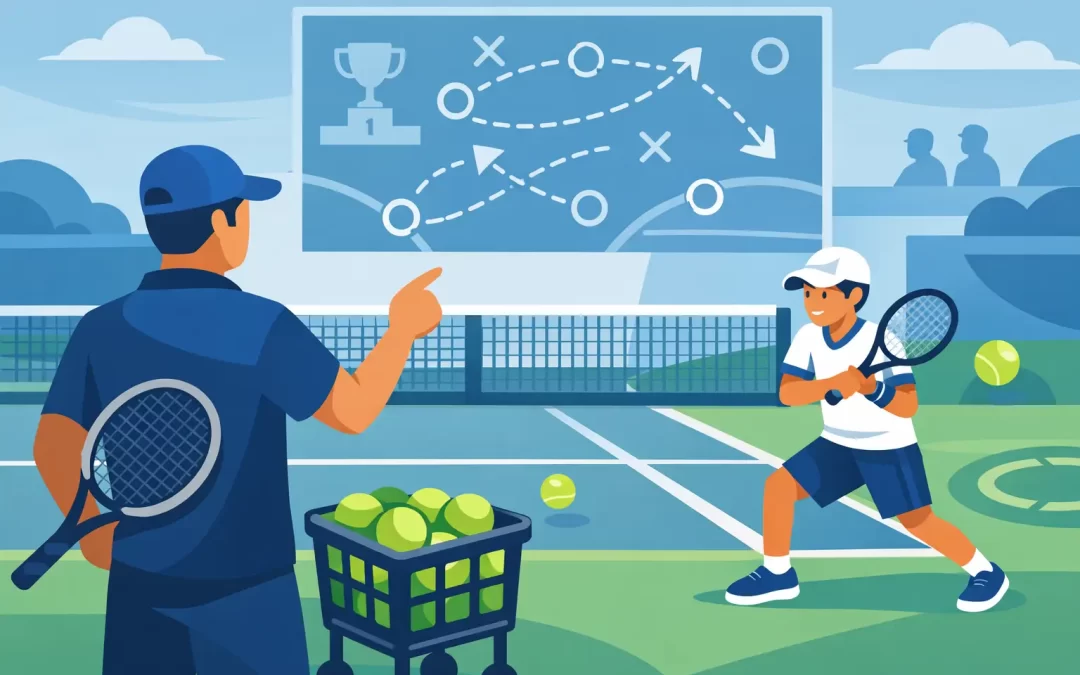
A junior can hit clean forehands for an hour and still struggle to win a match. The difference is often not effort or athleticism. It is decision-making. Tactical tennis coaching for juniors teaches players how to recognize what is happening on the court, choose higher-percentage plays, and stay composed when the score creates pressure.
For parents, this is the stage where development can feel confusing. Your child may look strong in lessons but become tentative, rushed, or predictable in competition. That gap does not close through random match play alone. It closes when technical training, movement, strategy, and mental habits are organized around the way points are actually won.
Why Junior Players Need Tactical Training
Junior tennis is often taught in pieces. A player works on a forehand one day, serves the next, and plays points at the end of practice without a clear purpose. Strokes matter, but a stroke is only valuable when a player knows when, where, and why to use it.
Tactical development gives a young player a framework for competition. Instead of simply trying to hit harder, they begin asking better questions: Is my opponent comfortable on the backhand side? Am I missing because I am aiming too close to the line? Should I attack this short ball or build the point one more shot? Those questions turn tennis from a series of reactions into a game of intentional choices.
This matters at every level. A beginner may need to learn that keeping the ball deep through the middle is smarter than attempting a low-percentage winner. An intermediate player may need to identify when an opponent is pulled wide and vulnerable to the open court. A competitive junior may need to build patterns that hold up against stronger opponents who can expose weak decisions quickly.
The goal is not to make juniors robotic. Great tactical coaching gives them options, then teaches them how to select the right one under pressure.
Tactical Tennis Coaching for Juniors Starts With Patterns
The best junior players do not enter every rally hoping for a perfect shot. They understand repeatable patterns that create favorable situations. A pattern may be as simple as serving wide from the deuce court and playing the next ball into open space. It may be using a heavy crosscourt forehand to move an opponent before changing direction down the line.
Patterns reduce uncertainty. When a player has a clear first-ball plan after the serve or return, they are less likely to panic at important moments. They do not need to invent a point from scratch at 30-30. They can rely on trained habits.
Coaching should introduce these patterns at the player’s current level. Younger or newer players need simple objectives: recover to the middle, send the ball safely crosscourt, and avoid giving away short balls. More advanced juniors can work on serve-plus-one sequences, return positioning, transition play, and using height, spin, pace, and direction to disrupt an opponent’s rhythm.
A tactical plan must also fit the player. A fast, aggressive junior may thrive by taking the ball early and controlling the baseline. A player with consistency and speed may be more effective extending rallies, changing height, and forcing errors. There is no single winning style. There is only a style that uses the player’s strengths while improving the areas that limit results.
The Four Decisions Behind Every Ball
Tennis decisions become clearer when juniors learn to evaluate four variables: the incoming ball, their court position, the opponent’s position, and the score.
A deep, fast ball may call for a neutral response rather than an aggressive attack. A short ball with time to set up may invite the player forward. If the opponent is recovering late, hitting behind them can be more effective than automatically aiming for the open court. At 40-0, a player may have more freedom to use a higher-risk play. At break point, a reliable pattern is usually the better choice.
This is competitive intelligence. It is not about playing cautiously. It is about understanding when aggression is earned and when patience wins the point.
Practice Must Look More Like Match Play
Many juniors train with excellent energy but little transfer to competition. They can execute drills because they know where the next ball is going. In a match, the ball is unpredictable, the opponent has a plan, and every mistake affects the score.
A structured practice plan bridges that gap. Technical drills should establish sound mechanics, but they need to progress into live-ball exercises with targets, score pressure, recovery requirements, and specific tactical goals. For example, a player may begin by drilling crosscourt forehands, then play a game where every rally must start crosscourt before either player changes direction. The constraint teaches patience, ball control, and recognition of the right attacking ball.
Serve training should go beyond placing balls in the service box. Juniors need to practice serving to a target and playing the next ball with purpose. Return training should include reading the serve, choosing a safe return target, and recovering quickly for the next shot. These details decide close sets.
Competition-based drills should also create consequences. If a player misses a tactical target, the coach can stop the point and ask what they saw, what choice they made, and what option offered a better percentage. This is not criticism for its own sake. It builds the reflection skills players need when a coach cannot step onto the court during a match.
Video Review Turns Matches Into Useful Feedback
A match can feel emotional and confusing immediately afterward. Video makes it specific. It shows whether a junior consistently gives up short balls, stands too far behind the baseline, returns serve into the opponent’s strength, or rushes between points after an error.
The purpose of video review is not to pick apart every mistake. A player does not need ten corrections at once. They need one or two priorities that can change their next training block.
For example, a coach may notice that a player loses most short-ball opportunities because they approach without a plan for the next volley. The next phase of training can focus on recognizing the short ball earlier, approaching to a higher-percentage target, and closing the net with balanced footwork. That is measurable progress, not vague advice to “be more aggressive.”
At Point of Mind Coaching, video feedback and weekly structure support the work that happens between in-person sessions. Juniors improve faster when tactical lessons are reinforced, reviewed, and practiced with clear expectations rather than left to memory.
Confidence Is Built Through Preparation, Not Pep Talks
Confidence in junior tennis is often misunderstood. It is not pretending to feel fearless. It is trusting that you have trained for the situation in front of you.
A player who knows their return target on a big point feels more stable than a player who is merely told to relax. A junior who has rehearsed a between-point routine can reset after a double fault instead of carrying frustration into the next game. Tactical clarity supports emotional control because it gives the player something productive to focus on.
Simple routines work best. After each point, the player can turn away from the court briefly, take a controlled breath, decide on the next-point intention, and move back into position with purpose. The routine will not erase nerves, but it prevents nerves from controlling the next decision.
Parents can support this process by shifting post-match conversations away from wins and losses alone. Ask what pattern worked, where the opponent caused problems, and what the player would adjust next time. This helps juniors become students of the game rather than judges of themselves.
What Progress Should Look Like
Tactical growth is visible before it always appears in a win-loss record. A junior may start recovering to better court positions, miss fewer returns, recognize short balls earlier, or stop forcing low-percentage shots when frustrated. Those are meaningful signs that match awareness is improving.
Over time, results usually follow because the player gives away fewer free points and competes with a clearer plan. Still, development is not linear. A player may initially lose while learning a new return position or committing to a more disciplined rally pattern. That does not mean the adjustment is wrong. It means coaching must track performance carefully and distinguish productive discomfort from a plan that needs revision.
The strongest junior competitors are not those who have every answer at age 12 or 15. They are the players who learn how to observe, adjust, and compete with discipline. Give your junior a training process that teaches those habits, and every match becomes more than a test of talent. It becomes a chance to make smarter decisions and compete stronger.