
A player looks sharp in practice, then falls apart in matches. Another improves fast for three weeks, then stalls. Most of the time, the problem is not effort. It is training design. When players and parents compare private lessons vs group tennis training, they are really asking a better question: what type of coaching creates consistent progress?
The right answer depends on the player’s level, goals, learning style, and competitive demands. Private lessons can accelerate correction and sharpen details quickly. Group training can build repetition, movement, decision-making, and live pressure in ways private sessions often cannot. Serious development usually is not about choosing one forever. It is about knowing what each format does best and using it with purpose.
Private lessons vs group tennis training: what actually changes
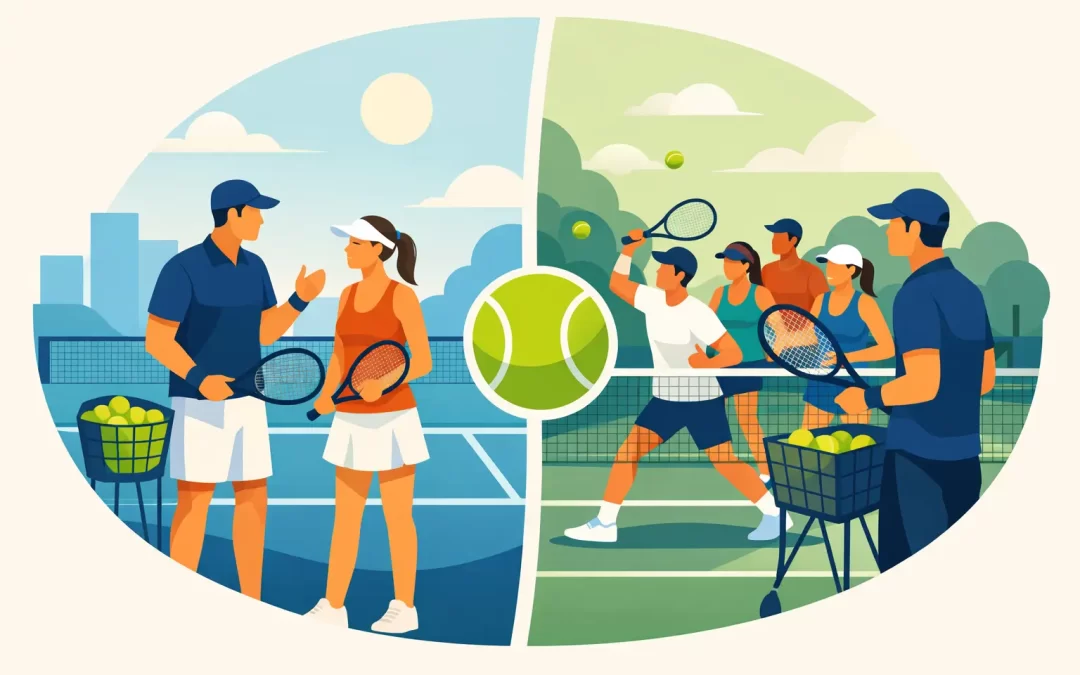
Private lessons give the coach full control over the session. Every minute is shaped around one player’s mechanics, habits, strengths, and weaknesses. If a forehand breaks down under pace, the coach can isolate that pattern immediately. If the serve toss drifts or the return position is too passive, the correction happens in real time, without waiting for a turn in line.
That level of attention matters because technical issues in tennis are rarely random. They are usually connected to footwork, spacing, timing, decision-making, or confidence. In a private session, the coach can trace the source of the problem instead of just addressing the result. That is one reason private coaching often feels faster and more precise.
Group training changes the environment. Instead of one player getting constant feedback, several players work through drills, points, movement patterns, and competitive scenarios together. This creates a different kind of value. The player must read the ball, recover, compete for space, manage tempo, and respond to pressure while others are doing the same. Tennis is not performed in isolation, and group settings expose habits that private lessons can miss.
Neither format is automatically better. They train different parts of development.
When private lessons are the better choice
Private lessons are strongest when a player needs targeted change. Beginners often benefit because they are building foundations that should be clean from the start. Grip, swing path, stance, contact point, and basic court positioning are easier to organize before bad habits become normal.
Intermediate players also gain a lot from private work, especially if they have reached a plateau. This is the stage where many players hit plenty of balls but keep repeating the same mistakes. They may look active in drills but still struggle with serve consistency, rally tolerance, or point construction. A private session can slow the game down enough to identify what is costing them results.
For competitive players, private lessons become even more valuable when the issue is specific. Maybe the second serve breaks under pressure. Maybe short balls are not being attacked correctly. Maybe the player is technically capable but chooses the wrong shot at key moments. High-level improvement is often about small adjustments with large consequences. That kind of detail usually requires individual coaching.
Private coaching also helps players who need accountability. Some athletes work hard in a group, but others hide inside it. In a one-on-one setting, there is nowhere to drift. The standard is clear, the feedback is direct, and the player learns exactly what needs to improve next.
The trade-off is equally important. Private lessons can become too controlled if they are not connected to match play. A player may strike the ball beautifully in a basket drill and still make poor decisions in live points. Technical progress without competitive application is incomplete progress.
When group tennis training makes more sense
Group training is often underestimated by players who think more individual attention always means better development. That is not how tennis works. Many players do need repetition, but they also need adaptation. They need to move, react, compete, and solve problems with less coach intervention.
That is where group work becomes powerful. It builds pattern recognition and pressure tolerance. It teaches players to recover between shots, track opponents, manage pace changes, and respond when a rally becomes uncomfortable. These are not side skills. They are central to winning matches.
For juniors, group training can be especially effective because it adds energy and competitive structure. Players learn to raise their level around others, not just in front of a coach. For adults, groups often create more live-ball volume and more realistic point play than a private session alone.
There is also a practical advantage. Group training usually allows players to train more often at a lower cost per session. Frequency matters. One excellent lesson a week can help, but improvement tends to speed up when players get repeated exposures to the right patterns, tactical situations, and performance demands.
Still, group training has limits. If the coach is managing multiple players, detailed correction will naturally be less frequent. Players with major technical flaws may not get enough individual intervention. And if the group lacks structure, players can leave tired but not improved. Volume is not the same as development.
Private lessons vs group tennis training for different player types
A beginner usually needs a strong technical base first. That does not mean every session must be private, but some individual instruction early on can prevent months of confusion. Once the basics are stable, group training becomes more useful because the player can apply those skills in movement and point situations.
An intermediate recreational player often needs both clarity and repetition. Many adults fall into a cycle of casual hitting, occasional lessons, and inconsistent match results. They improve more when private coaching identifies the priority problem and group sessions give them enough reps to own the adjustment.
An aspiring tournament player needs even more balance. Competitive tennis demands mechanics, patterns, fitness, emotional control, and decision-making under stress. Private lessons help clean up technical leaks and sharpen tactical planning. Group training puts those tools under speed and pressure. If either piece is missing, performance becomes unstable.
Parents deciding for a junior should look past the simple question of cost. The better question is whether the training is building a system. Is the child learning correct technique? Are they practicing patterns that transfer to matches? Are they getting feedback between sessions? Are confidence and competitive habits developing too? The format matters, but the structure behind it matters more.
The smartest approach is usually hybrid
For serious players, private lessons vs group tennis training is often a false choice. The strongest development model combines both.
Private coaching handles diagnosis and precision. It gives players direct feedback on strokes, movement habits, tactical blind spots, and mental patterns. Group training handles application. It asks the player to execute with other bodies on the court, changing rhythms, score pressure, and less time to think.
That combination is where progress becomes more reliable. A player learns what to fix, practices it with purpose, and then tests it in realistic situations. Add video review, weekly planning, and coach communication between sessions, and improvement stops feeling random. It becomes organized.
This is especially valuable for players who have talent but inconsistent results. They do not just need more court time. They need the right feedback loop. One precise private session can set the technical direction. One strong group session can reveal whether the change holds up when the environment gets messy.
A structured hybrid model is often the fastest way to improve because it closes the gap between lessons and real competition. That is a core reason many committed players are moving away from lesson-only training and toward a more complete coaching system.
How to decide what you need right now
Start with the problem, not the format. If your mechanics are breaking down, your serve is unreliable, or you need direct correction, private lessons are likely the priority. If you strike the ball well in practice but struggle to compete, recover, or make decisions in points, group training may be the missing piece.
Then look at your schedule and commitment level. Two group sessions per week may help more than one private lesson every other week. On the other hand, one focused private lesson paired with structured practice can create more improvement than several unfocused group classes.
Finally, be honest about your goals. If you want casual exercise and social play, group training may be enough. If you want measurable progress, stronger match results, and a clearer path forward, your training should include individual feedback somewhere in the plan. Players in New Rochelle, Westchester, and New York who are serious about long-term development often benefit most from coaching that blends technical instruction, tactical training, and support between sessions.
Better tennis is not built by guessing. It is built by matching the right training environment to the right developmental need, then showing up consistently enough for that work to compound.