
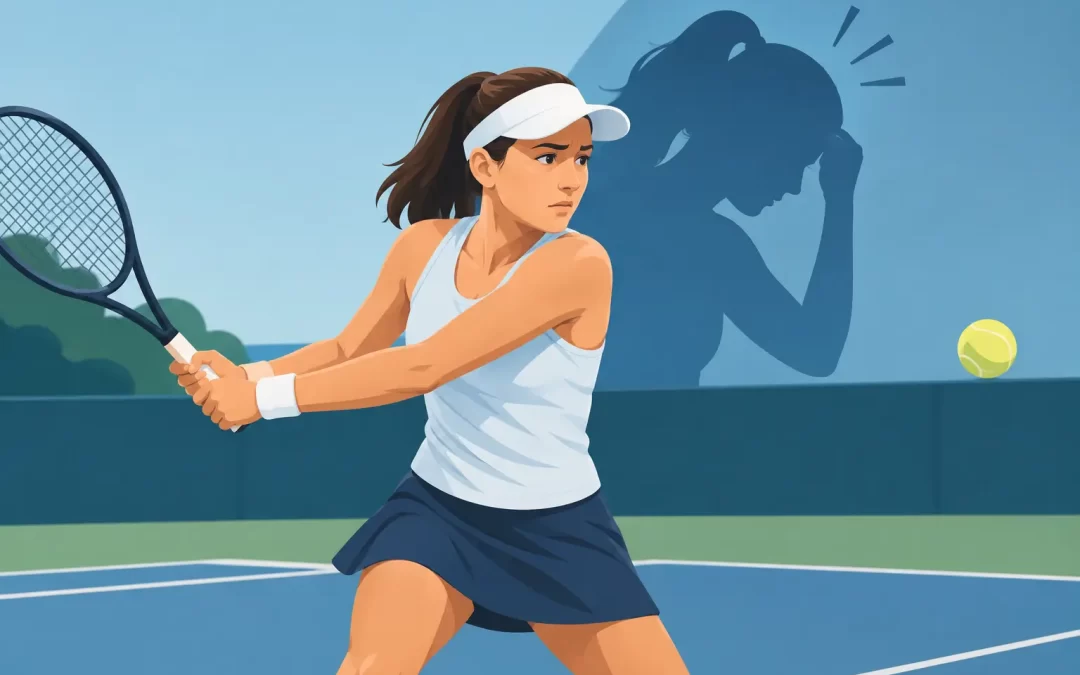
A forehand can look clean during warm-up and disappear the moment the score gets tight. If you are asking, “why does my tennis forehand fail?” the answer is rarely that you simply need to swing harder or copy a different grip. A failing forehand is usually the visible result of a breakdown earlier in the chain: recognition, footwork, spacing, preparation, contact, or decision-making.
That is good news. When you identify the real source of the error, practice becomes purposeful. Instead of hitting hundreds of forehands and hoping one change sticks, you can train the specific skill that holds your game back.
Why Does My Tennis Forehand Fail in Matches?
Match pressure exposes what is not yet automatic. In a lesson or cooperative rally, you know where the next ball is going and have time to set your feet. In competition, the ball arrives with different height, depth, spin, speed, and intent. Your opponent may attack your weaker movement pattern, rush your timing, or pull you outside your preferred contact zone.
A reliable forehand is not one that works only from a comfortable position. It is one that adapts while maintaining clear priorities: get organized early, create usable spacing, make contact in front, and choose a target that fits the ball you received.
Players often respond to a missed forehand by changing the swing. That can help when the mechanics are genuinely flawed, but it can also create more confusion. Before changing technique, ask a better question: Did I miss because of my swing, or because I was late, crowded, off-balance, or attempting the wrong shot?
The Technical Errors That Create Unforced Errors
Late preparation steals your contact point
The most common forehand problem begins before the forward swing. When the opponent strikes the ball, your first response should be a split step, early unit turn, and active movement toward the ball. If the racquet is still down by your side as the ball crosses the net, you are already behind the play.
Late preparation forces players to rush. They pull across the ball, contact it too close to the body, or flick with the wrist to create pace. The result may be a forehand that lands short, flies long, or finds the net under pressure.
Train the turn as a response to your opponent’s contact. Your non-dominant hand should help guide the racquet back while your shoulders rotate. The goal is not a large backswing. It is early organization.
Poor spacing makes good mechanics impossible
A forehand needs room. When the ball jams your hip or gets too far away, your normal swing path changes. Many players blame their grip or racquet face when the deeper issue is that they stopped moving too soon.
Use adjustment steps all the way into contact. Larger movement gets you near the ball; smaller steps create the exact distance needed to swing freely. If you are frequently crowded, move back or angle away from the ball before it drops into your strike zone. If the ball is too far away, move your feet instead of reaching with your arm.
This is especially important against heavy topspin. The higher bounce often pushes players backward, where they lose balance and allow the ball to crowd them. Sometimes the right answer is to take the ball earlier. Other times it is to create more space and let it fall. Your choice depends on the ball’s depth, your court position, and the time available.
Your contact point is too late
For most rally forehands, contact should be comfortably in front of the front hip, with the arm extended but not locked. Contacting behind the body causes the racquet face to become unstable and makes directional control difficult.
A late contact point often sends crosscourt balls wide or drives the ball into the net. Players then try to lift more with the wrist, which adds another moving part at the moment precision matters most.
Focus on meeting the ball in front rather than hitting it harder. A calmer swing with earlier contact will produce more pace and control than a rushed swing from behind your body.
The racquet path and target do not match
You cannot consistently drive a low ball with a steep, upward brushing motion. You also cannot create a safe, heavy topspin ball by swinging flat through a high-risk target. The incoming ball should influence your swing shape.
Against a low ball, get your legs down and use a more forward path with enough lift to clear the net. Against a higher ball, create space and use the height to drive or shape a heavier topspin shot. The objective is not to use one forehand for every ball. The objective is to have a repeatable base swing and smart variations.
Movement Problems Often Look Like Stroke Problems
Your forehand may fail because you are trying to hit it from a poor athletic position. If your weight is falling backward, your feet stop moving, or your recovery step is late, the stroke has to rescue the point. That is not a sustainable system.
Watch where your misses happen. Do they appear after wide balls, deep balls, short balls, or balls directed into your body? Patterns reveal the movement demand you need to train.
On a wide forehand, a player may need an open-stance recovery and a controlled crosscourt reply rather than a full-power winner. On a short ball, the problem may be hesitation. Players arrive late, then try to do too much with a ball that should have been an attacking opportunity. On a deep ball, the answer may be better court positioning and earlier preparation, not a larger backswing.
Build forehand footwork into every practice block. Hit from neutral positions, then add movement: recover, move wide, defend deep, transition forward, and play the next ball. Tennis rewards the player who can repeat the skill after movement, not just demonstrate it from a ball basket.
Your Shot Selection May Be Setting Up the Miss
Not every forehand deserves an aggressive target. A ball that is low, deep, fast, and outside your strike zone is not an invitation to redirect down the line at full pace. It is usually a ball to reset crosscourt with margin.
Competitive players separate opportunity balls from neutral and defensive balls. An opportunity ball is short enough, slow enough, or high enough to attack with balance. A neutral ball asks for depth and shape. A defensive ball asks you to stay in the point and recover your position.
If your forehand breaks down at important moments, examine your target selection. Are you aiming too close to the lines? Are you changing direction from a difficult position? Are you trying to finish points before you have earned the right ball?
A disciplined crosscourt forehand gives you more net clearance, more court to work with, and a higher percentage pattern. Down the line can be an effective attack, but it requires earlier preparation, cleaner balance, and a ball that supports the decision.
Pressure Changes Your Body and Your Decisions
Under pressure, many players tighten their hand, shorten their follow-through, hold their breath, and rush to finish the point. The forehand does not fail because pressure is unusual. It fails because the player has not practiced a response to pressure.
Create a simple between-point routine. Turn away from the last point, take one controlled breath, choose a clear intention, and commit to the next ball. Your intention should be specific and controllable: early turn, high over the net, deep crosscourt, or move your feet through contact.
Avoid technical overload in a match. Trying to remember five swing cues after an error usually produces more tension. Choose one performance cue for the next point. “See the ball early” or “create space” is enough.
Confidence also comes from evidence. When you train a pattern repeatedly, track it, and receive clear feedback, you trust it more when the score matters. This is why structured practice and video review are so valuable. They replace vague feelings with observable patterns.
A Smarter Way to Rebuild Your Forehand
Start by identifying one primary breakdown. Record a few points from behind the baseline and from the side if possible. Look for the first error in the sequence: late turn, poor spacing, late contact, unstable balance, or poor target choice. Do not judge the stroke only by whether the ball went in.
Then organize practice around that diagnosis. If you prepare late, use live-ball drills where the only goal is to turn before the ball crosses the net. If spacing is the issue, practice feeding yourself or receiving varied balls while using adjustment steps. If you miss under pressure, play score-based games with a simple target and consequence.
At Point of Mind Coaching, the goal is not to collect random tips. It is to build a forehand that holds up through movement, pressure, and real match decisions. Progress comes faster when technical work, tactical patterns, physical movement, and mental routines support each other.
Your forehand does not need to be perfect to become dependable. It needs a clear process behind it: recognize the ball sooner, move into the right space, choose the right target, and trust a trained response when the score gets tight.