
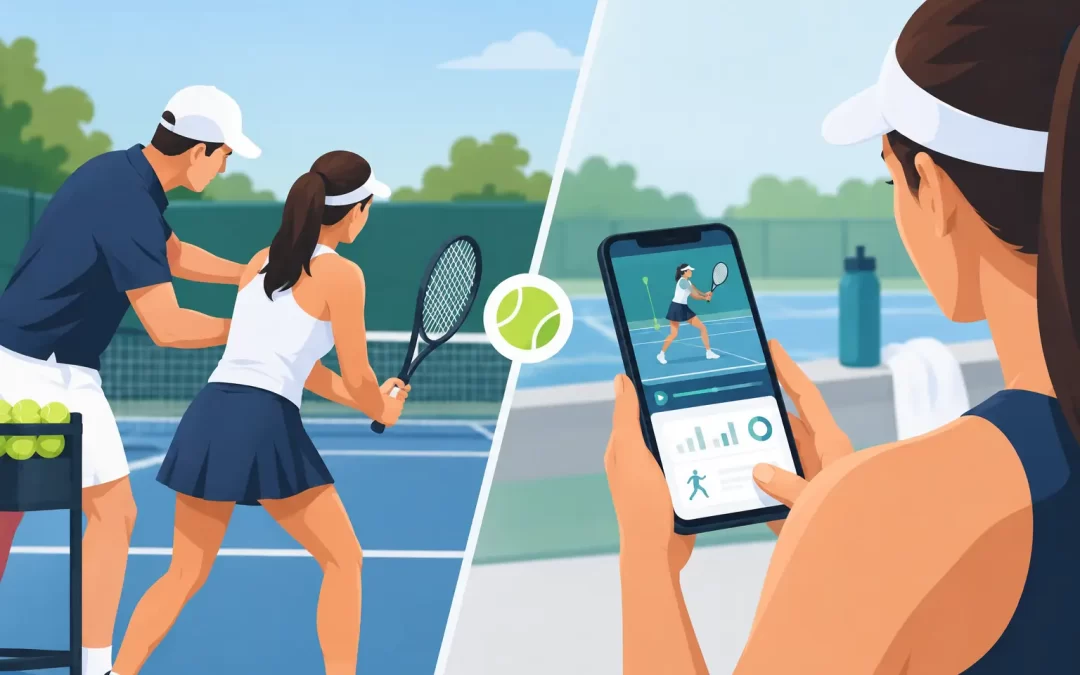
A tennis app can tell you to hit 50 crosscourt forehands. It cannot see that your contact point drifts behind you when the pace rises, that you stop recovering after wide balls, or that you abandon your best pattern at 4-4 in a set. That is the real issue behind remote coaching versus apps: access to information is not the same as having a development process.
For players who want more than occasional exercise, the right choice comes down to feedback, accountability, and competitive direction. Apps can be useful training tools. Remote coaching can turn training into a system that connects technical work, movement, strategy, and mindset.
What Tennis Apps Do Well
Tennis apps have made basic instruction easier to access. A player can find drills, fitness routines, serve tips, scoring tools, practice trackers, and video examples within minutes. For a beginner who needs ideas for a solo session, that convenience has real value.
The best apps also help players organize repetition. If you are building a daily mobility routine, tracking serves, or looking for a simple wall-drill progression, an app can remove friction. It gives you something to do when you do not have a coach on court.
That matters because improvement requires time on task. A player who follows a productive drill plan is usually better off than a player who practices randomly or waits for the next lesson to think about tennis again.
But an app works from general inputs. It may show what a technically sound forehand looks like, yet it does not know whether your specific error begins with poor spacing, a late split step, a rushed unit turn, or a grip that changes under pressure. It cannot reliably separate the cause from the symptom.
That limitation becomes more significant as a player becomes more competitive. Match improvement is rarely about collecting more drills. It is about identifying the few habits that cost the most points and addressing them in the right order.
Remote Coaching Versus Apps: The Difference Is Diagnosis
A skilled remote coach does not simply send workouts. The coach evaluates what is happening, determines why it is happening, and gives the player a clear priority. That priority may be technical, tactical, physical, or mental.
Consider a player who misses too many backhands long. An app might recommend a backhand drill or advise more topspin. A coach reviewing video can see whether the player is opening the shoulders early, contacting too far in front, failing to load outside the court, or trying to change direction from a defensive position. Those are different problems, and they require different corrections.
The same applies to match strategy. A player may say, “I play well in practice but lose close matches.” That statement does not point to one universal solution. The player may be overplaying low-percentage targets, serving predictably, returning from too far back, or becoming passive when protecting a lead. Remote coaching creates a conversation around patterns, decisions, and emotional responses that an app cannot fully interpret.
This is why video review is so valuable. It allows a coach to study strokes in context rather than offering generic advice. More importantly, it gives the player a focused assignment for the next practice session instead of a long list of changes to remember.
Feedback Between Lessons Changes the Training Cycle
Traditional lessons can be valuable, but a single hour on court does not automatically create progress for the other six days of the week. Players often leave with good intentions, then return to familiar habits because no plan connects one lesson to the next.
Remote coaching closes that gap. A player can send practice or match footage, receive corrections, follow a weekly plan, and report what happened. The training cycle becomes more complete: assess, assign, practice, review, adjust.
That process is especially useful for junior players and their parents. A motivated junior may be taking lessons, playing team tennis, entering tournaments, and practicing with friends, yet still lack a coordinated plan. Without one, volume can create repetition without development. A coach can help decide what deserves attention now and what can wait.
For committed adult players, the advantage is efficiency. Most adults cannot train endlessly. They need sessions with purpose. If you have 90 minutes twice a week, your plan should reflect your current game, your physical capacity, and the opponents you are trying to beat. That is a more intelligent use of court time than selecting a new drill because it looked useful on a screen.
Accountability Is Not Just Motivation
Many players believe they need more motivation. Often, they need a clearer standard.
A remote coach creates accountability by setting expectations: send the video, complete the practice target, track the serving pattern, review the match, and report the result. The player is not merely consuming advice. The player is participating in a disciplined development process.
That structure matters when progress feels slow. Technical changes can temporarily make a stroke feel less natural. Tactical changes can lead to uncomfortable losses before they become reliable habits. When a player trains alone, it is easy to quit too early or switch focus every week. A coach provides perspective and keeps the work connected to a longer-term objective.
Apps can send reminders and streak notifications, which may help with consistency. But a notification does not ask the harder question: Did you execute the intended pattern when the score became tight? It does not challenge a player who is avoiding the weakest part of the game. Real accountability is specific, not automated.
When an App May Be Enough
Apps are not the wrong choice for every player. They may be enough when the goal is casual fitness, simple drill ideas, scorekeeping, or basic exposure to tennis fundamentals. They can also be a practical supplement for players who already receive quality instruction and want additional structure between sessions.
The key is to use an app as a tool, not as a substitute for diagnosis. A serve-speed tracker can be useful. A footwork library can be useful. A practice journal can be useful. None of these replaces an experienced coach who understands how the parts of your game affect one another.
Players should also be honest about their ability to self-correct. Some athletes can watch their own video, recognize patterns, and apply one change at a time. Most players, particularly under match pressure, benefit from an outside perspective. What feels like a wrist problem may begin with footwork. What feels like a confidence problem may begin with unclear tactics.
Who Benefits Most From Remote Coaching?
Remote coaching is strongest for players who are ready to train with intent. That includes juniors preparing for stronger competition, high school players seeking more reliable match performance, adults stuck at the same level, and tournament players who need a better plan between events.
It is particularly effective when a player has court access but limited access to frequent in-person coaching. In New Rochelle, Westchester, and New York City, hybrid support can extend the value of in-person instruction by keeping development active between sessions. The player is not left guessing after the lesson ends.
The format also suits athletes who want help with the parts of tennis that are difficult to fix through repetition alone: point construction, return positioning, shot selection, routines between points, and confidence after mistakes. These areas require reflection, communication, and an honest review of match behavior.
Choose the Level of Support Your Goals Require
The practical question is not whether remote coaching or apps are universally better. It is whether your current training system is producing measurable improvement.
If your game is progressing, your practice has direction, and you can identify why you win or lose points, an app may be a helpful addition. If you are plateauing, repeating the same match mistakes, or training often without confidence that the work is translating to competition, you likely need more than content.
Point of Mind Coaching is built for players who want that higher level of direction: structured plans, video-based feedback, tactical guidance, and coaching that treats mindset as part of performance. The objective is not to keep players busy. It is to help them train with purpose and compete stronger.
Before your next practice, choose one area of your game that most affects your results. Record it, measure it, and build a plan around it. Better tennis begins when every session has a reason.