
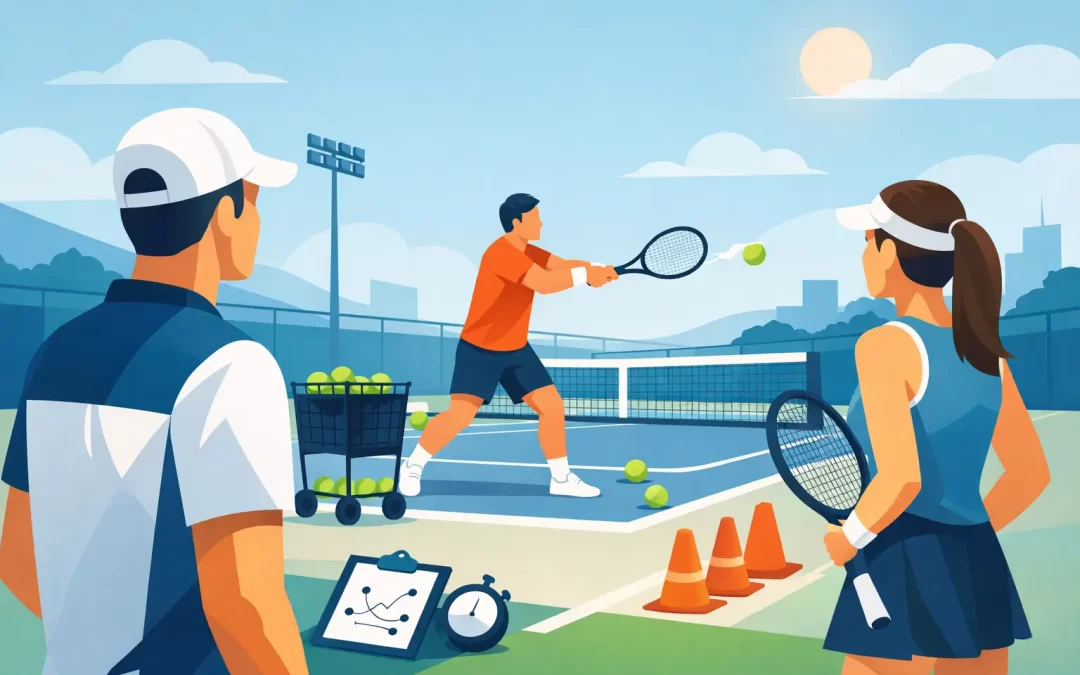
Most players know the feeling – you spend 90 minutes on court, hit plenty of balls, sweat a lot, and still leave without a clear sense of progress. That gap is exactly why players ask what makes a good tennis practice. The answer is not simply hard work. A good practice is organized, measurable, and connected to how you actually want to perform in matches.
Too many sessions fall apart because they are built around activity instead of development. Hitting can feel productive without actually improving timing, movement, decision-making, or confidence under pressure. If your practice does not train a specific skill, expose a weakness, and build a repeatable pattern you can trust, it is probably not doing enough.
What makes a good tennis practice session
A good tennis practice has a clear objective before the first ball is struck. That objective might be as simple as improving first-serve percentage, holding crosscourt rally tolerance on the backhand side, or recognizing when to attack short balls. The key is that the session has a target. Without one, players drift from drill to drill and confuse effort with improvement.
It also needs structure. Strong practices usually move through phases: warm-up, technical rehearsal, live pattern work, pressure-based competition, and short reflection. That progression matters because tennis is not just about producing strokes in isolation. You need to connect mechanics to movement, movement to decisions, and decisions to scoreboard pressure.
Feedback is another non-negotiable piece. Players often repeat the same mistake because nobody identifies it early enough or gives them a correction they can actually apply. Real improvement comes when a player knows what happened, why it happened, and what to change on the next ball. That is true for beginners learning fundamentals and competitive players refining patterns.
Finally, a good practice creates a standard. You should be able to answer basic questions when the session ends. What improved? What broke down? What needs attention next time? If you cannot answer those, the practice may have been active, but it was not fully productive.
Purpose beats volume every time
There is a big difference between playing a lot and training well. More court time can help, but only if the work has intention. Repeating low-quality reps usually reinforces low-quality habits. This is one of the biggest reasons players plateau. They are committed, but their practice lacks precision.
For example, a player might spend 30 minutes rallying from the baseline. That can be useful if the goal is consistency, footwork discipline, and depth control. But if both players are casually exchanging balls without targets, recovery standards, or tactical purpose, the value drops fast. The same drill can build a player or simply pass the time. It depends on how it is used.
Good practice respects the difference between technical work and performance work. Technical work isolates a movement and sharpens execution. Performance work asks the player to use that skill while moving, reading the ball, and making decisions. Both matter. Too much technical work creates players who look clean in drills but break down in matches. Too much live play without correction can harden flawed habits.
The best practices train more than strokes
Tennis improvement is never just mechanical. A player can hit a solid forehand in warm-up and still make poor choices under pressure. That is why strong practices train four areas together: technique, movement, tactics, and mindset.
Technique gives the player a dependable foundation. Movement determines whether that technique shows up on time and in balance. Tactics shape shot selection and point construction. Mindset holds everything together when the score gets tight. If one area is ignored, development becomes incomplete.
This is especially important for juniors and competitive players. A talented athlete may win early by hitting bigger than opponents, but as competition rises, patterns and discipline matter more. Adult players face a similar issue. Many can strike the ball well enough during lessons but lose matches because they rush, choose the wrong targets, or stop trusting their game under stress.
A good practice puts these pieces in the same environment. A crosscourt drill becomes more valuable when the player must recover with discipline, identify the short ball, and then commit to the right attack. A serving session becomes more effective when it includes target zones, second-serve accountability, and first-ball patterns. This is how practice starts transferring to matches.
Feedback changes everything
If there is one factor that separates random practice from real development, it is feedback. Players rarely improve fastest when they train alone without a plan. They improve when someone can identify trends, make adjustments, and hold them accountable.
That feedback can happen live on court, through video review, or in structured follow-up between sessions. What matters is accuracy and timing. Generic advice like move your feet or stay focused does not do much. Specific feedback does. For example: your contact point is dropping because your recovery steps are late, or your rally ball misses long because you are trying to finish points from neutral positions.
The strongest coaching systems also track progress over time. One good correction can help in a single session. A development plan helps across months. If a player is building a better serve, improving transition play, and becoming more composed in pressure moments, those goals should not live only in the coach’s head. They should shape the work week after week.
This is one reason structured coaching models are so effective. The combination of in-person work, match review, and ongoing support gives players more than isolated lessons. It gives them continuity. At Point of Mind Coaching, that kind of structure is central because progress usually accelerates when players stop guessing and start training with clear direction.
Competitive elements matter
A practice can be technically sound and still miss the mark if it never asks the player to compete. Tennis is a pressure sport. Players must execute while managing score, momentum, nerves, and consequences. If every session stays comfortable, match play will always feel like a different sport.
That does not mean every drill needs to become exhausting or intense. It means the practice should include moments where execution has a cost. A player might need to make four crosscourts before changing direction, hit six of ten first serves to a target, or play points beginning with a specific pattern. Those small competitive constraints sharpen concentration and expose habits that casual drilling hides.
This is also where mindset training becomes practical. Confidence is not built by positive phrases alone. It is built by repeatedly executing under a standard. Composure grows when players learn how to reset after errors, stick to a pattern, and make disciplined decisions when they feel rushed.
For parents evaluating junior training, this is worth watching closely. If a practice looks active but never includes pressure, consequences, or match-based decision-making, the player may improve slower than expected. Match toughness is trained, not wished into existence.
What a strong week of practice usually includes
A single great session helps. A connected week of practice changes players.
Most players improve faster when their training week includes a blend of technical repetition, live point play, movement work, and some form of review. The balance depends on level. A beginner may need more time on fundamentals and coordination. An intermediate player often needs consistency, pattern recognition, and point construction. A competitive player usually benefits from advanced situational training, match analysis, and mental discipline under pressure.
There is no universal formula because development is not one-size-fits-all. A player with unreliable serves needs a different emphasis than a player who defends well but cannot finish points. A junior preparing for tournaments should not train exactly like an adult who plays weekend league matches. Good practice is always specific to the player in front of you.
Still, the principle stays the same: each session should connect to a larger plan. If today addresses backhand stability, tomorrow might build that into rally tolerance and directional control. Later in the week, that same skill should show up in points. That is how isolated work becomes competitive progress.
Signs your practice needs to change
If your results are stuck, your practice habits may be the real issue. Common warning signs include doing the same drills every week without improvement, leaving practice without a clear takeaway, and playing matches that look nothing like your training. Another major sign is emotional inconsistency – strong in practice, rushed in competition.
The fix is not always to work harder. Sometimes it is to organize better. Narrow the goal. Raise the standard. Get feedback sooner. Build more pressure into drills. Review performance honestly instead of relying on feel alone.
Players improve when practice becomes intentional enough to reveal the truth. Are you missing because of poor spacing, bad decisions, or a technical flaw? Are you losing points because your strokes break down, or because your patterns are weak? Good practice answers those questions.
The best sessions do not just leave you tired. They leave you clearer, sharper, and better prepared for the next challenge. If your practice gives you that, you are on the right path.