
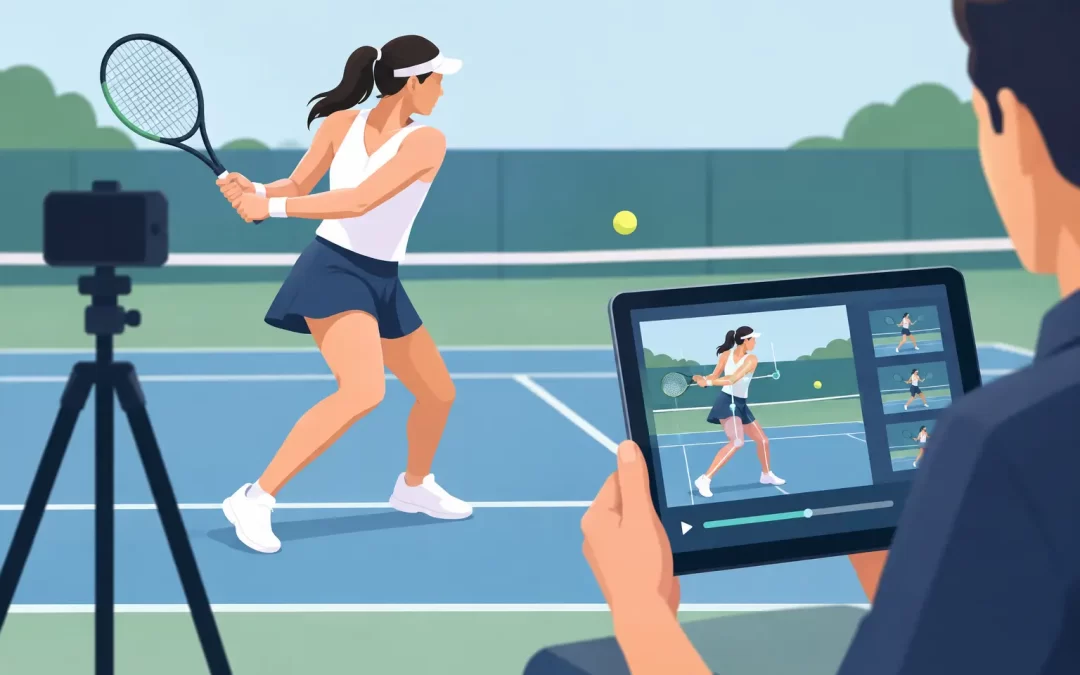
A forehand can feel powerful and still break down under pressure. A serve can look smooth in a lesson yet produce double faults in a match. That gap between what a player feels and what actually happens is where video becomes valuable. Can video improve tennis technique? Yes, but only when the footage is reviewed with a clear purpose and turned into focused training.
Video is not a replacement for live coaching, repetition, fitness, or match play. It is a feedback tool. Used well, it gives players and coaches an objective view of movement patterns, timing, balance, contact point, and decision-making that are difficult to recognize in real time.
Why Video Changes the Learning Process
Tennis happens quickly. A player may finish a stroke believing they stayed low, loaded correctly, or followed through toward the target. On video, they may see that their feet stopped, their contact drifted behind them, or their upper body opened too early. That difference matters because players cannot consistently correct what they cannot accurately identify.
A coach can deliver a technical cue during a lesson, but video gives that cue a visual reference. Instead of hearing, “Create more space on your forehand,” a player can see the crowded contact point, then compare it with a repetition that creates room and produces a cleaner ball. The feedback becomes specific, measurable, and easier to remember during the next practice session.
For committed juniors and adult competitors, this is especially useful between sessions. Progress often slows when players practice without knowing whether they are reinforcing a better habit or repeating the same error. Short video check-ins can keep training connected to the player’s development plan.
Can Video Improve Tennis Technique Without Making You Overthink?
It can, but this is where discipline matters. Too much footage and too many corrections can create a player who analyzes every swing instead of competing freely. Tennis technique should support performance, not become a collection of mechanical thoughts.
The strongest video review identifies one priority at a time. A developing player might focus on maintaining a split step before the opponent strikes. An intermediate player may work on recovering after a wide forehand. A competitive player may examine serve rhythm, first-ball patterns, or body position on defensive shots.
The goal is not to build a perfect-looking stroke. Different players have different grips, body types, movement abilities, and tactical strengths. The better question is whether the technique is efficient, repeatable, and reliable for the player’s level of competition. A technically attractive forehand that breaks down when the ball is high or fast is not yet a dependable match weapon.
What Video Reveals Best
Video is most effective when it focuses on patterns that influence ball quality and consistency. A single clip rarely tells the whole story, but repeated clips can show whether a problem is occasional or built into the player’s movement.
Footwork and balance
Many stroke issues begin before the racquet moves. Video can reveal late preparation, poor spacing, upright posture, or a recovery step that never happens. When players improve their feet, they often improve their contact without needing a major swing change.
This is why filming full-body movement is more useful than recording only the upper body. Watch the split step, first step, adjustment steps, loading position, contact, and recovery. These details determine whether a player arrives balanced enough to hit with control.
Contact point and spacing
A player may blame the swing for inconsistent shots when the real issue is where the ball is being struck. Video helps identify contact that is too close, too far away, too late, or too low. It also shows whether the player is maintaining space through the swing or collapsing toward the ball.
For serve development, slow-motion video can expose a falling toss, a rushed trophy position, limited leg drive, or a contact point that is too low. Those observations should lead to simple drills, not an attempt to rebuild everything at once.
Racquet path and body sequence
Video can show whether the racquet is prepared on time, whether the player is using the legs and torso efficiently, and whether the finish supports the intended shot. It is particularly valuable on the backhand, volley, serve, and overhead, where small timing errors can create major inconsistency.
Still, a video frame should not be judged in isolation. Tennis is dynamic. A player may look unconventional at one moment yet produce an effective ball because the movement sequence works. Expert feedback helps separate harmless style differences from patterns that limit performance or increase injury risk.
Tactical habits under pressure
Technique is only part of the picture. Match footage can reveal that a player attacks from poor positions, serves predictably on big points, retreats too far behind the baseline, or misses because they choose low-percentage targets. Those are not simply stroke problems. They are competitive decision-making problems.
This is where video analysis becomes a smarter way to train. Rather than reviewing every missed shot, review the point: What ball was received? Where was the player positioned? What was the best available option? Did the shot selection match the score and situation?
How to Film Productive Tennis Video
You do not need a complicated setup to collect useful footage. A phone, stable tripod, and a clear objective are enough. Film from behind the baseline for most groundstroke and serve analysis. This angle shows court positioning, ball direction, recovery, and the relationship between the player and the ball.
A side view is valuable when studying serve mechanics, contact point, balance, and depth of loading. For volleys and approach shots, capture enough of the court to see the transition forward, not just the finish at the net.
Keep clips purposeful. Record ten to fifteen serves, a focused groundstroke drill, or several complete points. Then label the session by objective, such as “second-serve height,” “backhand recovery,” or “crosscourt forehand consistency.” Random clips create random feedback. Organized footage creates a record of progress.
When reviewing, use a simple sequence: identify the pattern, choose one correction, select a drill, and retest it on video later. The retest is essential. A player may feel a change immediately, but the camera confirms whether the movement actually changed and whether it held up at realistic speed.
Turn Review Into Better Practice
The value of video is determined by what happens after the review. If the player sees a late unit turn, the next practice should include early preparation cues and feeds that challenge reaction time. If the player sees poor recovery after a wide ball, training should include movement patterns that require a strong crossover step back toward the court.
Technical work also needs progression. Start with controlled repetitions, then add movement, direction, height, pace, and a live-ball decision. Finally, test the change in point play. A correction that works only with hand-fed balls is not ready for competition.
This approach protects players from a common mistake: treating video as entertainment instead of accountability. Film should answer a training question. Did the first serve land with better shape? Did the player recover after attacking crosscourt? Did the backhand hold up when the rally became fast? Those questions connect technique to results.
When Professional Review Makes the Difference
Self-review can be helpful, especially for noticing obvious patterns. But players often see what they expect to see. A skilled coach brings context: developmental stage, physical limitations, tactical identity, match demands, and the order in which changes should be made.
For example, a junior with an inconsistent forehand may need better spacing and footwork, not a new grip. An adult player with a weak second serve may need a safer spin pattern and clearer targets before pursuing more power. A tournament player may have sound mechanics but lose points because their return position and shot selection are predictable.
At Point of Mind Coaching, video review is most effective when it supports structured instruction, weekly practice priorities, and direct feedback. The camera records the truth. The coaching process turns that truth into a plan.
Your next video session does not need to be perfect. Pick one stroke or match pattern, film it honestly, and give yourself one disciplined objective for the next practice. Small corrections, repeated with purpose, are how players build technique they can trust when the score gets tight.