
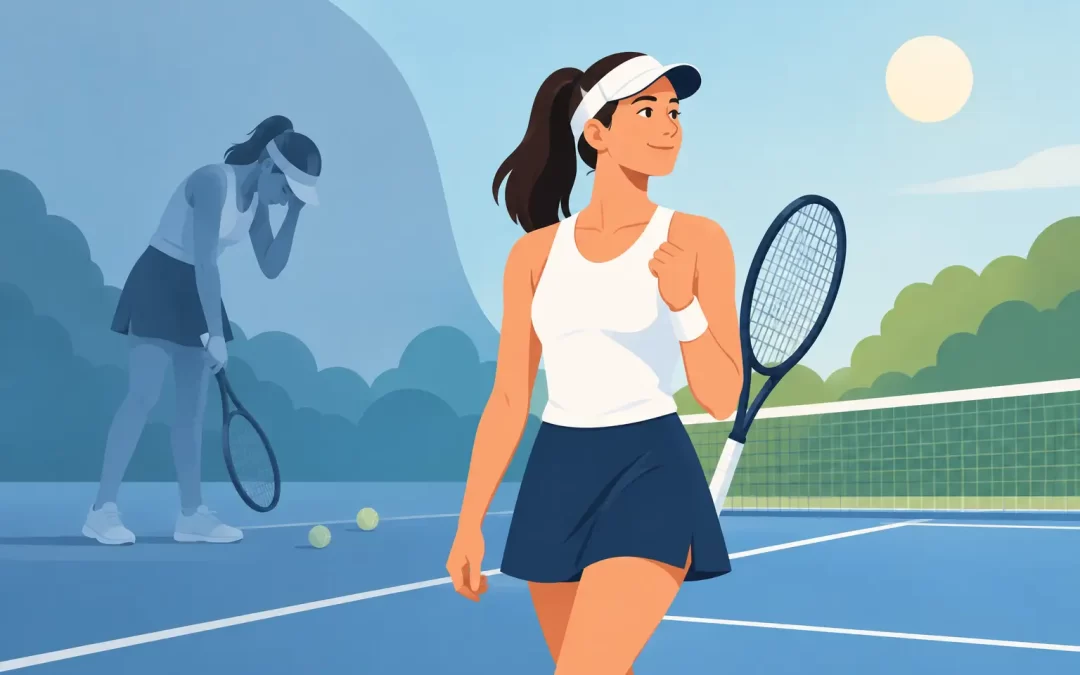
A double fault can change the temperature of an entire service game. One missed second serve becomes a tight grip, then a rushed toss, then a conversation in your head that has nothing to do with the next point. To build confidence after double faults, you need more than encouragement. You need a response system you can trust when the score is tight.
Strong competitors do not avoid every double fault. They recover from one without allowing it to dictate their decisions, body language, or serve selection. That is a trainable skill. It begins when you stop treating a double fault as proof that your serve is broken and start treating it as useful information.
Why Double Faults Damage Confidence So Quickly
A double fault is visible, immediate, and entirely self-generated. You do not get to blame an opponent’s great return or a bad bounce. For many players, that creates embarrassment, especially when teammates, parents, or opponents are watching.
The larger problem is not the lost point. It is the story that follows: “My second serve is weak.” “I cannot serve under pressure.” “I have to make this next one.” Those thoughts pull attention away from the only things you can control: your target, your shape, your rhythm, and your commitment to the swing.
Pressure makes this worse because players often respond by trying to guide the ball. They slow the racket down, push the serve, or change their motion mid-delivery. A second serve hit without acceleration usually has less margin, not more. Confidence disappears because the player no longer recognizes the action they are performing.
Build Confidence After Double Faults With a Reset Routine
Your reset must be short enough to use between points and specific enough to interrupt frustration. Do not wait for a changeover to regain control. The best response happens before you walk to the baseline for the next point.
After a double fault, turn away from the net briefly. Take one controlled breath, longer on the exhale than the inhale. Release your hand on the racket handle, then set it again with intention. Use one simple cue such as “shape and accelerate,” “up and through,” or “high-margin target.”
The exact words matter less than consistency. Your cue should direct your attention to an action, not an outcome. “Do not double fault again” is an outcome-based thought driven by fear. “Brush up to the backhand” gives your mind a job that supports better execution.
Then walk to the line with purposeful body language. Shoulders back, eyes up, steady pace. This is not pretending the error did not happen. It is a competitive signal to yourself that the point is over and your process remains intact.
Separate the Error From Your Identity
Competitive players often make their confidence too personal. They say, “I am a bad server,” after two poor deliveries. That language turns a technical or tactical issue into an identity.
Replace the judgment with a neutral assessment. Did you miss long because you overhit? Did you miss wide because the toss drifted? Did you decelerate? Were you aiming too close to the line at 30-30? A double fault has a cause. Find the cause without dramatizing it.
This distinction matters for juniors and adults alike. A player who can say, “My toss moved behind me, so I lost extension,” is already more composed than the player who simply labels the moment a disaster. Clear feedback creates a clear adjustment.
Choose a Second-Serve Target That Fits the Score
Confidence is not built by hitting every second serve safely down the middle. It is built by knowing what percentage serve gives you the best chance in a particular situation.
For most developing and intermediate players, the highest-value second serve combines net clearance, spin, and a target that avoids the returner’s favorite pattern. That may mean using a heavy serve to the backhand, a body serve that limits the returner’s swing, or a deeper serve through the middle that reduces angle.
The trade-off is real. A very conservative target may get the ball in but leave you vulnerable to an aggressive return. An overly ambitious target can create misses and hesitation. Your goal is not to find a risk-free serve. It is to choose a serve you can swing at with conviction.
Before the match, establish two or three dependable second-serve patterns. For example, you may use a crosscourt kick or topspin serve to a right-hander’s backhand from the deuce court, then a body serve from the ad court when you need to protect against a sharp angle. Keep the choices simple. Under pressure, a player with a clear pattern performs better than a player searching for the perfect serve.
Commit to Shape, Not Just Placement
A second serve needs a shape. Players who only think about “getting it in” tend to flatten the ball. A more reliable intention is to create a high, heavy trajectory that drops inside the service box.
This does not mean every player needs an advanced kick serve immediately. Beginners may need to focus first on a repeatable toss, balanced stance, and a smooth throwing motion. More experienced players should develop topspin or kick variation that gives them true margin over the net. The technical priority depends on the player, but the principle remains the same: confidence comes from a serve built for repeatability.
Train the Pressure, Not Just the Motion
You cannot expect match confidence from practice that has no consequences. Serving baskets without targets has value for technical work, but it does not fully prepare you for 30-40 in a close set.
Build pressure into practice with measurable standards. Serve a set of 10 second serves to a defined target zone and record how many land with the intended shape. Then add consequences. If you miss two in a row, restart the set. If you make eight of 10, play out a point beginning with a second serve. The purpose is not punishment. It is learning to execute your routine while the result matters.
Use these four training formats regularly:
- The 7-of-10 standard: Hit seven of 10 second serves into a chosen high-margin target before moving on.
- Down 30-40: Start each point at break point and play the service game with only one second serve allowed.
- Serve plus one: Deliver a second serve to a planned target, then recover and play the first ball with a specific pattern.
- Scoreboard serving: Play tiebreaks in which a double fault counts as two points for the opponent, but only if your reset routine is skipped.
The last format highlights an essential truth: the double fault is not always the biggest mistake. The bigger mistake is letting it trigger another unprepared serve. Training your response makes pressure familiar rather than threatening.
Review Patterns Instead of Reliving Misses
After a match, do not judge your serving day by memory alone. Emotions usually remember the worst two points and ignore the 40 solid serves around them. Track your first-serve percentage, second-serve percentage, double faults by set, and the score situations in which misses occurred.
If possible, review video. Look for patterns in toss location, balance, rhythm, and target selection. You may discover that your double faults come late in matches when your legs stop driving upward, or that they happen primarily when you attempt a low-margin wide serve under pressure. Those are coachable patterns.
Avoid making major technical changes after one bad serving day. If a flaw appears consistently across practices and matches, address it through structured repetition and feedback. If the issue only appears in competition, your training may need more score-based serving and mental routines rather than a complete overhaul of the motion.
Let Your Next Serve Be the Evidence
Confidence is not a feeling you wait for before you serve. It is evidence you create through preparation, clear decisions, and repeated recovery. Every time you reset after a double fault, select a smart target, and commit to your swing, you teach yourself that one error does not control the match.
The next time the second serve feels heavy, do not chase perfection. Take the breath, trust the pattern, and give yourself a competitive chance to play the point.