
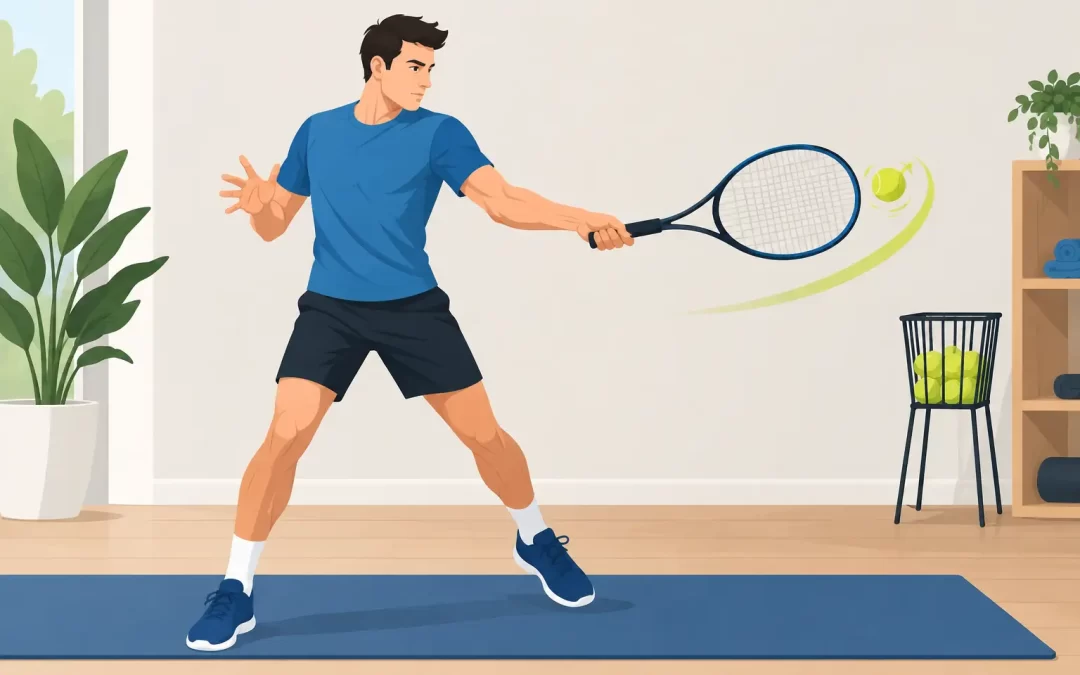
A forehand does not become reliable because you hit more balls once a week. It becomes reliable when your preparation, spacing, contact point, and finish hold up under pressure. You can train topspin forehand at home without a court, a ball machine, or a hitting partner if you train the parts of the stroke that create repeatable production.
The goal is not to swing fast in your living room or backyard. The goal is to build a forehand that starts on time, uses the ground efficiently, brushes the ball with purpose, and recovers for the next shot. Home training is especially valuable for juniors and committed adult players because it turns technical work into a daily habit rather than something attempted only during a lesson.
What a Match-Ready Topspin Forehand Requires
Topspin is not created by simply swinging low to high. That cue is useful, but incomplete. A heavy, controlled forehand comes from a coordinated sequence: early recognition, a unit turn, athletic loading, forward movement into contact, racquet acceleration, and a finish that matches the ball you intend to hit.
The racquet must travel up the back of the ball, but it also needs to travel through the ball. Players who only brush upward often produce a high, short ball with little pace. Players who only drive forward may hit a flatter ball that misses long when they increase speed. Your home work should teach both qualities: shape for net clearance and extension for depth.
There is also a competitive reason to train this stroke away from the court. In matches, a late forehand creates panic. You crowd the ball, lose your spacing, open the racquet face, and try to save the point with your hand. Rehearsing proper preparation at home gives you a better default when the ball arrives quickly.
Build the Motion Before You Add a Ball
Start with shadow swings. This is not pretend tennis. When done with precision, shadow work exposes whether your body is organized enough to produce the stroke you want.
Set up in an athletic stance with your knees flexed and your weight balanced over the balls of your feet. Begin by making a unit turn: your shoulders and hips rotate together while your non-dominant hand helps guide the racquet back. Avoid taking the racquet back with only your hitting arm. That move disconnects the stroke and makes timing harder.
From the loaded position, let the racquet head drop naturally below the imagined contact point. Then drive forward from the legs and torso. Contact should be clearly in front of your lead hip, not beside your body. Finish high and across your body for a standard topspin rally ball, while keeping your head quiet through the contact zone.
Do five slow repetitions, then five at a realistic match tempo. Record the second set from the side if possible. On video, check whether your contact point stays in front and whether your chest rotates through the ball rather than stopping abruptly. A fast swing with poor structure simply rehearses poor structure faster.
Use a Contact-Point Marker
A small training cone, a strip of tape, or even a water bottle can give your practice a clear reference. Place it where contact should occur, safely away from anything you could strike. Shadow swing to that marker without letting the racquet get too close to the ground or drifting behind your front hip.
This simple drill is valuable because players often know what a good forehand looks like but cannot feel where the ball should be struck. The marker turns an abstract instruction into a physical target. If you regularly contact too far back, do not solve it by reaching with your arm. Prepare earlier and move your feet so the ball meets you in the correct zone.
Train Topspin Forehand at Home With Simple Ball Drills
Once the movement is organized, use a tennis ball only when your space allows a controlled swing. A garage, driveway, quiet hallway, basement, or fenced backyard may work, but safety and ceiling height matter. If your space is tight, use foam balls or low-compression balls and prioritize clean contact over power.
Start with a self-drop forehand. Hold the ball at about waist height in front of your lead foot, release it, let it bounce once, and strike a controlled forehand toward a safe target. Your first objective is not maximum topspin. It is catching the ball at a consistent height and distance from your body.
After ten controlled contacts, give each swing an assignment. Hit five balls with a higher finish to create more margin, then five with a slightly longer extension toward the target. Notice the difference. The higher finish should produce shape, while the longer extension should help the ball travel deeper. Competitive players need both options because a neutral rally ball and an attacking forehand are not the same shot.
If you have a safe wall, stand close enough that the rebound stays manageable. Begin at half speed and rally only when you can maintain your technique. A wall exposes late preparation immediately, but it can also encourage frantic swinging if you stand too close. Give yourself enough distance to split step, turn, and set your spacing before each ball.
Do not turn every wall session into an endurance test. Quality repetitions matter more than chasing a high number. If your shoulders are opening early, your contact is drifting back, or your balance is falling toward the sideline, pause and reset. The correction is part of the training.
Footwork Is the Difference Between Practice and Performance
Many players try to fix their forehand with racquet drills while ignoring the reason it breaks down: they arrive at the ball poorly. At home, you can improve this without hitting a single shot.
Practice a split step followed by a first move. From a neutral position, make a small split step, call out “forehand,” turn your shoulders, and take two adjustment steps into an open or semi-open stance. Then shadow swing and recover back to center. Keep the movement compact. The purpose is to teach your body that preparation begins with the feet, not with a rushed backswing.
For a more demanding pattern, place two markers several feet apart. Start at the center, move laterally to one marker, set your outside leg, shadow a forehand, and recover. Alternate sides for 30 to 45 seconds. Stay low enough to remain balanced, but do not force an exaggerated squat. Tennis movement is elastic and reactive, not stiff.
It depends on your level and playing style which stance you use most. An open stance is practical when you are defending or handling a fast ball. A neutral or semi-open stance can help you move forward and transfer weight on a shorter ball. Train each pattern, but do not mistake a stance for the entire stroke. Your spacing and contact point still decide whether the ball is heavy and controlled.
Create Feedback Instead of Guessing
Home practice can build habits quickly, which is helpful only when those habits are correct. Use video as your accountability tool. Film from behind the baseline direction when possible, then from the side. You do not need complicated software to identify the major checkpoints.
Look for early shoulder turn, a stable head at contact, contact in front, and balanced recovery. Then choose one correction for the next session. Trying to repair five things at once usually creates a mechanical, hesitant swing.
A productive 20-minute session might include five minutes of movement preparation, eight minutes of deliberate shadow swings, five minutes of self-drop or wall work, and two minutes of video review. Keep a brief training note afterward: what improved, what broke down, and what you will focus on next time. That record gives your practice direction and gives your coach better information when you return to the court.
Progress From Clean Reps to Competitive Intent
Do not stay in slow-motion practice forever. Once you can repeat the basics, add realistic intention. Call a target before each swing: crosscourt height, deep middle, or aggressive inside-out direction. Even when you are shadow swinging, your brain should connect technique to a tactical purpose.
Pressure can also be trained at home. Set a standard such as eight balanced self-drop forehands in a row, with no rushed preparation and no falling backward after contact. If you miss the standard, restart. This is not punishment. It teaches you to execute when the repetition matters, which is exactly what happens at 4-all or in a tiebreak.
Point of Mind Coaching treats technical development as part of a larger performance system: movement, decision-making, confidence, and honest feedback all shape the forehand you bring into a match. Use your home sessions to earn better repetitions, then carry that discipline onto the court. A stronger topspin forehand begins long before the next ball crosses the net.