
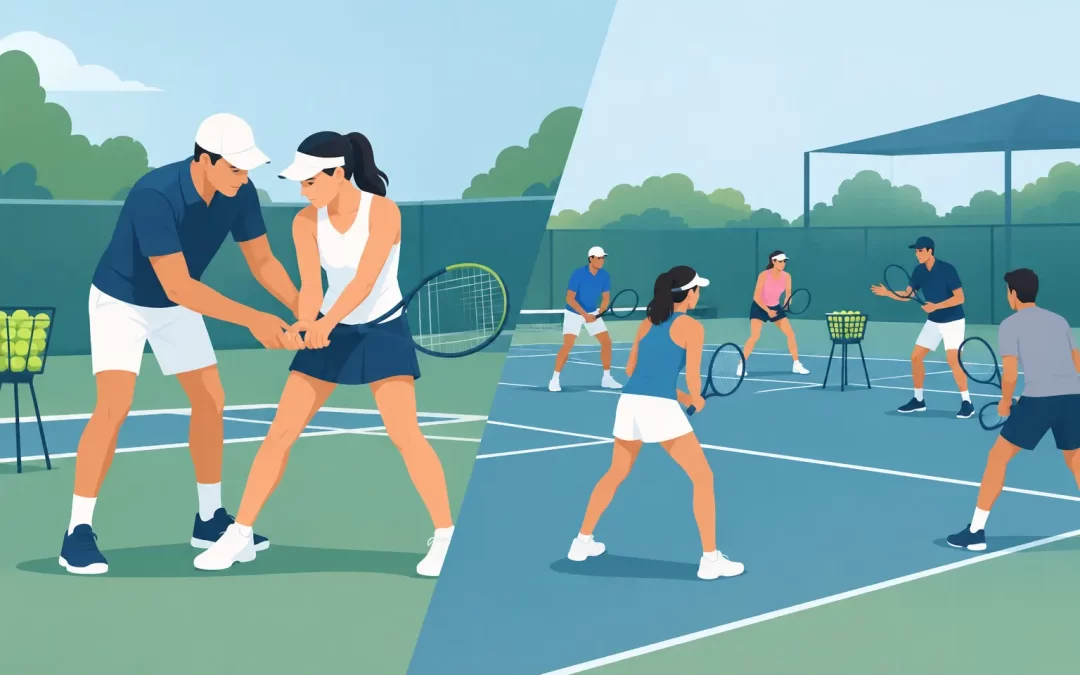
A player can hit clean forehands in a quiet private session and still struggle to win points on Saturday. Another can look sharp in a fast-moving group clinic but repeat the same technical error for months without anyone stopping to correct it. That is why the choice between tennis lessons versus clinics matters. Each format can improve your game, but they solve different problems.
The right question is not, “Which is better?” It is, “What does my game need next?” Players who want lasting progress need a training environment that matches their current technical level, competitive goals, practice habits, and ability to apply feedback under pressure.
Tennis Lessons Versus Clinics: The Core Difference
Private tennis lessons are built around individual attention. The coach can assess your stroke mechanics, movement patterns, decision-making, and habits in real time. A lesson can slow down a problem, explain why it is happening, and give you a clear correction before that mistake becomes more deeply ingrained.
Clinics are built around repetition, live-ball training, and shared competitive energy. You may hit hundreds of balls, play point-based games, work on patterns, and face different styles of players in one session. When organized well, a clinic helps players learn to execute skills while moving, reacting, recovering, and making decisions.
Neither format is automatically superior. A private lesson without purposeful practice between sessions can become expensive instruction with limited retention. A clinic without enough coaching detail can become exercise disguised as development. Serious improvement comes from using the right setting for the right phase of training.
What Private Lessons Do Best
Private lessons are the strongest choice when a player needs specific feedback. This is especially true for beginners building sound fundamentals, juniors preparing for a higher level of competition, and adults trying to fix a recurring weakness that appears in matches.
A coach can isolate the cause of a problem rather than merely point out the result. For example, a backhand that breaks down under pace may be caused by late preparation, poor spacing, an unstable base, or an unclear swing path. Those are different problems, and each requires a different solution. In a one-on-one setting, the coach can use targeted feeds, video review, movement drills, and progressions to address the issue directly.
Private coaching also creates accountability. The player has a plan, receives direct feedback, and can measure whether the adjustment is carrying into practice and match play. For a competitive player, this can include tactical preparation, return patterns, between-point routines, and the mental habits needed to compete with composure.
The trade-off is that private lessons do not automatically recreate the unpredictability of live competition. If a player only trains in controlled feeding situations, they may understand the correction but struggle to use it when the ball arrives faster, deeper, or at an uncomfortable height.
What Clinics Do Best
A quality clinic creates the volume and pressure that many players need. It puts skills into motion. Players have to judge the ball, recover after each shot, communicate in doubles situations, and choose targets quickly. This is where technique begins to become usable tennis.
Clinics are particularly valuable for players who need more reps, more court time, and more exposure to competitive situations. They can develop footwork, fitness, point construction, and confidence against a range of opponents. For juniors, the social and competitive environment can also make consistent training more engaging.
The limitation is attention. In a group, the coach must divide time among several players. A player may receive a useful correction, but not enough individual repetition to fully change an established habit. Group quality also varies. A well-structured clinic has clear objectives, appropriate player levels, active coaching, and purposeful point play. A poorly organized clinic can leave stronger players underchallenged and newer players overwhelmed.
Choose Based on Your Current Need
If your technique is limiting your consistency, private lessons should usually lead the plan. The goal is to establish reliable fundamentals before asking the player to perform them at speed. A beginner who is learning to serve, rally, and control the ball benefits from clear instruction and immediate correction.
If your strokes are generally sound but you lose points through poor movement, rushed decisions, or weak patterns, clinics may provide the better next step. You need live-ball reps and competitive situations, not another hour of isolated shadow swings. The same is true for players who practice well alone but tighten up during points. A clinic can create manageable pressure and force better decisions.
For match-focused players, the answer is often both. Private instruction identifies the highest-priority adjustment, while clinics provide the repetitions needed to test it. This combination prevents a common training mistake: working on one skill in a lesson and then abandoning it during the rest of the week.
Parents of junior players should also consider maturity and readiness. A young player who cannot yet focus, self-correct, or handle fast-paced group instruction may need more private guidance. A junior with a strong foundation and competitive interest often needs clinics to develop court awareness, resilience, and the ability to solve problems against other players.
Cost, Value, and Training Frequency
Clinics usually offer a lower cost per hour than private lessons. That makes them a practical way to increase weekly court time, particularly for players who need regular repetition. But lower cost is not always better value if the clinic is too broad for the player’s level or does not address the problems holding them back.
Private lessons cost more because the coaching is individualized. Their value comes from precision. One well-designed lesson that identifies the real reason a player is missing can save weeks of unfocused practice. The strongest players treat that time as an investment, then reinforce the lesson through planned practice rather than waiting for the next session to start over.
Frequency matters as much as format. One lesson each month may provide useful direction, but it rarely creates meaningful change without a practice structure. A player who trains twice per week in clinics but never reviews goals may improve fitness and ball tolerance while still plateauing tactically. Progress accelerates when training has continuity: clear objectives, feedback, repetition, review, and adjustment.
Build a Smarter Weekly Training Plan
A committed recreational player might use one private lesson to address a technical or tactical priority, then attend a clinic to apply that focus in live play. A competitive junior may need individual technical work, group drilling, match play, physical preparation, and video review across the week. The exact plan depends on age, schedule, level, and tournament goals.
The key is to avoid treating every session as separate. If the focus is improving the second serve, it should show up in the private lesson, serve practice, point play, and match reflection. If the focus is defending the backhand corner, the player should train footwork, recovery position, shot selection, and confidence under pressure. This is how isolated instruction becomes competitive growth.
At Point of Mind Coaching, the development model is designed around that connection. Players need more than a coach identifying a flaw for an hour. They need structured training, ongoing feedback, strategic understanding, and accountability between sessions so improvement has a direction.
The Best Choice Is the One That Exposes Your Next Gap
Choose private lessons when you need diagnosis, detailed feedback, and a personalized correction. Choose clinics when you need volume, movement, live-ball experience, and competitive application. Combine them when you are serious about converting technical improvements into stronger match performance.
The player who progresses fastest is not necessarily the one who spends the most time on court. It is the player who knows what each session is meant to improve, practices that skill with intention, and is willing to measure whether it holds up when the score matters.