
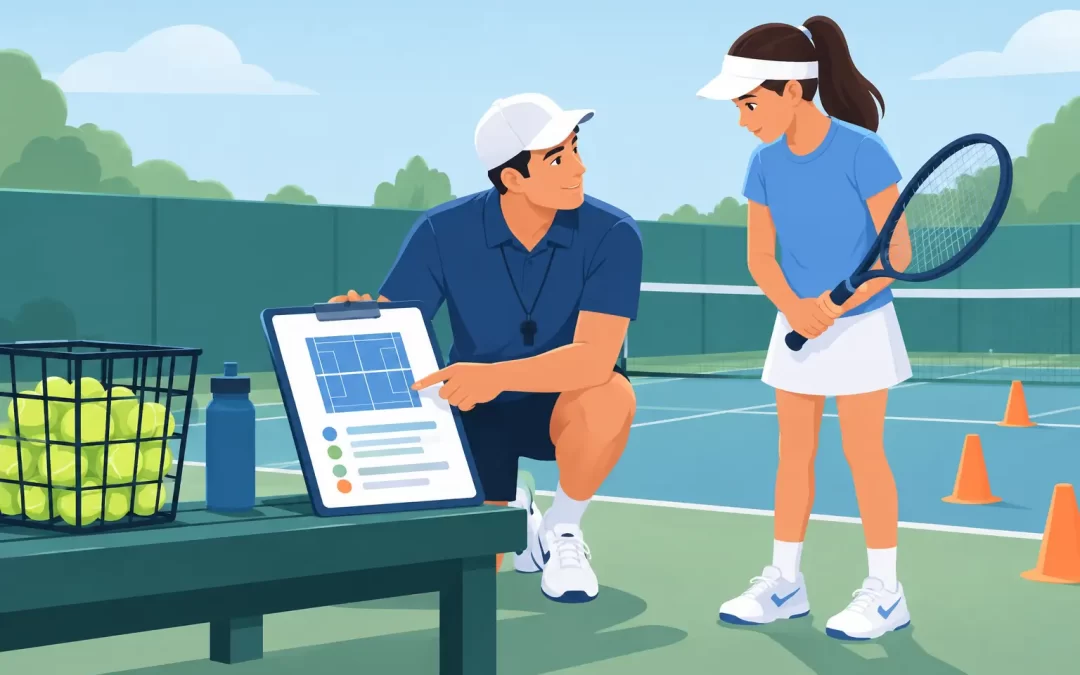
A junior can hit hundreds of forehands in a week and still fail to improve if those repetitions have no purpose. To organize junior tennis training effectively, parents and players need more than a calendar full of lessons, clinics, and matches. They need a progression system that connects technical work, movement, tactics, mindset, and recovery.
The goal is not to keep a young player busy. The goal is to build a player who understands how to practice, competes with confidence, and develops skills that hold up under pressure.
Start With the Player, Not the Schedule
Training should begin with an honest assessment of the junior in front of you. Age matters, but developmental stage matters more. A motivated 10-year-old with sound coordination may be ready for more structured repetition than a 13-year-old who is still learning to control balance, spacing, and attention.
Look at four areas: stroke fundamentals, movement quality, match awareness, and emotional response. Can the player rally with shape and consistency? Do they recover after each shot? Do they recognize when to attack, defend, or use margin? What happens after an error or a close game?
These answers determine the right training priorities. A beginner does not need an advanced match-analysis routine before they can sustain a controlled rally. A competitive junior with reliable strokes may not need more technical volume as much as better serve patterns, return decisions, and pressure training.
Parents should avoid comparing their child’s schedule to another player’s. More court time is not automatically better. The right amount depends on the player’s goals, physical maturity, school demands, current workload, and ability to recover with energy and focus.
Organize Junior Tennis Training Around Clear Priorities
Every training block should have one primary objective and a small number of supporting objectives. When every practice attempts to fix everything, the player leaves with plenty of information and very little progress.
A four-to-six-week block works well for many juniors. For example, the primary objective might be building a more dependable second serve. Supporting work could include shoulder-friendly strength exercises, return games that create second-serve pressure, and a simple between-point routine for staying composed after a double fault.
This structure gives each session a reason. Private instruction can refine mechanics. Group training can add live-ball repetition and decision-making. Match play reveals whether the new skill survives when the score matters. Video review helps the player see patterns that are difficult to feel in real time.
Strong development comes from connecting these pieces, not treating each one as a separate activity.
Build one weekly theme
A weekly theme keeps training focused without making it repetitive. One week might center on “play deeper through the middle before changing direction.” Another might focus on “serve plus first ball.” The player should be able to state the theme in plain language before stepping on court.
That theme should appear in drills, points, and match reflection. If the lesson teaches a higher net-clearance forehand but weekend matches reward low-percentage winners from behind the baseline, the training message is unclear. The player needs a consistent performance standard.
Give every session a job
A productive practice usually includes a warm-up, a technical or movement emphasis, a decision-making segment, and a competitive finish. The proportions change based on the player’s level and the day’s goal.
For a developing junior, the main body of practice may emphasize rally tolerance, athletic movement, and basic ball control. For a tournament player, more time should be spent on serve and return patterns, score-based games, transitions, and pressure situations.
The competitive finish is not optional. Juniors must learn to execute skills when points have consequences. A player who looks excellent in cooperative drills but panics at 30-30 does not need criticism. They need repeated exposure to score, choices, and emotional control in practice.
Create a Weekly Training Rhythm
A practical weekly plan balances quality court time with physical development, school, and recovery. The exact schedule varies, but each week should include intentional work in five areas: technical development, live-ball training, match play, athletic movement, and recovery.
A younger beginner may do two or three court sessions per week, plus active play and basic coordination work. An aspiring competitive junior may train on court four to six days per week, with carefully managed strength, mobility, and conditioning. Tournament weeks require a different balance than development weeks.
Here is the key distinction: training days are not all supposed to feel the same. Some days are for learning. Some are for volume. Some are for competing. Some are for restoring the body and mind.
Avoid stacking hard sessions without a reason. A demanding lesson, intense fitness session, and long match on consecutive days can create fatigue that changes mechanics and reduces decision-making quality. If a junior is consistently tired, irritable, or losing enthusiasm, the solution is not always more discipline. It may be a better workload.
Use Match Play as Feedback, Not Judgment
Matches are essential because they expose the gap between practiced ability and competitive performance. They should not become a weekly verdict on a junior’s talent or future.
After a match, review three questions: What patterns worked? Where did points break down? What is one priority for the next practice? Keep the conversation specific. “You need to focus more” is vague. “Your return position gave away too many short balls on second serves” creates an actionable target.
Statistics can help when they are simple. Track first-serve percentage, double faults, return depth, unforced errors by side, and points won using the intended pattern. Do not turn a junior into an accountant during competition. Use data to identify trends, then return to a clear training focus.
Losses can be highly productive when the player learns to separate effort, decision-making, and outcome. A close loss played with disciplined patterns may show real progress. A win built on panic, pushing, or poor habits may reveal work that still needs to be done.
Develop the Mindset Alongside the Strokes
Junior tennis is emotional. There are missed calls, bad bounces, stronger opponents, public mistakes, and the pressure of adults watching from the fence. A training plan that ignores mindset leaves a major part of performance to chance.
Teach a short between-point routine early: reset body language, take a breath, choose the next intention, and move forward. It does not need to be complicated. The value comes from repetition until the routine is available when frustration rises.
Language matters as well. Replace labels such as “choker” or “head case” with useful observations. Did the player rush between points? Stop moving their feet? Abandon the game plan? These are trainable behaviors. Juniors improve faster when mistakes are treated as information rather than identity.
Parents can reinforce this by praising process. Ask what the player learned, what pattern they tried, or what they will practice next. Save technical coaching for the coach unless the coach has specifically asked for support at home. The car ride after a match should protect the player’s willingness to compete again.
Make Progress Visible
Young players stay committed when they can see evidence that training is working. Set measurable standards that fit the player’s level: sustain a 20-ball crosscourt rally, make seven of 10 second serves into a target zone, win a defined percentage of points starting with a neutral ball, or use a reset routine after every error in a set.
Review these standards every few weeks. Video can be especially valuable because players often remember only their best or worst moments. Seeing improved footwork, cleaner spacing, or better recovery positioning makes progress concrete.
This is where hybrid coaching can add real value. A short video clip, weekly plan, or coach message between sessions can prevent a lesson from becoming an isolated event. Point of Mind Coaching uses this kind of structured feedback to help players carry the right focus from the court into the rest of their training week.
Adjust the Plan Before the Player Burns Out
A well-organized plan is disciplined, not rigid. Growth spurts, school exams, injuries, tournament travel, and changes in motivation all require adjustment. Pushing through every warning sign is not toughness. It is poor long-term planning.
When progress stalls, first check the basics: sleep, recovery, workload, clarity of goals, and the quality of practice attention. Then determine whether the player needs a technical correction, more competitive repetition, or a simpler task. Often, reducing the number of priorities creates better results than adding another drill.
The best junior training plan gives a player direction without taking away ownership. When a junior understands the purpose of the work, tracks progress, and learns to respond to pressure, practice becomes more than time on a court. It becomes preparation for competing stronger, one deliberate session at a time.