
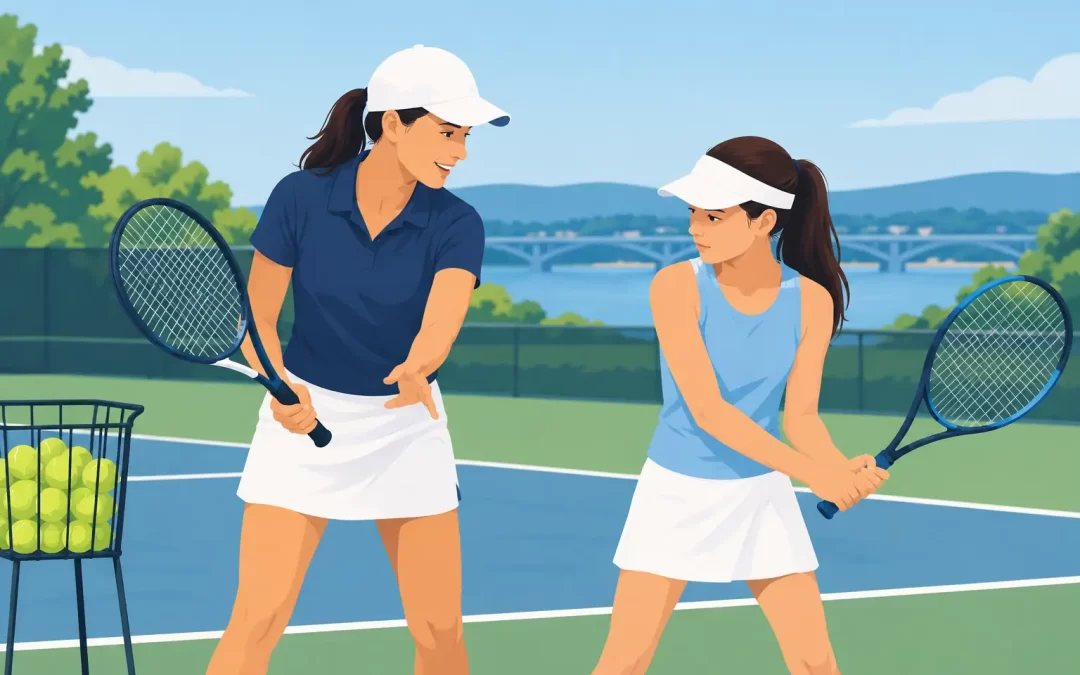
A player can take lessons for months and still hesitate on a second serve, lose the same rally pattern, or feel different in a match than on the practice court. That is why evaluating Westchester tennis instructor options should go beyond finding an available court time. The right coach gives you a system for improving between lessons, competing under pressure, and knowing exactly what to work on next.
For a beginner, that system creates sound habits before frustration takes hold. For a junior with competitive goals, it creates accountability and a measurable path forward. For an adult competitor, it turns scattered practice into training that carries over when the score is tight.
Westchester Tennis Instructor Options: Start With Your Goal
The first question is not, “Who has the best forehand?” It is, “What am I training for?” A coach who is a strong fit for a new player learning to rally may not be the best fit for a tournament junior building match strategy. Neither is inherently better. The fit depends on the player’s current level, commitment, and goals.
If your goal is to learn the game comfortably, look for instruction that emphasizes grip, spacing, balance, contact point, and basic rally skills. A new player needs clear progressions, not ten corrections at once. The best early lessons make tennis feel understandable while building the physical habits that will support more advanced strokes later.
If your goal is to win more league or club matches, your needs change. Technique still matters, but patterns of play, serve and return choices, transition skills, and shot selection become equally valuable. Many adult players do not need a complete technical rebuild. They need to recognize the ball they can attack, stop donating errors in predictable situations, and develop a dependable plan for pressure points.
Competitive juniors and aspiring tournament players need the deepest level of support. They benefit from a coach who can connect technical work to movement, decision-making, match analysis, recovery, and mindset. A good session alone is not enough. The player needs a weekly training plan and standards that hold up when the opponent changes the pace or the score reaches 5-5.
What Lesson-Only Coaching Can Miss
Private lessons are valuable, especially when a player needs direct feedback. But a lesson-only model has a limitation: the coach may see the player for an hour, while the player’s habits are shaped during every practice and match in between.
Without a plan, players often repeat what feels comfortable. They hit crosscourt forehands, avoid their backhand under pressure, and call it practice. Then they wonder why the same weakness appears in competition. Improvement requires purposeful repetition. It also requires feedback on whether the player is actually applying the intended change.
This is where hybrid coaching can make a meaningful difference. In-person instruction establishes the skill. Video review can reveal what changes under match pressure. Strategy coaching explains why a pattern breaks down. Direct communication and weekly plans help a player stay on task after leaving the court.
That structure is especially useful for motivated players whose schedules do not allow daily in-person training. Rather than treating the week as a gap between lessons, coaching turns it into part of the development process.
Evaluate the Coach’s Teaching System
A tennis instructor should be able to explain more than what to do with the racquet. Ask how they assess a player, set priorities, and measure progress. A clear answer signals that the coach has a repeatable process rather than a collection of drills.
Strong coaching usually begins with an assessment of technical fundamentals, movement, consistency, serve and return, tactical awareness, and competitive behavior. The findings should lead to a limited set of priorities. When everything is treated as urgent, players rarely make lasting progress.
The system should also match the player’s stage. Beginners need simple checkpoints and confidence-building reps. Intermediate players need greater control of height, depth, direction, and recovery position. Advanced players need training that reflects match realities: defending with purpose, creating offense, recognizing opponent tendencies, and managing momentum.
Ask what happens after the lesson. Does the player receive specific practice assignments? Is there a way to review match video? Can the coach adjust the plan after a poor performance or a breakthrough? These details separate instruction from development.
Credentials Matter, But Application Matters More
Certifications, playing experience, and professional affiliations can indicate that a coach has invested seriously in the craft. They are worth considering, particularly for families making a significant commitment to junior development. A coach with advanced credentials may bring broader technical knowledge and a more refined understanding of long-term progression.
Still, credentials alone do not guarantee the right fit. Watch how the coach communicates. Do they give feedback a player can use immediately? Do they balance correction with encouragement? Do they explain the reason behind a drill, or simply feed balls and move on?
For competitive players, look for a coach who understands that better tennis is not only cleaner stroke production. It is also emotional control, tactical discipline, and the willingness to choose the right shot when the easy choice is tempting. A player who can hit beautifully in a cooperative rally but cannot solve a match problem needs more than technical instruction.
Choose the Right Training Format
There is no single best format for every player. Private lessons provide the most individualized feedback and are often the fastest way to address a specific technical or tactical issue. They are a strong option for players who need focused attention, have demanding goals, or are preparing for competition.
Semi-private and small-group training can add a useful competitive element. Players learn to make decisions against live balls, handle different styles, and stay engaged when they are not the center of attention. The trade-off is less individual feedback per minute, so the group should be matched by level and have a clear purpose.
Online coaching and video analysis are valuable when they support, rather than replace, court training. They allow a player to review matches, clarify a tactical plan, and receive feedback without waiting for the next lesson. For a committed junior or adult competitor, that continuity can prevent small issues from becoming entrenched habits.
The most effective option may combine formats. A player might use private coaching for technical priorities, structured practice for repetition, match play for application, and video review for accountability. That is the model behind Point of Mind Coaching: building players through in-person instruction supported by planning, analysis, and ongoing coaching communication.
Questions Parents and Players Should Ask
Before committing to a program, have a direct conversation about expectations. A serious coach should welcome thoughtful questions because alignment saves time and protects the player’s confidence.
Ask how progress will be tracked over the next eight to twelve weeks. Ask what the player should practice independently and how often. Ask how the coach handles tournament feedback, match losses, and confidence issues. If the player has a specific weakness, ask whether it is a technical flaw, a tactical problem, a movement issue, or a combination of all three.
Parents of juniors should also ask how the coach communicates standards. The goal is not to create constant pressure. It is to help the player develop ownership, resilience, and mature habits. A young athlete should leave coaching knowing what success looks like beyond simply winning the next match.
For adults, ask whether the coaching reflects your actual playing environment. A 3.5 doubles player has different needs than a singles tournament player. Training should respect the player’s goals while still challenging limiting habits.
Make the Choice Based on Development, Not Convenience
Location, price, and scheduling matter. In a busy area like Westchester, convenience can determine whether a player trains consistently. But the most convenient lesson is not always the best investment if there is no plan beyond the hour on court.
Look for a coach who can identify the highest-value improvement, explain the path forward, and hold the player accountable to it. Progress in tennis rarely comes from one dramatic correction. It comes from disciplined work, informed feedback, and enough repetition for the right decisions to become reliable.
Choose instruction that gives you more than a good workout. Choose a process that helps you walk onto the court with a plan, adapt when the match changes, and compete stronger when the point matters most.