
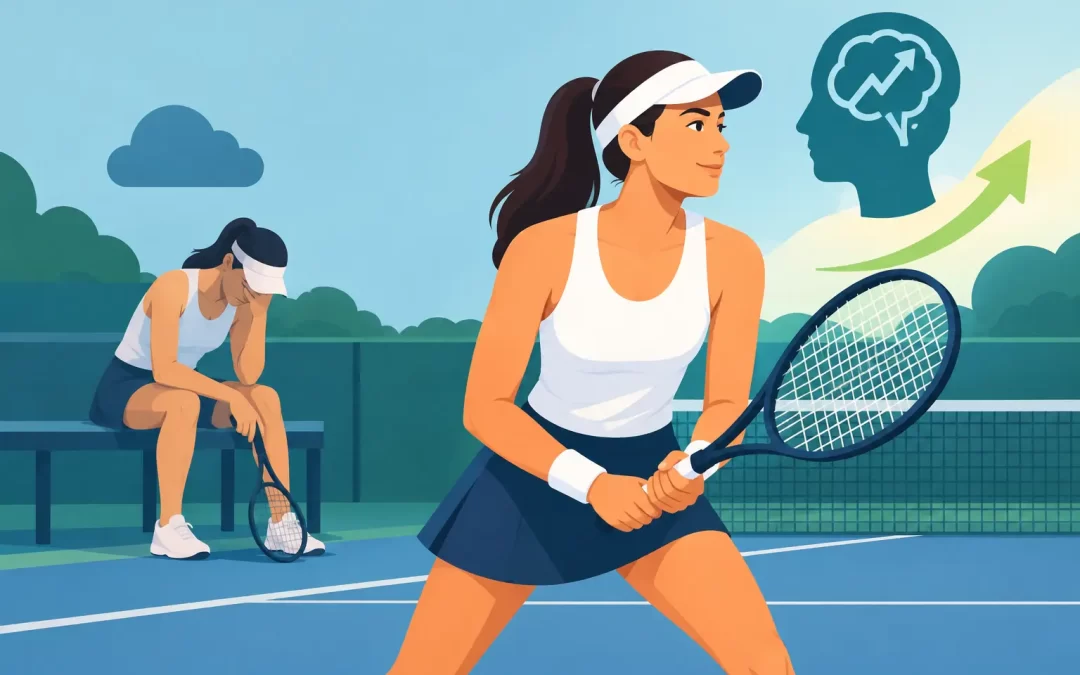
A 6-4, 6-4 loss can feel frustrating because it looks close on the scoreboard. But close scores often reveal a clear gap: one player made better decisions in the important moments. If you want to know how to stop losing in tennis, stop treating every loss as proof that your strokes are not good enough. Start treating it as performance data.
Players rarely lose for one reason. A missed forehand may be the final error, but the point may have been lost earlier through poor court position, an impatient target, a weak second-serve plan, or tension under pressure. Winning more matches requires a system that improves your technical execution, tactical awareness, physical reliability, and mindset together.
Stop Chasing Perfect Tennis
Many players believe they need to hit harder, cleaner, or more aggressively before they can win consistently. Sometimes technique is the limiting factor. More often, the issue is that a player tries to play perfect tennis when smart tennis would be enough.
You do not need to paint lines to beat a player at your level. You need to make fewer low-percentage choices than they do. That means giving yourself margin over the net, hitting to purposeful targets, recovering after every ball, and recognizing when the right shot is a neutral ball rather than a winner attempt.
Competitive tennis rewards the player who can repeat a quality pattern under stress. Build your game around shots you trust. If your crosscourt forehand is reliable, use it to establish the point. If your backhand breaks down when you rush, give yourself more height and space until you earn the chance to attack. This is not passive tennis. It is disciplined tennis.
Separate Errors From Bad Decisions
Not every missed shot is a bad shot. A player can make the correct tactical choice and miss by a few inches. That still deserves attention, but it is different from attempting a down-the-line winner from a defensive position with no balance.
After each match, identify whether your biggest problem was execution or decision-making. If you lost because you missed routine balls, your training must improve consistency, movement, and contact quality. If you lost because you repeatedly chose the wrong ball to attack, you need tactical training and clearer point construction. Guessing at the answer leads to unstructured practice. Reviewing the match gives your next session a purpose.
How to Stop Losing in Tennis by Winning the Patterns
Matches are not won one random point at a time. They are won through repeated patterns. The strongest players recognize what is happening and return to the patterns that give them the best odds.
Start by learning the answers to a few basic questions. Which wing breaks down first under pressure? Does your opponent struggle more with height, pace, spin, or movement? Can they hurt you from the baseline, or do they need short balls? What happens when you serve to their backhand? These observations turn a match from a collection of rallies into a problem you can solve.
A useful rule is to make the court smaller before you make it bigger. Early in a point, use higher-percentage crosscourt targets and create pressure through depth. Move your opponent, but do not overreach. Once you receive a short ball or force a weak reply, then change direction or come forward.
For many club and junior players, the highest-value patterns are simple:
- Serve to a clear target, then expect the likely return.
- Rally crosscourt until you receive a ball you can attack with balance.
- Use depth through the middle when you are under pressure.
- Attack short balls with margin, not desperation.
- Make your opponent hit one more quality shot at critical moments.
The right pattern depends on your game. An aggressive baseliner may use heavy forehands to open the court. A counterpuncher may win by extending rallies and changing height. A player with strong net instincts may use the serve and first volley to take time away. The goal is not to copy someone else’s style. The goal is to know what your best tennis looks like and organize your points around it.
Train the Score, Not Just the Stroke
A clean forehand in a feeding drill does not automatically hold up at 30-30. If your practice contains no consequences, no decisions, and no pressure, your match performance will eventually expose that gap.
Add score-based training to your weekly plan. Play points that begin at 30-30. Practice serving at 5-4. Play tiebreakers where every second serve must be hit to a selected target. Create games in which you only earn a point after a certain number of controlled balls. These constraints teach you to execute when the score matters.
You should also practice your first four shots. At most levels, the serve, return, and next ball shape the entire point. A player who serves well but has no plan for the next shot often gives away the advantage immediately. A returner who puts the ball safely in play but stands still afterward misses the chance to take control.
Before training, choose one measurable priority. It might be landing 70 percent of second serves, recovering behind every groundstroke, or returning crosscourt with depth. One clear objective creates feedback. Trying to fix everything in the same session creates confusion.
Build a Routine for Pressure Points
Pressure does not cause every mistake. But pressure reveals whether you have a process to settle yourself when the match becomes uncomfortable.
Between points, use a routine that is short enough to repeat. Turn away from the court, take a controlled breath, relax your hands, and choose the next point’s intention. Your intention might be “heavy crosscourt,” “first-serve percentage,” or “move my feet.” Keep it simple. The purpose is to direct attention toward an action, not toward the fear of losing.
Avoid arguing with yourself after an error. A visible reaction may feel honest, but it often carries frustration into the next point. Strong competitors reset quickly because they understand that the next point is the only point they can influence.
On big points, do not suddenly attempt a shot you have avoided all match. Trust a pattern you have earned. If your second serve has been reliable to the body, use it. If your opponent has struggled with deep crosscourt balls, make them handle another one. Confidence is not pretending you cannot miss. It is committing to a clear choice even when the outcome is uncertain.
Make Your Practice Match the Reason You Lose
Players plateau when they practice what they enjoy instead of what repeatedly costs them matches. If you lose because you cannot sustain rallies, more winner drills will not solve the problem. If your movement fades late in sets, an occasional casual hit will not build match fitness. If you freeze when opponents change tactics, you need coached problem-solving, not just more ball striking.
A structured development plan connects the loss to the training response. Technical work improves the stroke limitation. Movement training improves your ability to arrive balanced. tactical work gives you options when a match changes. Video review can reveal habits you do not feel, such as recovering too slowly, standing too close to the baseline, or attacking from poor positions.
This is where consistent feedback matters. A player can work hard for months and still repeat the wrong pattern without a coach or training partner who can identify what is actually happening. Point of Mind Coaching approaches development as more than a weekly lesson: the goal is to build a repeatable system for training, competing, reviewing, and adjusting.
Use Losses Without Letting Them Define You
After a loss, write down three things: what worked, what broke down, and what you will train before the next match. Be specific. “My backhand was bad” is not useful. “I gave up short balls because I contacted my backhand late when pulled wide” gives you a training target.
Also review the score honestly. Losing 7-6 in the third after competing with discipline is different from losing 6-1, 6-1 because you abandoned your plan after two errors. Both losses offer lessons, but they require different responses.
Do not measure progress only by wins this month. Measure whether you are serving with a plan, recognizing patterns earlier, recovering better between shots, and competing with more control when the score tightens. Those improvements are the foundation that makes winning more frequent and more sustainable.
The next time a match starts to slip away, do not search for a miracle shot. Slow the moment down, return to your strongest pattern, and make the opponent earn every point. That is how losses begin to become training evidence – and how your game begins to compete stronger.