
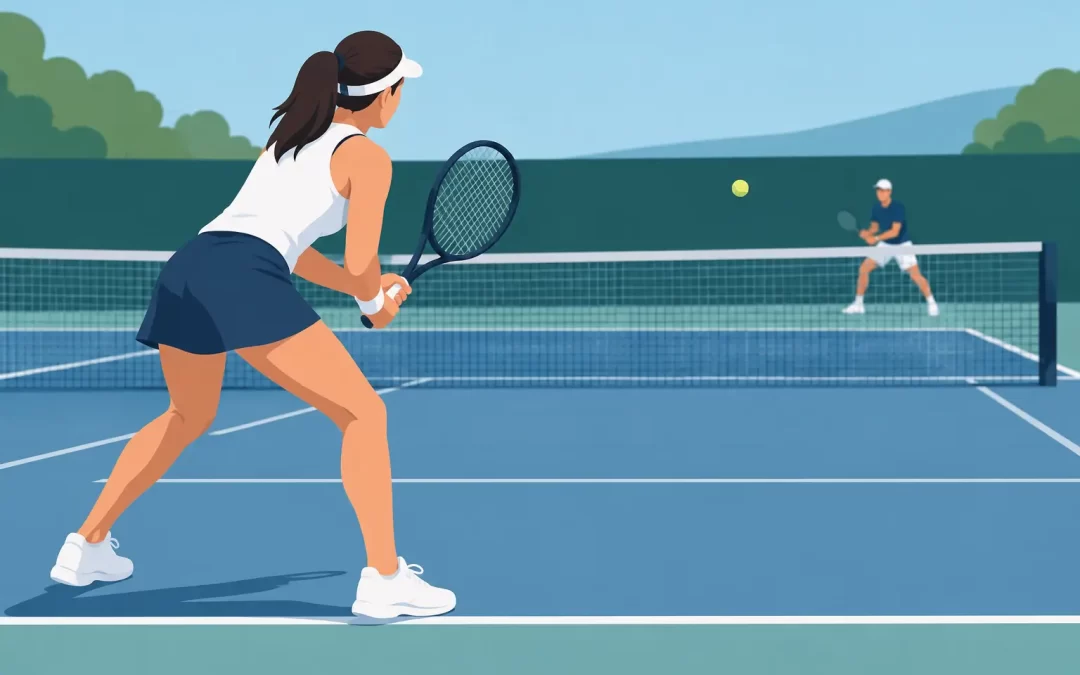
A returner who stands in the wrong place can make a manageable serve feel untouchable. To improve tennis return positioning, stop treating your starting spot as a fixed location. It is a tactical decision based on the server, the score, the surface, and the return you intend to make.
The return of serve is one of the few shots where your opponent controls the first ball. Your job is not to guess perfectly or hit a winner from a defensive position. Your job is to give yourself enough time, balance, and court coverage to neutralize the serve and begin the point on your terms.
Improve Tennis Return Positioning With a Baseline Plan
Start with a neutral return position, then make adjustments from there. Against a typical first serve, stand roughly one to two large steps behind the baseline. This gives you time to recognize the direction, make a split step, and create a compact swing. For many developing players, this is a better starting point than crowding the baseline and hoping for a quick reaction.
Your lateral position should usually be near the center mark, with your body slightly shaded toward the opponent’s most likely serve. On the deuce side, that may mean respecting a right-handed server’s wide slice. On the ad side, it may mean preparing for the wide kick or slice that pulls you off the court. Do not overcommit. Shade your position enough to protect the percentage play while keeping the body serve covered.
A strong return position is not just where your feet are. It includes your posture. Stay low enough to move immediately, hold the racket in front of your body, and keep your weight balanced on the balls of your feet. If your heels are heavy or your racket starts beside your hip, your position will fail even if you are standing in the correct spot.
Read the Serve Before You Move
Positioning improves when you learn to collect better information before contact. Watch the server’s toss, shoulder turn, toss location, and contact point. These details are not guarantees, but they create useful clues.
A toss that drifts farther to a right-handed server’s right often supports a slice serve. A toss that stays more over the head can produce a flatter serve or kick, depending on the player’s mechanics. The server’s stance and prior patterns matter too. If they have served wide on three important points, they may return there when pressure rises.
Use those observations to make small adjustments, not dramatic guesses. Moving two feet toward a wide serve can be smart. Moving so far that a body serve jams you is not. Competitive returners protect the middle first because a serve into the body removes time and exposes poor spacing.
Between points, ask a simple question: What is this player trying to do with the serve? Some servers want a weak ball to their forehand. Others are trying to open the court for the next shot. Once you understand the pattern, your return position becomes intentional rather than reactive.
Know When to Move Forward or Back
The distance behind the baseline depends on the quality and type of serve. There is no single position that works against every opponent.
Against a powerful flat first serve, moving farther back often gives you the reaction time needed to make clean contact. The trade-off is that you may give the server more time to establish the first attacking shot. When you stand deeper, commit to returning with depth and height through the middle or crosscourt. A short defensive return gives away the advantage you created with extra time.
Against a slower second serve, move forward. Taking the ball earlier puts pressure on the server and prevents a high-bouncing kick serve from pushing you too far behind the baseline. This does not mean rushing recklessly. Move in only far enough that you can still split step, see the ball, and swing with balance.
For juniors and recreational competitors, a useful rule is this: step inside the baseline against a second serve you can attack, stay near the baseline against a second serve that has pace or heavy kick, and move back when the ball consistently climbs above your comfortable strike zone. The correct answer depends on your ability to control the return, not on copying a professional’s court position.
Build Your Position Around the Split Step
Many return problems that look like positioning problems are actually timing problems. You can stand in an excellent location and still feel late if your split step happens after the server hits the ball.
Begin your split-step motion as the server moves into the upward swing. Land as the ball leaves the racket. From that landing position, push toward the ball with the outside leg and take the smallest number of steps needed to create space.
Do not bounce aimlessly while waiting. Your split step should be a purposeful loading action. The feet land apart, knees flex, and your center of gravity stays forward. That ready position lets you handle a wide serve, a body serve, or a serve down the T without a major reset.
If you regularly get jammed, first check whether you split too late. Players often respond by standing farther back, but that only masks the real issue. Better timing may allow you to hold a more aggressive return position without losing control.
Use Different Positions for First and Second Serves
Standing in the same place for every serve makes you predictable and limits your options. Make the server feel the difference between a first-serve return and a second-serve return.
On first serves, prioritize contact and depth. Keep the backswing compact, aim through larger targets, and accept a neutral return when the serve is strong. Your position should help you get the ball in play with quality, not force a low-percentage strike.
On second serves, show greater intent. Move forward when appropriate, take away time, and look to return with purpose. A deep return through the middle can be more damaging than an ambitious angle because it reduces the server’s ability to attack with the next ball. If you are receiving a weak second serve, position yourself to take control, but do not confuse aggression with overswinging.
This contrast also creates mental pressure. Servers notice when a returner steps in. Even if you do not hit a winner, you may force a safer second serve and receive more attackable balls later in the set.
Practice Return Positioning With Constraints
You will not improve this skill by returning serves randomly from the same spot. Build structure into practice. Use cones, court lines, or visual markers to identify three return positions: deep, neutral, and aggressive. Have a partner serve sets of first and second serves while you choose the position before each ball.
Track whether your choice produced clean contact, a return in play, and a return that did not leave you immediately defending. After ten serves, assess the pattern. Were you late because you stood too close? Were you giving away court because you stood too far back? Did you fail to adjust laterally for a serve that repeatedly targeted one area?
Video review is especially useful here. On court, players often believe they are moving forward on second serves when they are still well behind the baseline. Video shows the truth: where you began, when you split, how far you moved, and whether your position matched the serve. This type of feedback is central to a structured development process at Point of Mind Coaching.
Add score-based drills once your mechanics are stable. Play return games where you must call your intended position before the serve. Award yourself an extra point for a deep, controlled return from the correct position. The goal is to connect court awareness to competitive decision-making, not just hit more balls.
Avoid the Common Positioning Traps
The first trap is standing too close because you want to look aggressive. If you cannot react to pace, your aggression becomes panic. The second is retreating far behind the baseline against every serve, which may keep the ball in play but gives the server too much time and space.
Another mistake is ignoring the body serve. Players often shade so far toward the wide serve that they leave no room to clear their hands and rotate through contact. Keep enough space to move around the ball or block it back with a firm, compact racket face.
Finally, do not let one missed return force a major adjustment. A missed wide serve does not automatically mean you need to stand farther toward the alley. Ask whether you read it late, split late, chose the wrong target, or simply missed a makeable ball. Good competitors make evidence-based adjustments.
The best return position is the one that gives you a calm first move and a clear purpose for the ball that follows. Train it with discipline, adjust it with intent, and every serve you face becomes a chance to compete stronger from the first shot.