
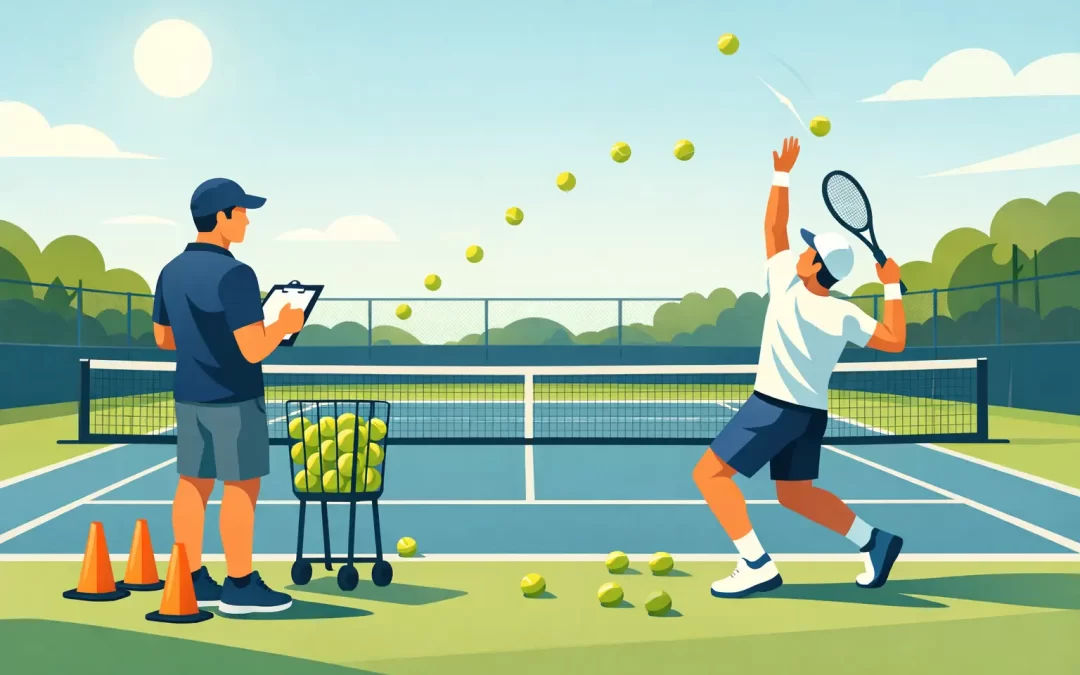
A serve can look excellent in a lesson and still disappear at 4-4 in a tight set. The difference is rarely effort alone. The best ways to practice serves build repeatable mechanics, clear target awareness, and the confidence to execute when the score creates pressure. Randomly hitting a bucket of balls may tire your shoulder, but it will not necessarily make your serve more dependable.
For juniors, competitive players, and committed adults, serving practice should have a purpose. Every session needs a technical focus, a target, and a way to measure whether your work carries into match play. That is how a serve becomes more than a point starter. It becomes a weapon that protects your service games and creates opportunities on the next ball.
Start With a Serve Practice Plan
A productive serve session does not begin by trying to hit hard. It begins by deciding what you are training. You may be improving your first-serve percentage, developing a more reliable second-serve kick, or learning to serve wide when your opponent is under pressure. Those are different goals, and they require different targets and scoring systems.
Choose one primary objective for each session. If your toss is inconsistent, do not spend the same session judging yourself on serve speed. If you are working on a slice serve, do not switch back and forth between every serve variation after two balls. Focus creates better feedback.
A strong 30- to 45-minute practice block can include a brief warm-up, technical repetitions, target work, and a pressure segment. This structure keeps the session focused while also training the player to perform, not just to swing.
Build the Motion Before You Add Speed
Many players try to fix their serve by forcing more power. Usually, that creates a tighter arm, a lower contact point, and less control. Power comes from an organized kinetic chain: a balanced base, leg drive, torso rotation, shoulder motion, and a relaxed acceleration through contact.
Start with shadow serves without a ball. Rehearse the rhythm from the ready position to the trophy position and through the finish. Pay attention to balance. If you fall heavily to the left or right after contact, your body may be working around an unstable toss or rushed loading phase.
Then use abbreviated serves from the service line or just behind it. Begin in a trophy-position setup and focus on reaching up to a high contact point. This reduces moving parts and helps players feel the upward extension required for spin and margin. It is particularly valuable for players who collapse their elbow or pull their head down before contact.
Once the motion is organized, move back to the baseline. Do not assume that every practice serve needs maximum pace. A controlled 70 percent serve hit with the right shape, height, and target is often more valuable than a full-speed miss.
Train the Toss as Its Own Skill
The toss determines whether the rest of the motion has a chance. A poor toss forces last-second adjustments, which leads to inconsistent contact and unreliable direction. Yet many players only notice their toss when a serve misses.
Practice tossing without hitting. Place a racquet or a small marker on the court where you want the ball to land, then repeat until the toss drops consistently into that area. For a right-handed player, a flatter first-serve toss typically sits slightly into the court and in front of the hitting shoulder. A slice or kick variation may require a slightly different placement, but the toss should never feel like a rescue mission.
Use your phone to record from the side and behind the baseline. Video often reveals patterns that feel invisible: a tossing arm that drops too early, a ball tossed too far behind the head, or a toss that varies wildly from one serve to the next. Objective feedback beats guessing.
The Best Ways to Practice Serves Use Targets
A service box is too large to be a useful target by itself. If your goal is simply to get the ball in, you will practice broad intentions and get broad results. Create smaller target zones that reflect the serves you need in real points.
For example, place cones, flat markers, or spare balls near the wide target, body target, and T target in each box. You do not need to hit a tiny spot every time. The goal is to develop a clear visual picture before you begin your motion and to measure whether your ball is landing in the intended area.
Train direction before chasing pace. First, hit ten first serves to the deuce-court T at a controlled speed. Then work ten wide serves. Keep track of how many land in your target zone, not merely inside the box. Repeat the same pattern on the ad side.
For second serves, set a higher standard for margin. Give yourself a target that clears the net comfortably and lands with enough shape to push the returner away from the baseline. A second serve that barely catches the line in practice may feel impressive, but it is not the serve you want at 30-30.
Practice First and Second Serves Differently
Your first serve and second serve have different jobs. The first serve is designed to create an advantage through pace, placement, disguise, or a combination of all three. The second serve must be dependable enough to survive pressure while still preventing your opponent from attacking freely.
First-serve practice should include patterns. Serve wide, then imagine or have a partner feed the next ball into the open court. Serve into the body, then look for a shorter return. This connects the serve to the next shot, where many points are actually won or lost.
Second-serve practice should prioritize shape and intention. Work on brushing up and across the ball while maintaining a loose arm and a high finish. A player with a reliable topspin or kick second serve has more freedom to swing in pressure moments. That freedom changes the entire service game.
If you are a newer player, a consistent topspin serve may be a better investment than trying to develop an advanced kick serve too soon. Build a second serve you can trust first. Then add more height, movement, and disguise as your fundamentals improve.
Add Pressure Before Match Day
Serving alone is useful, but it does not fully prepare you for the score. In matches, you must serve after a double fault, when the opponent is watching your favorite target, and when one point can change the set. Pressure practice teaches you to return to your process under stress.
Use scoring games that have consequences. Play a first-serve percentage challenge in which you must make seven of ten serves to a chosen target before moving on. For second serves, require yourself to make three in a row to each service box. If you miss, restart the count. The goal is not punishment. It is learning how to reset your breathing, visualization, and rhythm after an error.
Another effective drill is the “serve plus one” challenge. Start each point with a declared serve target, then play the point out with a partner. You earn a bonus point if the serve lands in the intended zone and you execute the planned first-ball pattern. This develops tactical discipline rather than relying on hope.
Do not make every serve practice a pressure test. Too much consequence work can make players overly mechanical or tense. Use technical training early in the session, then finish with a shorter competitive segment once the movement is established.
Use Feedback to Avoid Repeating the Same Mistake
Repetition only helps when the repetitions are pointed in the right direction. If you practice a flawed toss, late contact, or poor balance for 100 serves, you have simply become more familiar with the problem.
Film a few serves at the beginning and end of a session. Review one or two priorities rather than analyzing every detail. A player may need to focus on keeping the tossing arm up longer, reaching higher at contact, or landing with balance inside the court. Trying to correct five things at once usually produces confusion.
Coaching feedback accelerates this process because it connects what you feel with what is actually happening. At Point of Mind Coaching, video review and structured training plans help players identify the highest-value adjustment, then build drills that make the correction stick between lessons.
Protect Your Shoulder and Train With Intent
Serving is demanding on the shoulder, elbow, and lower back. A fatigued shoulder does not learn clean mechanics. Warm up the rotator cuff, upper back, hips, and trunk before serving at full intensity. Build volume gradually, especially if you are returning after time away or increasing your weekly training load.
Quality matters more than endless volume. Twenty-five focused serves with clear targets and feedback can be more valuable than 150 rushed balls. Stop when your mechanics break down significantly. Continuing to serve through fatigue may reinforce poor positions and increase injury risk.
Keep a simple record after each practice: first-serve percentage, second-serve percentage, best target, weakest target, and one technical cue for the next session. Over several weeks, this turns serving practice into measurable development instead of a vague routine.
The serve rewards players who train with patience and standards. Walk to the baseline knowing your target, your shape, and your next-ball intention. When pressure arrives, trust the process you have practiced.