
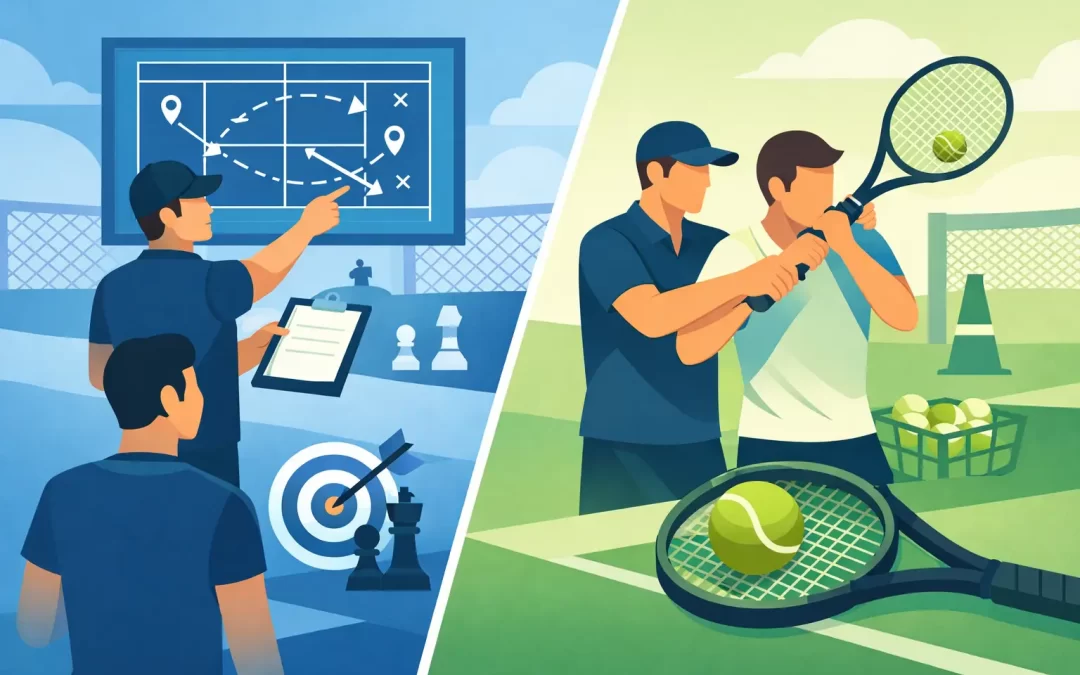
A player can hit clean forehands in practice and still lose to an opponent who simply understands where to serve, when to defend, and how to manage pressure. That is the real question behind tennis strategy coaching vs stroke coaching. Both matter, but they solve different performance problems. Players who want consistent progress need to know which problem is holding them back before adding more training.
Stroke coaching builds the tools. Strategy coaching teaches the player how and when to use them. When those areas are developed together, practice becomes more purposeful and match results become more predictable.
What Stroke Coaching Develops
Stroke coaching focuses on how a player produces the ball. It addresses grip, preparation, footwork, swing path, contact point, balance, recovery, serve mechanics, and consistency. For a beginner, this work is essential. A player cannot execute a reliable pattern of play without a dependable serve, rally ball, return, and ability to move into position.
Strong technical coaching does more than make a stroke look better. It helps a player create margin over the net, control depth, generate appropriate pace, and reduce unforced errors. A sound backhand gives a player more options under pressure. A more efficient serve creates easier first balls. Better movement allows technique to hold up when the point becomes physical.
Technical work is also necessary when a player has a clear limitation. If a junior is late on every high backhand, the answer is not only tactical. The player may need earlier preparation, better spacing, or a more stable contact point. If an adult player double-faults at key moments, a coach may need to address the serve motion, second-serve shape, and rhythm before asking for more aggressive match decisions.
The limitation of stroke-only coaching appears when lessons stay disconnected from competition. A player may improve a forehand in a basket drill, then return to matches without knowing when to attack, when to reset the rally, or how to protect a weaker wing. The stroke improved. The player’s decision-making did not.
What Tennis Strategy Coaching Adds
Tennis strategy coaching focuses on the choices that shape points, games, and matches. It teaches players to recognize patterns, assess opponents, use score situations intelligently, and build points around their actual strengths.
This is not about memorizing complicated plays. It starts with competitive awareness. Can the player identify the opponent’s weaker side? Do they know whether the opponent struggles more with depth, height, pace, or movement? Can they recognize when an opponent is defending and when that opponent has regained control of the point?
A player with strategy training begins to see the court differently. Instead of trying to hit a winner from every neutral ball, they learn to earn an attacking position. Instead of returning serve without a plan, they choose a safe target that keeps the opponent from taking immediate control. Instead of blaming nerves after a tight set, they can identify the decisions that created unnecessary risk.
Strategy also gives players a repeatable response under pressure. At 30-30, the goal is rarely a perfect shot. It is a clear, high-percentage pattern the player has practiced: a reliable serve location, a disciplined return target, or a crosscourt ball that creates room for the next shot. Confidence grows when players know what they are trying to do.
Tennis Strategy Coaching vs Stroke Coaching: The Real Difference
The simplest difference is this: stroke coaching improves execution, while strategy coaching improves selection.
Execution asks, Can you hit the ball you intend to hit? Selection asks, Was that the right ball to hit in that moment? Matches demand both. A player with excellent technique but poor selection often gives away points. A player with smart ideas but unreliable strokes cannot carry out the plan consistently.
Consider a player facing a deep, heavy ball to the backhand. Stroke coaching may improve the player’s ability to handle that ball with better footwork and a more stable swing. Strategy coaching may teach the player that this is not the moment to force a down-the-line winner. A higher crosscourt response may buy time, move the opponent, and restore a neutral position.
Neither approach is automatically better. It depends on the player’s stage of development and the evidence from real matches. Beginners usually need a greater share of technical work because they are building their foundation. Intermediate players often need both technical reinforcement and a clearer understanding of patterns. Competitive juniors and serious adult players frequently benefit most from strategy coaching because their matches are decided by margins, choices, emotional control, and repeated situations rather than one obvious technical flaw.
Signs You Need More Strategy Training
Many players assume they need a new stroke whenever they lose. That assumption can lead to endless technical changes and very little match improvement. Strategy may be the missing piece if you regularly experience the following patterns:
- You play well in lessons but cannot reproduce it in matches.
- You lose to players who seem less powerful or less technically polished.
- You make different decisions when the score gets tight.
- You do not have a clear plan against pushers, big hitters, or strong servers.
- You finish matches unsure why you won or lost.
These are not signs of a lack of effort. They are signs that the player needs a better competitive framework. Match analysis, guided practice plans, and direct feedback can turn vague frustration into specific training priorities.
The Most Effective Model Combines Both
The best development programs do not separate technique and tactics into unrelated categories. They connect them. A player might work on a higher, heavier crosscourt forehand technically, then use that ball in a drill designed to push an opponent behind the baseline. The stroke has a purpose. The strategy has an execution standard.
The same connection applies to serves. A technical session may improve leg drive, toss consistency, and pronation. Strategy training then asks where that serve should go at deuce court, ad court, break point, or against a returner who stands far behind the baseline. A stronger serve becomes more valuable when the player knows how to build the next ball.
Movement training works the same way. Players should not only learn to recover after a shot. They should understand where to recover based on the ball they hit and the likely reply. Recovery position is a tactical decision supported by physical skill.
For committed players, video review is especially valuable because it reveals the gap between perception and reality. A player may believe they are losing because their backhand breaks down. Video may show that the problem begins earlier: short rally balls, poor court positioning, or rushed shot selection. That clarity prevents wasted practice time.
How to Structure Training for Match Results
A productive week should include technical repetition, live-ball decision-making, and match reflection. The exact balance changes based on age, level, and tournament schedule, but the training should not be random.
A developing player might spend more time on fundamental stroke patterns, serves, returns, and movement. As reliability improves, more training should shift toward point construction, score-based games, transition play, and opponent-specific adjustments. Competitive players need regular practice under consequences, not only cooperative rallies where every ball arrives comfortably.
After a match, avoid the unhelpful verdict of “I played badly.” Review a few specific questions instead. Which patterns produced the most errors? Which serve and return situations felt uncertain? Did the player lose points through execution, selection, or emotional discipline? The answers should shape the next training session.
This is where structured coaching creates momentum. Rather than rebuilding everything after a loss, the player identifies one or two priorities and works on them with intention. Over time, that process builds a game that holds up beyond the practice court.
Choosing the Right Focus Right Now
If your technique prevents you from rallying, serving consistently, or controlling basic directional targets, prioritize stroke coaching. Build the foundation first. If your strokes are dependable in practice but your matches remain inconsistent, add strategy coaching immediately. The goal is not to choose one forever. The goal is to give your training the emphasis your game needs now.
Parents of junior players should look beyond whether a lesson produces a cleaner-looking swing. Ask whether the player is learning to compete with composure, solve problems independently, and understand patterns of play. Adult players should ask whether practice is preparing them for the score pressure and awkward ball situations they face on match day.
At Point of Mind Coaching, the standard is not simply hitting better during a lesson. It is developing the technical, tactical, and mental discipline to compete stronger when the result matters. Build the stroke, train the decision, and give every practice session a clear purpose.