
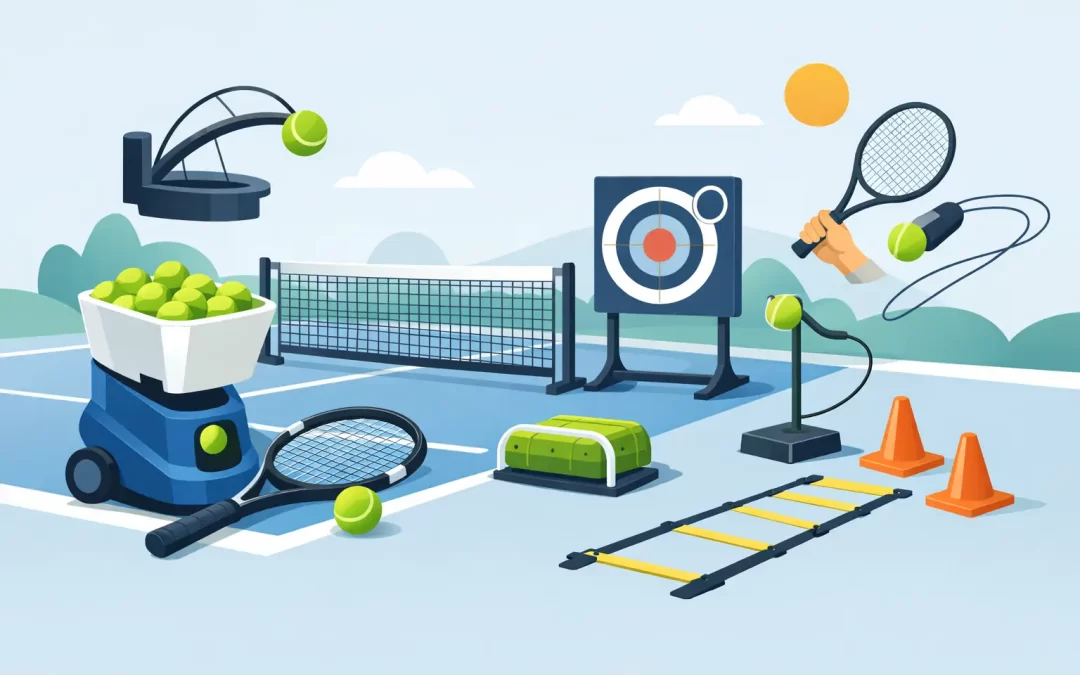
A basket of balls and an extra hour on court will not automatically create better tennis. The best tennis training aids give each repetition a purpose: cleaner contact, quicker feet, a more reliable serve, or better decisions under pressure. Used well, they turn practice from random hitting into measurable development.
The key is not buying more equipment. It is choosing a tool that addresses the specific limitation holding a player back, then using it within a structured plan. A junior who reaches late to the ball needs a different aid than an adult player whose forehand breaks down in tight match situations.
What Makes a Training Aid Worth Using?
A useful aid creates immediate feedback. It helps a player see, feel, or measure whether the movement was correct without needing a coach to interrupt every repetition. The best tools are simple enough to use consistently, yet specific enough to reinforce the right habit.
Avoid equipment that promises to fix every part of your game at once. Tennis is a movement, timing, and decision-making sport. No device can replace technical coaching, live-ball practice, or match play. Training aids work best as focused additions to those essentials.
Before buying anything, identify the performance problem. Is the player losing balance on wide balls? Mishitting volleys? Serving without a repeatable toss? Practicing with no targets or standards? A clear answer makes the right choice much easier.
10 Best Tennis Training Aids for Focused Development
1. Flat court markers
Flat rubber markers may be basic, but they are among the most valuable tools on a tennis court. Use them to create recovery zones, target areas, approach-shot landing spots, and movement patterns for split steps and directional changes.
They are especially effective for younger players who need visible structure. Rather than saying, “Recover faster,” place a marker where recovery should happen and build a drill around it. The player can now measure whether they return to position after each shot.
2. Agility ladder
An agility ladder can improve coordination, rhythm, and foot-speed awareness when it is used correctly. It is not a substitute for tennis movement. Players do not move through a point in neat ladder patterns. But it can help build body control, particularly for developing juniors and players who struggle to organize their feet before striking the ball.
Keep the work short and purposeful. Use it as part of a warm-up, then immediately transfer that footwork emphasis to live tennis movement. If the player looks quick in the ladder but still arrives off-balance to the ball, the training has not transferred yet.
3. Mini hurdles
Mini hurdles train knee lift, coordination, and explosive first steps. They are useful for players who move flat-footed, cross their feet while recovering, or fail to load properly before changing direction.
The value is in quality, not fatigue. A few precise sets with athletic posture are more productive than turning the drill into conditioning. Follow hurdle work with short reaction-based court drills so the player learns to apply that sharper movement to a ball.
4. Resistance bands
Resistance bands are practical for shoulder preparation, hip activation, core control, and rotational strength. For tennis players, they are most useful before practice and as part of an organized off-court routine.
Bands can support healthier serving mechanics by strengthening the shoulder and upper back, but they cannot correct a flawed serve by themselves. A player with pain, recurring discomfort, or a major technical issue should work with qualified coaching and appropriate medical guidance rather than trying to train through the problem.
5. A serve target or target cones
Many players serve basket after basket without a target. That is activity, not necessarily training. A simple set of cones or a portable target gives every serve a location, intention, and result.
Set targets for the wide serve, body serve, and T serve. Track how many serves land in the intended area out of 10, then repeat under a score-based consequence. This develops accuracy, but it also develops the ability to execute when the player knows the result matters.
6. A toss-training aid
An inconsistent toss creates an inconsistent serve. A toss-training aid, whether it is a visual reference, a practice attachment, or a simple marked contact zone, can help players establish a more repeatable release and placement.
Use it carefully. The goal is not to force every serve into one identical toss position. Slice, kick, and flat serves require subtle variations. The real objective is a toss that is controlled enough to support the intended serve rather than forcing the player to chase the ball.
7. Rebounder net
A rebounder net is one of the better at-home options for developing feel, preparation, and repetition. It is useful when court access is limited and can support forehands, backhands, volleys, and reaction work.
Its limitation is predictability. A rebounder cannot reproduce the height, spin, pace, and decision-making demands of a live opponent. Use it to sharpen a technical focus, then test that skill in movement-based drills and match situations.
8. Swing-path trainer
Swing-path trainers can provide a helpful physical reference for players learning spacing, extension, or a more stable contact point. They are most beneficial at the beginner and intermediate levels, where a player may need a clear external cue to organize the stroke.
Be cautious about overusing them. Good strokes adapt to different ball heights, speeds, and positions. If a player becomes dependent on one prescribed path, they may look polished in a drill but struggle when the point becomes unpredictable. A coach should use the trainer to establish a feeling, then remove it.
9. Ball machine
A ball machine is a serious investment, but it can be one of the best tennis training aids for committed players. It delivers high-volume repetition and makes it possible to train patterns that are difficult to repeat consistently with a partner.
The most productive ball-machine sessions include movement, targets, and consequences. For example, a player might hit four crosscourt balls, change direction down the line, recover, and repeat. Simply standing in one spot and hitting 100 forehands builds comfort. It does not necessarily build match readiness.
10. Phone tripod for video analysis
For many players, the most powerful training aid is already in their pocket. A phone tripod makes video review accessible and gives the player evidence instead of assumptions. It can reveal a late unit turn, poor spacing, an unstable serve toss, or a recovery step that feels quick but is actually delayed.
Film from useful angles and review one priority at a time. Trying to correct five technical details from one clip usually creates hesitation. A structured video review should lead to one clear practice cue, followed by drills that let the player apply it.
How to Build the Best Tennis Training Aids Into Practice
Equipment does not create progress. A practice system does. Start each session with one technical or movement goal, select the aid that reinforces it, and establish a standard for success. That might be eight of 10 serves to a target, a certain number of balanced recoveries, or a percentage of balls struck through a defined court zone.
Then add pressure. Players often execute well when there is no score, no consequence, and no uncertainty. Build in a challenge: complete the target sequence before leaving the court, play a point after every successful pattern, or restart the count after an error. This connects training to competition.
At Point of Mind Coaching, this is the standard behind purposeful development: tools support the plan, feedback directs the adjustment, and match performance determines what comes next. The aid is never the program.
Choose Tools That Match the Player
Parents should resist the urge to buy every new gadget for a junior player. Start with versatile basics such as markers, cones, mini hurdles, and a tripod. These tools remain useful as the player develops because they support movement, targets, and feedback rather than one temporary technical fix.
Competitive players may benefit from a ball machine, video setup, and targeted serve equipment, particularly if they have a weekly plan and coach feedback. Adult recreational players often improve fastest by choosing one priority – serve consistency, footwork, or contact – and practicing it with a clear score instead of trying to rebuild their whole game at once.
The right training aid should make better practice easier to repeat. Choose one that exposes a real weakness, train with a standard, and carry that work into the moments that matter most: the points you need to win.