
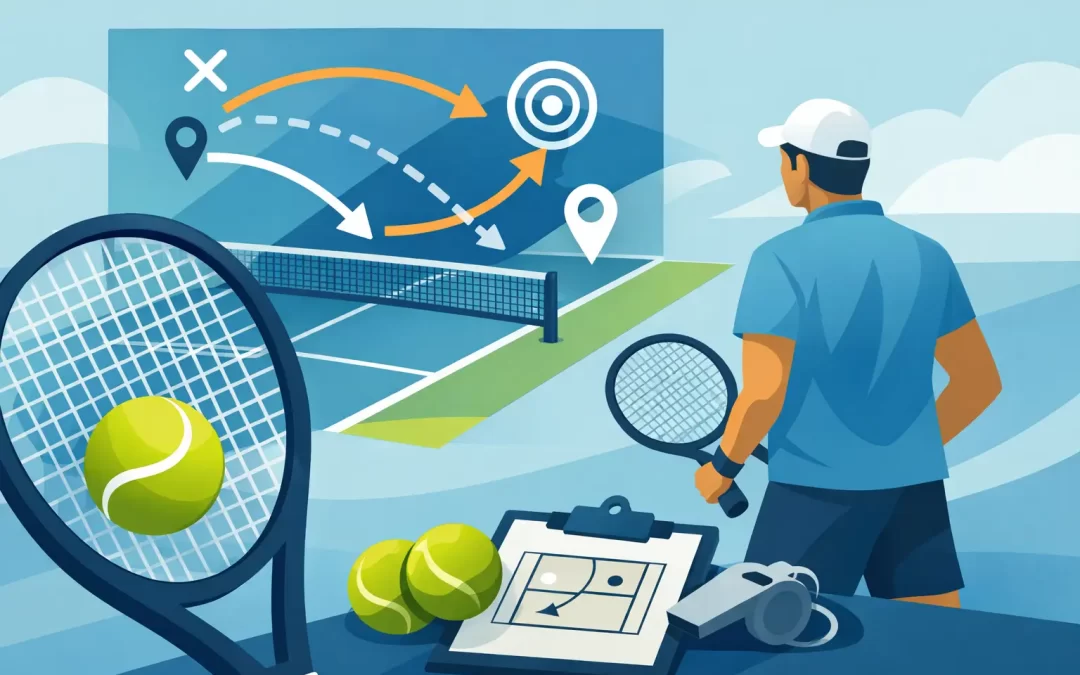
The difference between winning and losing often has less to do with your best shot and more to do with your decisions between shots. That is where tennis match strategy separates players who compete with purpose from players who simply react. If you want better results, you need more than clean strokes. You need a plan you can trust under pressure.
Most players go into matches with a vague idea of what they want to do. Hit deep. Stay consistent. Be aggressive when possible. Those ideas are not wrong, but they are incomplete. Strategy is not a slogan. It is a repeatable system for choosing the right target, the right pattern, and the right response based on the score, the opponent, and your own strengths.
What tennis match strategy really means
A strong tennis match strategy is not about trying to outsmart every opponent with something clever. It is about making high-percentage decisions often enough that the match starts moving in your direction. That means understanding three things clearly: what you do well, what your opponent does poorly, and what patterns hold up when the score gets tight.
For one player, strategy might mean using a heavy crosscourt forehand until a short ball appears. For another, it might mean serving to the backhand, attacking the next ball, and finishing at net. The specific pattern can change, but the principle stays the same. Good strategy reduces guesswork.
This is why many players look sharp in practice but struggle in competition. Practice often rewards execution in isolation. Matches reward decision-making under stress. If your training does not include tactical intention, your game can break down the moment points become uncomfortable.
Start with your identity as a player
Before you build a plan for any opponent, you need an honest picture of your own game. Every player wants to believe they are more complete than they really are. Competitive improvement starts when you stop building strategy around your ideal game and start building it around your current game.
Ask direct questions. What shot can you trust when you are nervous? Which return gives you the best chance to start neutral? Can you defend well enough to extend points, or do you need to take control earlier? Are you strongest from the baseline, in transition, or at net?
A disciplined player knows the difference between a weapon and a hopeful shot. If your backhand down the line works two times out of ten, it is not yet a match pattern. If your crosscourt forehand keeps the ball deep and creates short replies, that is a foundation. Strategy should be built on reliability first, then expanded as your game develops.
Build points instead of chasing winners
One of the biggest tactical mistakes in tennis is trying to finish points too early. Players feel pressure, see a half-opening, and go for more than the situation requires. The result is usually unforced errors at the exact moment patience would have created a better opportunity.
Effective point construction is about using each shot for a purpose. Sometimes that purpose is to move the opponent. Sometimes it is to change height. Sometimes it is simply to avoid giving away court position. Not every ball needs to hurt the opponent. Some balls need to set up the next decision.
If you are a baseliner, this may mean establishing crosscourt control before changing direction. If you are an all-court player, it may mean using depth to earn a shorter ball instead of rushing forward behind a neutral shot. The trade-off is clear. Aggression can win quick points, but premature aggression often gives away free ones. Smart players know when to press and when to build.
A simple framework for match plans
A practical tennis match strategy should be simple enough to remember during changeovers. If your plan is too detailed, you will abandon it when the pace of the match picks up.
Start with these three areas.
Your serve plus one
The serve is not just a way to start the point. It is your best chance to create an immediate advantage. Think about where your serve sets up your next ball. A wide serve may open the court for the first forehand. A body serve may jam the returner and produce a weaker reply.
Do not evaluate your serve only by aces or service winners. Evaluate it by whether it gives you a manageable first shot after the return. A player with an average serve but a clear serve-plus-one pattern can hold more effectively than a player with a bigger serve and no follow-up plan.
Your return position and target
Many players return without intention. They just try to get the ball back. Against stronger opponents, that usually leaves them defending right away.
Decide where you will stand and what type of return you want to play. Deep middle returns are often underrated because they reduce angles and force the server to play one more ball. Against a weaker second serve, you may step in and direct the return to a corner or the opponent’s weaker wing. It depends on your skill level and timing, but the key is to choose, not improvise.
Your rally pattern
Every player needs one or two default rally patterns. This is what keeps you composed when points get physical or tense. A default pattern might be heavy crosscourt to the backhand. It might be forehand inside-out until the court opens. It might be deep middle balls to neutralize a shotmaker who likes angles.
Default patterns do not make you predictable if they are effective. They make you stable. Once you establish control, you can vary.
Read the opponent without overcomplicating it
You do not need a scouting report to make useful adjustments. Within the first few games, pay attention to what breaks down under pressure.
Does the opponent struggle on high balls to the backhand? Do they recover slowly after wide movement? Are they comfortable redirecting pace, or do they prefer rhythm? Can they attack short balls consistently, or do they miss when asked to finish?
The key is to separate one-time errors from repeatable patterns. Anyone can miss a forehand early in a match. Strategy changes should come from repeated evidence, not guesses. If a player consistently floats backhands when stretched, that is something you can build around. If they miss one return and then make the next five, that was not a weakness. That was a moment.
Score awareness changes the right decision
Not every point should be played the same way. Score matters because pressure changes shot tolerance.
At 40-love, you may accept a little more risk on a first serve or a forehand change of direction. At 30-40, a higher-percentage target is usually the better choice. This is not passive tennis. It is competitive intelligence.
Many players lose matches because they use low-margin shots at high-pressure moments. Under stress, your body tends to tighten and your timing gets less precise. That is why disciplined patterns matter most on big points. Your strategy should become more clear, not more creative, when the score gets tight.
Adjust without panicking
Even good plans can fail if they are applied without context. Maybe your opponent is handling your preferred pattern better than expected. Maybe the conditions are faster, windier, or more uncomfortable than what you prepared for. Strong competitors adjust, but they do not reinvent themselves every two games.
A useful adjustment is specific. If your crosscourt forehand pattern is not creating enough damage, the answer may be more depth, not a completely different game style. If your return position is leaving you rushed, move back a step instead of trying to swing harder. Small tactical corrections are usually more effective than emotional overreactions.
This is where coaching and match review can accelerate progress. Structured feedback helps players see whether the problem was execution, selection, or discipline. At Point of Mind Coaching, that distinction matters because long-term development depends on fixing the right issue.
The mental side of strategy
Strategy is not separate from confidence. In many matches, confidence is simply the feeling of knowing what you are trying to do. Players look mentally strong when their decisions are clear. They look uncertain when they are stuck between options.
That is why routines matter. Before points, simplify your focus. Know your serve target. Know your return intention. Know your first rally pattern. Pressure becomes more manageable when the mind has a job.
There is also an emotional side to discipline. Good strategy will not prevent frustration. You may still miss easy balls, lose long points, or get outplayed for stretches. The question is whether you can stay connected to the plan long enough for it to work. Many players abandon winning patterns because they want immediate results. Matches rarely reward impatience.
Train your tennis match strategy before match day
Strategy should not be something you think about only in competition. It needs to be trained in practice until your patterns become familiar under stress.
That means playing practice sets with tactical goals, not just hitting balls. It means rehearsing serve-plus-one combinations. It means tracking what happens when you use your best pattern five times in a row. It also means reviewing matches honestly. Did you lose because the opponent was better, or because you played without structure when the match got close?
The players who improve fastest are not always the most talented. They are often the most organized. They train with intent, compete with a plan, and make adjustments based on evidence instead of emotion.
Your next match does not require a perfect game. It requires a clear one. Start with patterns you trust, make smart adjustments, and compete with purpose. That is how strategy turns effort into results.