
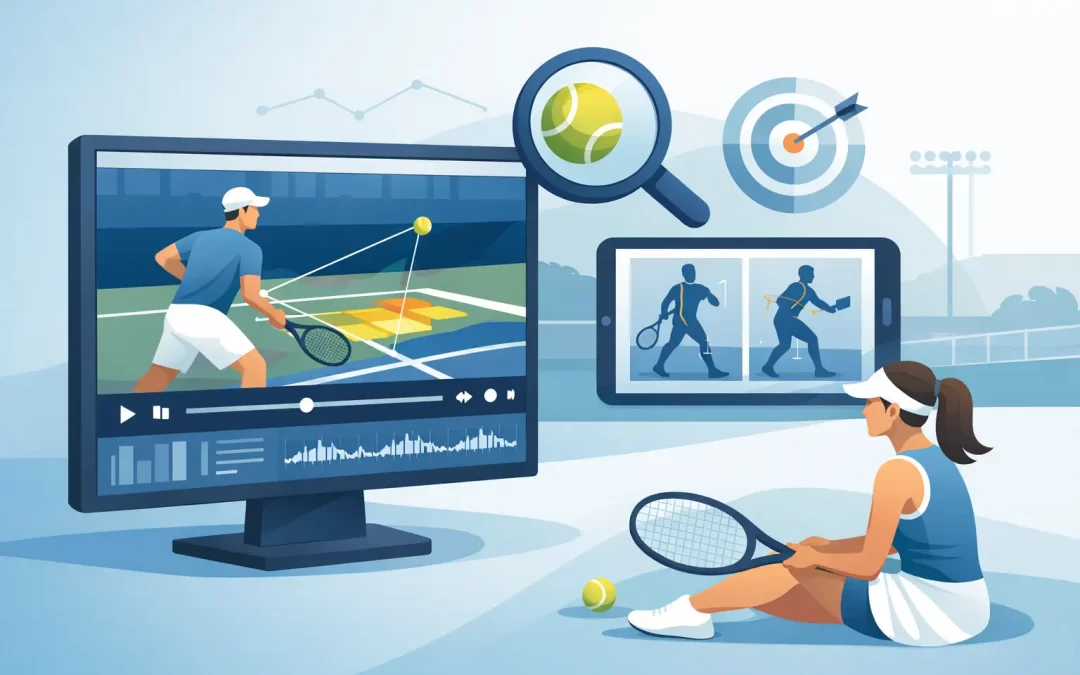
Most players watch their own tennis video once, notice a few ugly misses, and move on. That does not create improvement. If you want to know how to analyze tennis video in a way that actually changes performance, you need a clear system. The goal is not to collect clips. The goal is to identify patterns, connect them to match results, and turn them into specific training priorities.
That matters because video can either sharpen your development or distract you. If you try to fix everything at once, you usually create more confusion. Strong analysis is disciplined. It separates what looks bad from what actually costs you points.
What good tennis video analysis should tell you
A useful video review should answer four questions. First, what is happening technically? Second, what is happening with movement and positioning? Third, what decisions are you making under pressure? Fourth, what patterns keep repeating?
Most players stop at technique. They look at the serve, the forehand, or the backhand and assume the problem starts there. Sometimes it does. But just as often, the stroke breaks down because the feet were late, the recovery was poor, or the player chose the wrong shot for the situation.
That is why serious analysis has to move beyond form alone. A forehand error on video might be a footwork issue. A weak backhand might come from poor court position. A missed return might be less about mechanics and more about reading the server too late.
How to analyze tennis video without getting overwhelmed
Start with one match or one focused practice session. Do not review five different sessions at once. You need clean information, not more footage than you can use.
Watch the video through once without pausing. This first pass is for feel. You are looking for the bigger picture. Did you control rallies or react to them? Did your level drop in pressure moments? Did your movement hold up over time? Resist the urge to diagnose every point.
On the second watch, narrow your focus. Pick one category at a time: serve, return, baseline patterns, transition game, movement, or point construction. This keeps your review objective. When players try to study everything on every point, they usually miss the trend.
On the third watch, write down specific patterns. Not opinions. Not emotional reactions. Patterns. For example: second serve lands short under pressure, backhand contact is late on higher balls, recovery after wide forehand is too slow, or returns are directed back to the server too often.
That is where progress begins. Improvement comes from repeated evidence, not isolated mistakes.
Start with the camera angle and context
If the video quality is poor, your analysis will be limited. The best angle for most tennis review is from behind the baseline, centered as much as possible. That gives you the clearest look at court position, shot direction, recovery, and point patterns. Side angles can help with stroke shape, especially on serve, but they are weaker for reading the full point.
Context matters too. Practice footage and match footage serve different purposes. Practice video is better for studying technical habits in a controlled setting. Match video is better for seeing what holds up when the score matters. If a player looks clean in drills but breaks down in competition, that is valuable information. It tells you the issue may be tied to pressure, decision-making, or preparation rather than pure mechanics.
What to look for in stroke analysis
When players ask how to analyze tennis video, they usually mean stroke analysis first. That is fine, as long as you stay organized.
Look at contact point, balance, spacing, and recovery before you obsess over cosmetic details. A forehand with a slightly unusual backswing can still be effective. A forehand with poor spacing and off-balance contact usually will not be.
On the serve, pay attention to rhythm, balance through the motion, toss consistency, and whether the player can repeat the same action under pressure. Do not just judge serve speed. A fast serve that disappears on big points is not a dependable weapon.
On groundstrokes, study whether the player creates enough space, meets the ball in front, and recovers with purpose after contact. One common mistake in self-analysis is focusing only on the swing while ignoring what happened two steps earlier. In many cases, the feet explain the stroke.
Movement and positioning often tell the real story
This is where many matches are won and lost. A player can have solid strokes and still underperform because movement habits put them in bad positions all day.
Watch how quickly the player reacts after the opponent makes contact. Watch the first step. Watch the recovery after wide balls. Watch whether the player gives up court position too easily or fails to move forward on short balls.
There is also a difference between effort and efficiency. Some players look active on video, but they are doing extra work because their anticipation and positioning are poor. Others seem calmer because they read the game early and move with better purpose. Video helps you see that difference clearly.
If you are analyzing a junior player, this section is especially important. Young players often chase stroke changes when the bigger gains are in split step timing, spacing, and recovery discipline.
Use video to study decision-making
A technically clean player can still lose because of bad choices. That is why learning how to analyze tennis video should include tactical review.
Ask simple, performance-based questions. What shot was chosen and why? Was the player building points with intention or hitting without a plan? Did they recognize short balls? Did they defend smart or force low-percentage attacks? Did they play the score, or ignore it?
This is where patterns become powerful. If a player misses crosscourt backhands occasionally, that may not mean much. If the player repeatedly changes direction too early from a neutral ball and gives away errors, that is a tactical issue. If a player keeps returning serve to the opponent’s strength side, that is not a stroke problem. That is a competitive intelligence problem.
Strong players do not just hit better shots. They make better decisions more often.
How to turn video analysis into a training plan
This is the step that separates serious development from passive observation. Once you identify your patterns, rank them. What is costing the most points right now? What can realistically improve in the next training block? What needs technical work, and what needs tactical or mental work?
Usually, you want one primary focus and one secondary focus. That is enough. For example, a player might choose first-serve reliability as the primary priority and backhand recovery footwork as the secondary one. Another player might focus on return position and building higher-margin rally patterns.
Keep the plan measurable. Instead of saying, improve backhand, define the target. Examples include making contact farther in front, recovering inside the singles sideline after crosscourt exchange, or reducing second-serve double faults in pressure games.
This is also where coach feedback matters. Self-review is useful, but players often misread cause and effect. A disciplined coach can help separate the issue you notice from the issue that actually needs correction. That is one reason structured video review is such a strong tool in serious player development programs.
Common mistakes when analyzing your own video
The first mistake is judging yourself too emotionally. Players often label a match terrible when the video shows a more specific issue, like poor return depth or weak decision-making on short balls. Emotion blurs detail.
The second mistake is trying to rebuild technique from one clip. One freeze-frame can be misleading. You need repeated footage, multiple points, and enough context to understand the pattern.
The third mistake is focusing on style over function. Not every effective player looks textbook. What matters is whether the movement, contact, and decisions produce reliable results under pressure.
The fourth mistake is reviewing video without any follow-up. Analysis without action is just replay.
A simple process for every review
If you want a repeatable method for how to analyze tennis video, keep it simple. Watch once for the overall match story. Watch again for one category at a time. Write down recurring patterns. Choose one or two priorities. Build your next training block around those priorities.
That process works for competitive juniors, serious adult players, and parents trying to better understand what their child actually needs. It also keeps improvement grounded in evidence instead of guesswork.
At Point of Mind Coaching, this is the difference between random feedback and structured development. Video should not leave you with more noise. It should give you a clearer path.
The best review sessions are not the ones where you notice the most mistakes. They are the ones where you finally understand which changes will move your game forward fastest.