
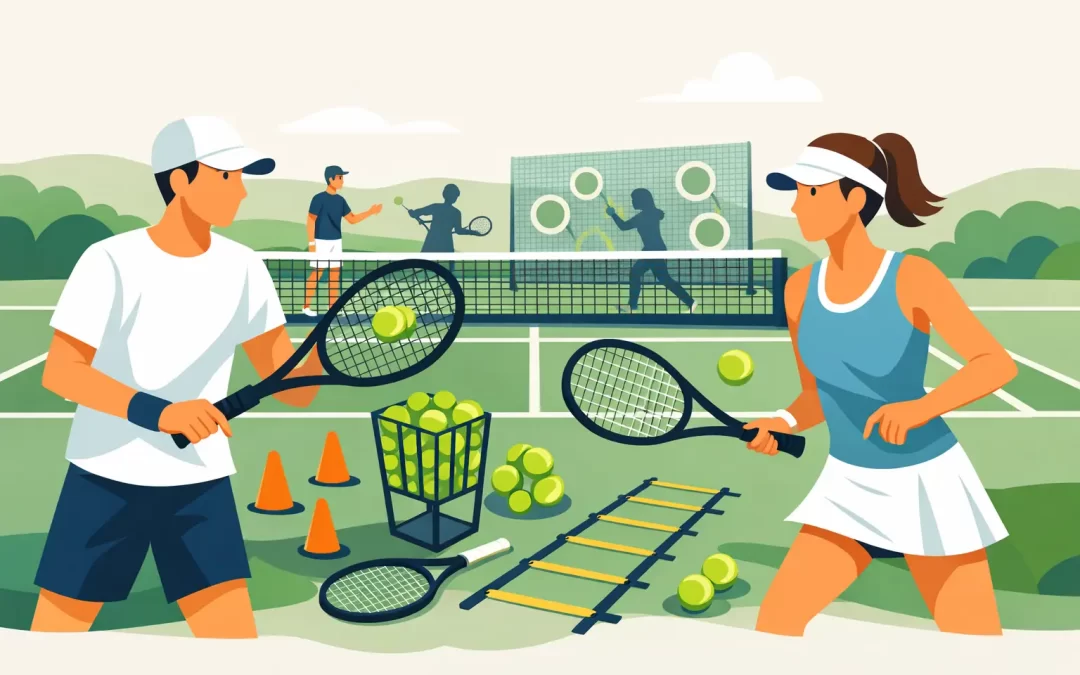
Most beginners do not struggle because they lack effort. They struggle because they repeat the wrong things, too fast, with no structure. The best tennis drills for beginners are the ones that build clean fundamentals, improve movement, and create repeatable habits under control. If your practice feels random, your progress will feel random too.
A good beginner drill should do three things. It should simplify the skill, give you enough repetition to learn it, and help you measure whether you are improving. That matters for junior players, adults starting later, and parents trying to make sure training time is actually productive.
What makes the best tennis drills for beginners work
Beginners often think they need more advanced instruction when what they really need is better organization. A drill only works if it matches the player’s current level. If the ball is moving too fast, the target is too small, or the player is trying to fix five things at once, the drill stops teaching and starts exposing weaknesses without solving them.
The best beginner drills focus on contact, balance, spacing, and recovery. They also build confidence. Early confidence is not about praise alone. It comes from seeing the ball go where you intended, feeling your feet get you into position, and learning that you can repeat a skill on purpose.
That is why structured training beats casual rallying for most new players. Rallying has value, but beginners usually need a clearer progression before they can benefit from open play consistently.
1. Self-drop forehand drill
This is one of the simplest and most effective starting points in tennis. The player drops the ball in front of the body, lets it bounce once, and hits a controlled forehand toward a target area. No feeding partner is required, and the slower pace gives the player time to organize the swing.
The goal is not power. The goal is clean contact and balance through the finish. A beginner should focus on setting the feet, making contact out in front, and finishing under control. If the player is off balance after the swing, the pace is too fast or the setup is rushed.
A smart way to progress this drill is to aim for five to ten balls in a row into the same half of the court. That creates accountability. If every shot goes somewhere different, the player is swinging without enough control.
2. Mini tennis for touch and timing
Mini tennis is one of the best tennis drills for beginners because it teaches control before full-court hitting. Players stand inside the service boxes and rally softly, using compact swings and trying to keep the ball low and manageable.
This drill reveals a lot. If the player cannot control the ball at short distance, moving back to the baseline usually makes things worse. Mini tennis teaches timing, feel, and the ability to adjust the racket face without overhitting.
It also helps players learn the difference between swinging hard and striking the ball well. That distinction matters early. Many beginners chase pace before they have control, and that habit slows development.
3. Crosscourt rally drill with targets
Once a player can make reasonable contact, crosscourt rallying becomes a strong next step. Crosscourt gives the player more court space, a safer net clearance, and a more realistic pattern than just hitting straight ahead.
Set up a simple target zone with cones or visual markers and have the player rally only crosscourt on the forehand side or backhand side. The target does not need to be small. In fact, for a true beginner, bigger targets are better because they reinforce shape and direction without demanding precision too early.
This drill starts teaching one of the most important competitive ideas in tennis – margin. New players improve faster when they learn to use space intelligently instead of trying low-percentage shots.
4. Split-step and recovery drill
A lot of beginners think tennis is mainly about strokes. It is not. Tennis is also about getting to the ball on time and recovering after each shot. Without that, even decent technique falls apart.
In this drill, the coach or partner feeds side to side while the player starts at the center mark, performs a split step, moves to the ball, hits under control, and recovers back toward the middle. The emphasis is on movement discipline, not speed for the sake of speed.
Beginners should learn that recovery is part of the shot, not what happens after the shot. That mindset creates better habits early and prevents players from watching their own ball instead of preparing for the next one.
5. Toss-catch volley drill
Volleys can feel rushed for beginners because the contact happens so quickly. Before using the racket, it helps to build hand-eye coordination and positioning with a toss-catch progression. A partner tosses balls to the player at the net, and the player catches them out in front with the hands and body under control.
Then the player repeats the same movement with the racket, using a short blocking motion rather than a swing. This teaches the correct contact point and reinforces the idea that volleys are built on positioning and racket stability.
The trade-off here is that this drill can feel too basic to some players. That is exactly why it works. The beginner who respects simple drills usually develops faster than the player who rushes into advanced feeding patterns without control.
6. Serve progression from service line to baseline
The serve is often the most intimidating shot for beginners because it is fully self-initiated. There is no incoming ball to react to, which means every technical weakness gets exposed.
A better approach is to build the serve in stages. Start at the service line and practice a smooth throwing motion with a relaxed arm and simple target. Then move gradually farther back as consistency improves. This helps the player learn rhythm, contact height, and directional control before worrying about full power.
Too many beginners start at the baseline, miss repeatedly, and develop tension. That tension becomes a habit. A staged progression builds confidence while keeping technique cleaner.
7. Two-bounce decision drill
This drill is excellent for beginners who panic under movement or make rushed decisions. The coach feeds a ball and allows the player to track it mentally as if reading whether it could be played after one bounce or if more time is needed to organize. In some cases, the player lets the ball bounce twice during learning phases to improve spacing and calm the footwork pattern before striking the next feed.
The purpose is not to play legal points with two bounces. The purpose is to train awareness, spacing, and composure. Beginners often fail because they rush into bad contact points. Giving them a controlled way to slow the sequence can improve judgment much faster.
This is a good example of why coaching should be level-specific. A drill that looks unconventional can still be highly effective if it teaches the right underlying skill.
8. Cooperative rally count drill
One of the fastest ways to build confidence is to make consistency visible. In this drill, two players work together to achieve a rally goal, such as six, eight, or ten shots in a row. The objective is cooperation, not winning the exchange.
This changes the mindset immediately. Instead of trying to hit a better shot than the other player, the beginner starts thinking about shape, height, and control. Those are the habits that lead to longer rallies and better match performance later.
As players improve, you can add restrictions, such as forehands only, crosscourt only, or one player changing direction after the fifth ball. That creates a natural pathway from basic control into tactical development.
How to use beginner tennis drills the right way
Good drills do not guarantee good results if the practice itself is disorganized. A beginner should not rotate through ten drills in one session just to stay busy. That usually creates shallow repetition and poor retention.
A better session might include one ball control drill, one movement drill, and one rally drill, with clear goals for each. For example, you might track how many balanced forehands land in the target, how quickly the player recovers after each feed, and how many cooperative balls the pair can sustain. That gives practice a measurable standard.
Feedback matters just as much as repetition. If a player keeps missing, the answer is not always more reps. Sometimes it means the drill needs to be simplified, the feed needs to be adjusted, or the technical focus needs to narrow to one correction.
For serious beginners, especially those who want to improve faster, structure between lessons is often the missing piece. That is where a coaching system with progression, video feedback, and accountability can make a major difference. It turns practice from activity into development.
The real goal of beginner drills
Beginner drills are not just about learning how to hit a forehand or serve a ball into the box. They are about building habits that hold up later under pressure. Clean setup, balanced movement, smart targets, and controlled repetition form the base of every stronger player.
If you are new to tennis, keep the standard simple but serious. Train with purpose. Choose drills that match your level. Repeat them enough to own the skill, not just try it once. That is how confidence becomes competence, and how competence starts to show up when the score matters.