
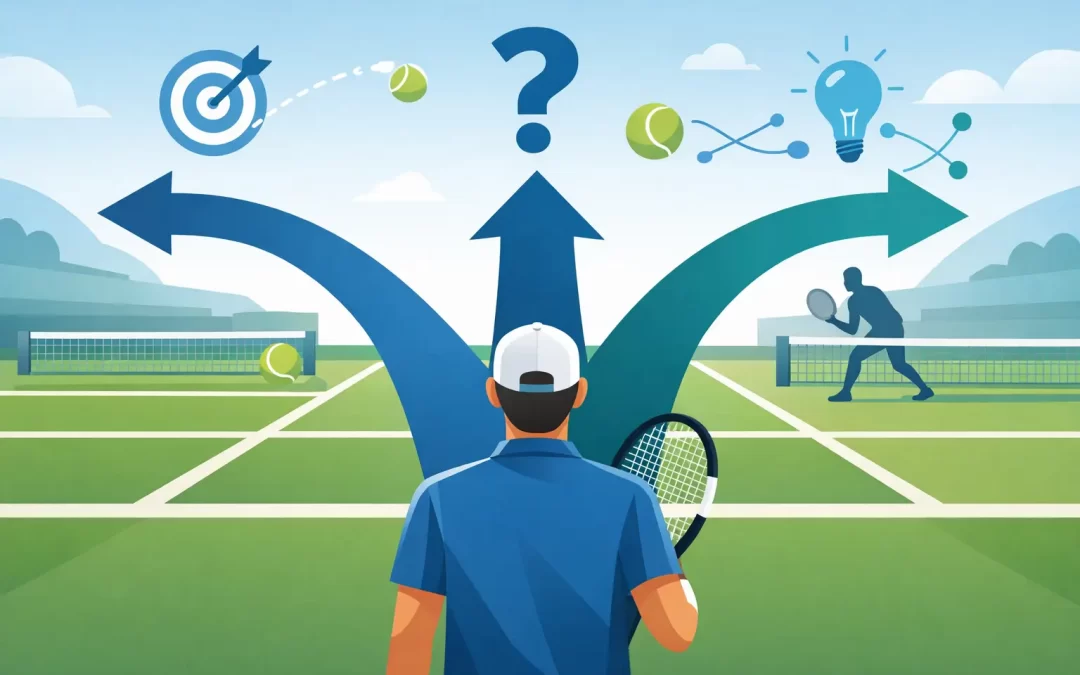
The point is over in three shots, and afterward the mistake feels obvious. You chose the down-the-line forehand from a neutral ball, missed by a foot, and handed away momentum. Most match losses are not caused by one bad stroke. They come from a string of poor choices. If you want to know how to improve tennis decision making, start by treating it as a trainable skill, not a personality trait.
Good decision-making in tennis is not about playing safe all the time. It is about choosing the right shot for the ball you received, your court position, your opponent’s position, and the score. Players who improve fastest learn to connect technique, movement, and tactics into one process. That is where smarter tennis starts.
Why tennis decision-making breaks down
Most players do not make bad decisions because they lack effort. They make bad decisions because they are overloaded. The ball comes in fast, footwork is late, balance is compromised, and the brain rushes to solve the problem. Under pressure, players often default to habit instead of judgment.
That is why decision-making cannot be separated from movement and preparation. If you arrive late, your options shrink. If your contact point is poor, the aggressive shot you imagined is no longer the correct one. Many players think they need better tactics when they actually need better spacing and earlier recognition.
There is also an emotional side. Score pressure changes shot selection. A player who rallies patiently at 15-15 may force low-percentage offense at 30-40. If your decisions swing with your emotions, your level becomes unpredictable.
How to improve tennis decision making in real matches
The fastest way to improve is to simplify what you look for. Strong competitors do not process everything. They filter. Before contact, they identify three things: the quality of the incoming ball, their court position, and the opponent’s recovery position.
If the incoming ball is deep and heavy, your decision should usually be neutral or defensive. That might mean a higher crosscourt ball with margin, a deeper middle ball, or a reset slice if you are stretched. If the ball is short and you are balanced inside the court, now offense becomes available. If your opponent is out of position, you can choose a pattern that exposes space instead of hitting hard just because the ball looks attackable.
The key is that the decision matches the situation. A neutral ball does not deserve a hero shot. A short sitter should not be treated like a rally ball. Better players separate defense, neutral, and offense quickly, and their shot choices reflect that.
Build decisions around patterns, not impulses
One reason players make poor choices is that they improvise too much. Match play feels chaotic when you do not have clear patterns. The answer is not more random creativity. The answer is organized intent.
A pattern gives your decision-making structure. For example, if you are pulled wide in a rally, your default may be high crosscourt to recover. If you get a mid-court forehand, your pattern may be heavy crosscourt first, then attack the open court on the next ball. On return games, your pattern might be deep through the middle against a big server to reduce angles and start neutral.
These are not rigid rules. Tennis always has exceptions. But patterns reduce mental clutter and improve decision speed. You are no longer asking, What should I do with every ball? You are asking, Does this ball fit one of my trained patterns?
Use score to guide risk
Smart players adjust risk based on the score without becoming passive. That is an important distinction. At 40-0, you may accept a little more aggression on a second-serve return. At 30-40, the better decision might be a high-margin rally ball that starts the point on your terms.
Many players do the opposite. They play loose when the score is irrelevant and reckless when the score matters. That pattern costs matches.
A practical standard is this: when pressure rises, increase margin before you increase pace. Aim bigger targets. Favor crosscourt over low-percentage line changes unless the ball clearly allows it. Make your opponent earn the point. Decision-making under pressure is less about courage and more about disciplined shot tolerance.
Train recognition, not just execution
If you only practice feeding drills with predictable balls, your decisions will lag behind your strokes. You may look sharp in practice and still choose poorly in matches because recognition was never trained.
To improve tennis decision making, practice drills need live variables. That means using scenarios where players must read depth, speed, and positioning before selecting a response. One ball should trigger a neutral rally shot. Another should trigger an approach. Another should force a reset.
Video review is especially useful here because it removes emotion from the point. You can pause before contact and ask a simple question: what were the realistic options, and which one had the best percentage? Players often discover that the issue was not execution alone. The shot choice was wrong before the swing started.
This is one reason structured coaching matters. Feedback closes the gap between what you felt during the point and what actually happened. Over time, that sharpens competitive intelligence.
Make better choices by improving court position
Decision-making improves when court position improves. This sounds basic, but it changes everything. A player hitting from two feet behind the baseline should not make the same choices as a player stepping inside the court. Yet many do.
When you are behind the baseline, the court is longer, angles are harder to create, and recovery takes more time. The percentage play is often to build the rally, use shape, and recover toward neutral. When you are inside the baseline with balance, you can take time away and direct the ball with more purpose.
This is why footwork training matters tactically, not just physically. Better spacing gives you better information and better options. If your base is unstable, your decisions will usually be rushed or overly ambitious.
Know when the middle is the best target
Competitive players sometimes resist the middle because it feels too conservative. In reality, middle targets win a lot of points when used with intent. A deep ball through the middle can jam an opponent, reduce their angles, and buy you time to recover. It is often the smartest choice when you are off balance, late, or facing an opponent who feeds off your directional changes.
The trade-off is obvious. If you hit too short through the middle, you give up control. So the goal is not passive middle balls. It is purposeful depth with margin.
Players who understand this stop forcing offense from bad positions. They use the middle as a stabilizer, then attack when the next ball earns it.
Create a between-point decision routine
Good decisions rarely come from emotional carryover. If the last point still owns your attention, the next point is already compromised. You need a simple reset process.
Between points, review only what matters. First, identify the previous point in one sentence. Too aggressive from neutral. Late on the backhand return. Good patience, wrong finishing ball. Then set one clear intention for the next point. Heavy crosscourt first ball. Early split step on return. Bigger target under pressure.
That routine keeps your thinking narrow and useful. It also builds accountability. Instead of hoping your decisions improve, you start coaching yourself in real time.
Practice constraints that sharpen decision-making
Decision-making gets stronger when practice includes consequences and boundaries. If every ball can be hit anywhere at any speed, players often rehearse chaos. Constraints create learning.
For example, a rally game where the first four balls must go crosscourt teaches patience and pattern discipline. A live point where the only attack ball is a short ball inside the service line teaches recognition. A serve-plus-one drill with one target on the first groundstroke teaches commitment after the serve instead of random hitting.
This kind of training is highly effective because it connects intention to execution. It also exposes habits. If you keep changing direction from poor positions, the drill makes that visible immediately.
At Point of Mind Coaching, this is a core part of development. Structure matters because players do not rise to the level of their best swings. They compete at the level of their trained decisions.
What better decisions actually look like
Better decision-making is not flashy. It looks like choosing height when you are stretched, using crosscourt patterns until the court opens, and accepting that some points need to be rebuilt instead of won instantly. It looks like understanding when to absorb, when to neutralize, and when to attack.
It also looks personal. A high-level junior with great speed can defend differently than an adult player with a strong first strike game. A lefty may see patterns that a righty does not. Decision-making should match your strengths, but it still has to respect percentage tennis.
That is the standard. Build a game style that fits you, then make choices that hold up under pressure.
The players who compete stronger are not always the ones with the prettiest strokes. They are the ones who see the court clearly, accept what the ball is giving them, and choose with discipline when the match gets tight.